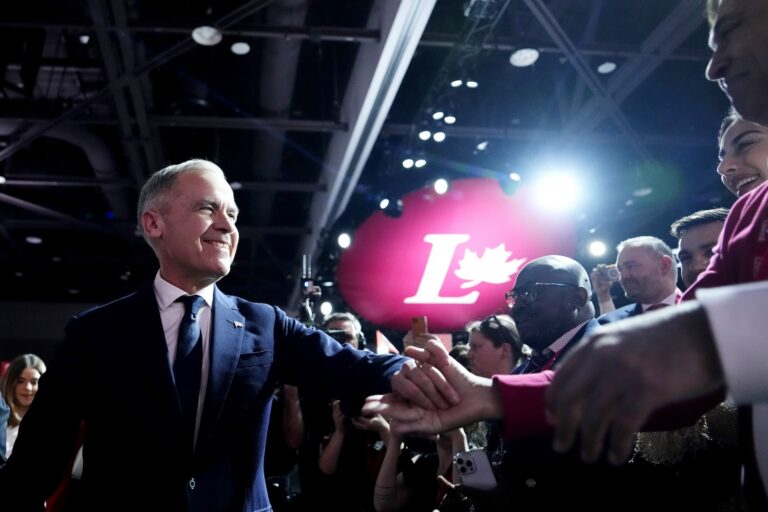
OTTAWA — Nine days after he went to Rideau Hall to be sworn in as prime minister, Liberal Leader Mark Carney went back to say he wants Canadians’ permission to keep the job.
The Governor General granted his request, and an election is set for April 28.
Here’s what you need to know as the campaign begins.
Opening lines
In a news conference outside the doors of Rideau Hall, Carney said he’s made numerous moves to buttress the Canadian economy against pressure from U.S. President Donald Trump in the little time he’s been in office.
“What’s important is that the government has a mandate from the Canadian people to finish the job,” Carney said—a mandate he defined as licence to build the domestic economy, make new deals with other countries and stand up to Trump.
Conservative Leader Pierre Poilievre’s campaign launch focused on the rising cost of living, which he blamed on the previous Liberal government and said was exacerbated by Trump’s threats. Canadians are worried about the costs of housing and food and the spread of crime, drugs and disorder, he said at a news conference in Gatineau, Que. “What I say to those people is that change is on the way.”
NDP Leader Jagmeet Singh used his campaign launch in Ottawa to cast himself as a champion of the little guy, focusing on social programs while charging both Carney and Poilievre with being on the side of billionaires over working Canadians.
The Trump effect
Talking Points
- Prime Minister Mark Carney asked the Governor General to dissolve Parliament and call an election just one week after being sworn in as prime minister
- The platforms of the Liberal and the Conservative parties are expected to focus heavily on the economic toll of the U.S. trade war with Canada
Before Justin Trudeau announced in January that he would quit, the Liberals were a zombie government, barely ahead of the New Democrats in polls before an election that NDP Leader Jagmeet Singh had said he’d force as soon as possible.
Since then, U.S. President Donald Trump’s attacks on the Canadian economy and new leadership in Carney have vaulted the Liberals back to narrow but consistent leads in public opinion surveys. The same polls suggest the NDP are looking at catastrophe, with serious risk of losing official party status in the House of Commons.
The Conservatives, meanwhile, appeared for years to be the government in waiting before Trump drastically shifted the political dynamic. At his campaign launch on Sunday, Poilievre acknowledged the fear and anger Trump’s tariffs have stirred in Canada, and said he shares those feelings. “I also draw great resolve in knowing that we can transform the anxiety and anger into action,” he said.
The party has made little attempt to change the key economic messages that propelled them to the top of the polls during Trudeau’s tenure, but instead have wrapped those policies—including axing the carbon tax—in more patriotic rhetoric to capture the nationalistic mood of the country.
Carney said he’s seeking a “strong positive mandate” to meet Trump’s threats, which he called the greatest Canada has faced in a lifetime.
“He wants to break us so America can own us,” said Carney.
Singh argued Canadians don’t have to look to Carney or Poilievre to protect them from Trump’s threat. “This is like being told you have to pick between a house with a leaky roof or a cracked foundation—one patched together with empty Conservative slogans, the other rotting from the inside after years of Liberals protecting the most wealthy,” he said.
The pre-campaign
The official election call is unlikely to change much for Poilievre, who has been making stump speeches and holding rallies for weeks to muster support. For the Tories, the campaign started in February when Poilievre laid out his campaign priorities at a rally in Ottawa. But he seemed to hit the trail in earnest as soon as Carney was elected Liberal leader. He mustered a massive crowd in London, Ont., to rival the Liberal leadership event, where he attempted to cast Carney as a Trudeau insider who prioritized his own profits while serving in the private sector.
Poilievre has already begun to roll out details of his long-awaited platform in campaign-style speeches in Ottawa, Iqaluit, London, Sudbury, Ont., and Jonquière, Que. He’s spent almost as much time at those podiums critiquing Carney’s first week in office.
Carney has spent the nine days between his Rideau Hall visits trying to look as prime ministerial as possible. He announced a stripped-down cabinet, took a whirlwind trip to see the leaders of France and the U.K. (and stopped in to see the King). On the way back, Carney alighted in Iqaluit to announce Canada would buy a new northern radar system from Australia.
Carney met with his council on Canada-U.S. relations, headed west to see Alberta Premier Danielle Smith, skated with the Edmonton Oilers and announced a $187-million federal contribution to rebuilding fire-ravaged Jasper. Then he held a meeting with provincial and territorial leaders and pulled together a joint statement on lowering internal trade barriers, hastening approvals for big projects and working on a “national trade corridor” for commodities.
In the background, Innovation Minister Anita Anand distributed hundreds of millions of Strategic Innovation Fund dollars, and Finance Minister François-Philippe Champagne convened provincial and territorial finance ministers in Montreal. Via Rail also signed a major contract for years of development work on its high-speed rail project in Ontario and Quebec.
Policy announcements
With Canada’s response to the United States’ heel-turn as the central election issue, all the major parties have been making early cases for why they’re best equipped to face the menace Trump poses to Canada’s trade, economic health and sovereignty.
All the major parties have been making cases for why they’re best equipped to face the menace Trump poses.
On the day he was sworn in, Carney cut the consumer carbon tax to zero. He’s definitively cancelled the capital-gains tax changes that business owners and associations hated.
As a leadership candidate, he laid out plans to promote internal trade and make major projects easier to complete, amid less specific pledges about strengthening the country—with a more efficient federal government, incentives for greener choices and more homebuilding.
In announcing the election call, Carney put forward his first promise of the campaign: a one-point cut to the federal income tax rate on the lowest bracket, which he said would be worth $825 to a family with two working parents.
Conservatives have started to give some details about plans they previously signalled in slogan form. Poilievre has promised to retaliate against Trump’s tariffs and use the revenue to fund government tax cuts. He said he would set a “small sum” for workers hit hardest by the impacts of the trade war.
The rest of his policies are aimed at making Canada’s economy more resilient and independent from U.S. influence, with plans to harmonize interprovincial trade and labour regulations, drastically cut taxes and speed up approvals for major Canadian energy and mining projects. He’s also announced plans to remove the industrial carbon tax, arguing greater Canadian energy production will ultimately drive down global emissions. He plans to pay for his policies by cutting back the public service and Canadian contributions to foreign aid.
Singh’s NDP has been quieter in the lead-up to the election call. An NDP government would cancel plans to buy a full fleet of F-35 fighter jets from the U.S., and build planes in Canada instead. The party’s announcement last week was also combined with a plan for developing and defending the Arctic.
With trade, security and diplomatic relations at the forefront, the Bloc Québécois’s separatist message has been drowned out. Its leader Yves-François Blanchet has argued that support for Quebec sovereignty will return fiercely—later. Muted though it might be, the Bloc remains a force in Quebec and its demands could matter in a possible minority Parliament. Among them: no trading away food supply management in a new deal with the U.S., and no new oil pipelines across Quebec.
Who’s minding the store
Though the prime minister and ministers keep their posts during an election campaign, long tradition holds that they must do nothing except what’s needed to keep the lights on and respond to emergencies. This time, things are happening in the world that won’t wait.
The Trump administration is set to apply major new tariffs on Canadian goods in early April. Yet-unspecified worldwide “reciprocal” tariffs to counter economic policies Trump considers unfriendly are due April 2, and exemptions to Canada-specific tariffs for goods covered by the United States-Mexico-Canada Agreement, and for autos, expire a few days later.
What counts as a legitimate response to an emergency is a grey area. Ontario Premier Doug Ford drew political criticism during his recent re-election campaign for a trip to Washington, D.C. to talk about tariffs, and an official scolding for using footage from the trip in a campaign video.
Asked at Carney’s leadership convention about maintaining stability while the government is in caretaker mode, François-Philippe Champagne, who has since been appointed finance minister, said, “we’ve done all of the work already.”
Meanwhile, an international meeting on supporting Ukraine is planned just this week. Canada could skip it (and others that might come) due to the election, but at the risk of being sidelined.
This story was updated to add quotes from party leaders.