Companies like Honda, Stellantis and General Motors that have delayed or cut production plans in Canada face a potential reckoning this week, as the federal government takes its first hard look at the numbers of its tariff relief program for automakers.
Skip to content


Special Report
Automakers face reckoning as Ottawa eyes new tariff quotas
Policy tying tariff relief to protection of Canadian automaking jobs kicks in this week
GM cut a shift at its assembly plant in Oshawa, Ont., where it makes Silverado pickup trucks. Photo: The Canadian Press/Chris Young
Companies like Honda, Stellantis and General Motors that have delayed or cut production plans in Canada face a potential reckoning this week, as the federal government takes its first hard look at the numbers of its tariff relief program for automakers.
The process will test how Prime Minister Mark Carney and his government will respond to shift cuts and delayed product launches at Canadian auto factories announced this spring, after the Liberal government pledged to penalize carmakers that don’t maintain Canadian jobs.
How it works: Canada’s reciprocal tariff-relief program on motor vehicles, announced in April, applies to automakers that make vehicles in both Canada and the United States. Under it, Ottawa remits some of the tariffs paid on autos that those companies make in the U.S. but sell in Canada. The amount, though, will depend on how well those companies protect jobs in their Canadian operations.
The government assigned each of the five automakers who qualify—Ford, General Motors, Honda, Stellantis and Toyota—a quota of vehicles they can import duty-free from the U.S. for one year, ending April 8, 2026. If an automaker goes above the specified import levels, those vehicles will be tariffed, Finance Department spokesperson Audrey Milette said in a statement to The Logic.
Meanwhile, the quotas are contingent on automakers upholding their production plans. The government says it will reassess each automaker’s allotment every three months, with the first such examination due to take place this week.
Talking Points
- The Canadian government has assigned Ford, General Motors, Honda, Stellantis and Toyota a specified quantity of vehicles eligible for duty-free import from the U.S.
- Ottawa said it will reassess each automaker’s allotment every three months, starting this month, which could be pivotal for companies that have paused production plans.
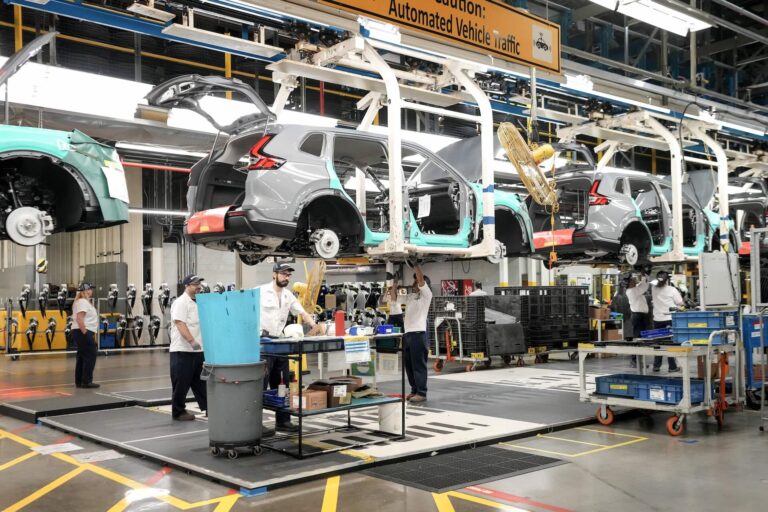
Why would the allotments change? Honda has postponed its $15 billion expansion in Canada, GM has paused production at its Ingersoll, Ont., plant and cut a shift at its Oshawa, Ont., plant, while Stellantis has delayed plans to make the Dodge Charger EV model in Windsor, Ont. Ford’s Oakville, Ont., complex has been under renovation, with new trucks not expected to roll off production lines until late 2026.
What’s not yet clear is which changes to automakers’ production schedules will count against them in the eyes of the government.
Unifor, the union representing Canadian autoworkers, would like to see Ottawa respond to broken promises. In a media briefing in June, union officials suggested the government deny all tariff relief to companies that make permanent cuts to their Canadian operations.
As written, the tariff relief program is notably labour-friendly, said Andreas Schotter, a professor at the Ivey Business School at Western University, who studies trade policy and who previously worked at Volkswagen. By attaching a duty cost to each layoff, he said, the policy encourages automakers to invest in “retraining, shorter furloughs, even co-investing in automation that augments rather than replaces workers.”
Related Articles
How much will the government cut automakers’ current quota? Government officials and the automakers alike refused to reveal the current or future allotments to The Logic, citing competitive issues.
Toyota Canada spokesperson Michael Bouliane said the program is a “missed opportunity to support Canadian manufacturing.”
“While we appreciate that our government is fighting hard to protect the Canadian automotive industry, the current federal policy related to duty remission on automobile imports actually benefits net importers of vehicles into Canada more than it benefits our largest producers and exporters,” Bouliane wrote, applying the emphasis himself.
About half of the 1.7 million new vehicles Canadians bought in 2023 were imported from the U.S. Last year, the value of U.S. vehicle imports to Canada totalled about $35.6 billion.
Schotter shares a similar concern. By letting in a slew of tariff-free vehicles before hitting the quotas, the policy buys automakers time without compromising Canada’s leverage in its negotiations with the U.S., he said. But the program offers little to companies like Volkswagen, which invested in Canada with hopes to export electric-vehicle batteries to the U.S. The company’s $7 billion gigafactory investment in Canada doesn’t appear to qualify it for tariff relief, which applies only to companies that make fully assembled vehicles domestically.
What’s next: The government must decide whether it will penalize automakers in the name of protecting Canadian manufacturing jobs, or ease up on the industry as the trade war escalates.
While the tariff refunds give automakers breathing room to complete major projects, Schotter said, they don’t stop companies in the long term from cutting things like overtime for workers.
“The moment a Canadian production line underperforms, Detroit headquarters starts asking whether the next tranche of EV investment shouldn’t migrate to Tennessee instead,” he said. While the tariff relief system is “fast and accountable,” he added, “it risks turning a temporary customs tool into a long-term location gamble.”
David Adams, who leads the Global Automakers of Canada, which represents Toyota and Honda, said neither company has cut jobs in the country as a result of tariffs. Canadian Vehicle Manufacturers’ Association CEO Brian Kingston, whose group represents Ford, Stellantis and GM, said that the tariff-remission program should be temporary until a deal is reached with the U.S., which Carney hopes will happen by July 21.
“Everyone is working ahead on the assumption that we will get to some sort of agreement,” Kingston said. “The longer that these tariffs are in place, the more significant the impacts will be.”



Loading...
Thanks for sharing!
You have shared 5 articles this month and reached the maximum amount of shares available.
CloseThis account has reached its share limit.
If you would like to purchase a sharing license please contact The Logic support at [email protected].
CloseGift the full article!
You have gifted 0 article(s) this month and have 5 remaining.
Recipients will be able to read the full text of the article after submitting their email address. They will not have access to other articles or subscriber benefits.
Photo: The Canadian Press/Chris Young
Most Popular This Week




In-depth, agenda-setting reporting
Great journalism delivered straight to your inbox.
News
Panel decries Canada’s chaotic way of funding world-class science
Briefing
Feds pledge $15M for U.S. satellite navigation company Xona to expand in Montreal
Inovia raises US$200M for new VC fund as it eyes AI’s impact
43% of eligible Albertans voted ahead of Monday’s referendum
Best business newsletter in Canada
Get up to speed in minutes with insights and analysis on the most important stories of the day, every weekday.
Exclusive events
See the bigger picture with reporters and industry experts in subscriber-exclusive events.
Membership in The Logic Council
Membership provides access to our popular Slack channel, participation in subscriber surveys and invitations to exclusive events with our journalists and special guests.





