Skip to content

 Toronto-based Li-Cycle filed for bankruptcy protection in Canada in May after failing to raise financing needed to rescue its global battery-recycling business. Photo: Christopher Katsarov Luna for The Logic
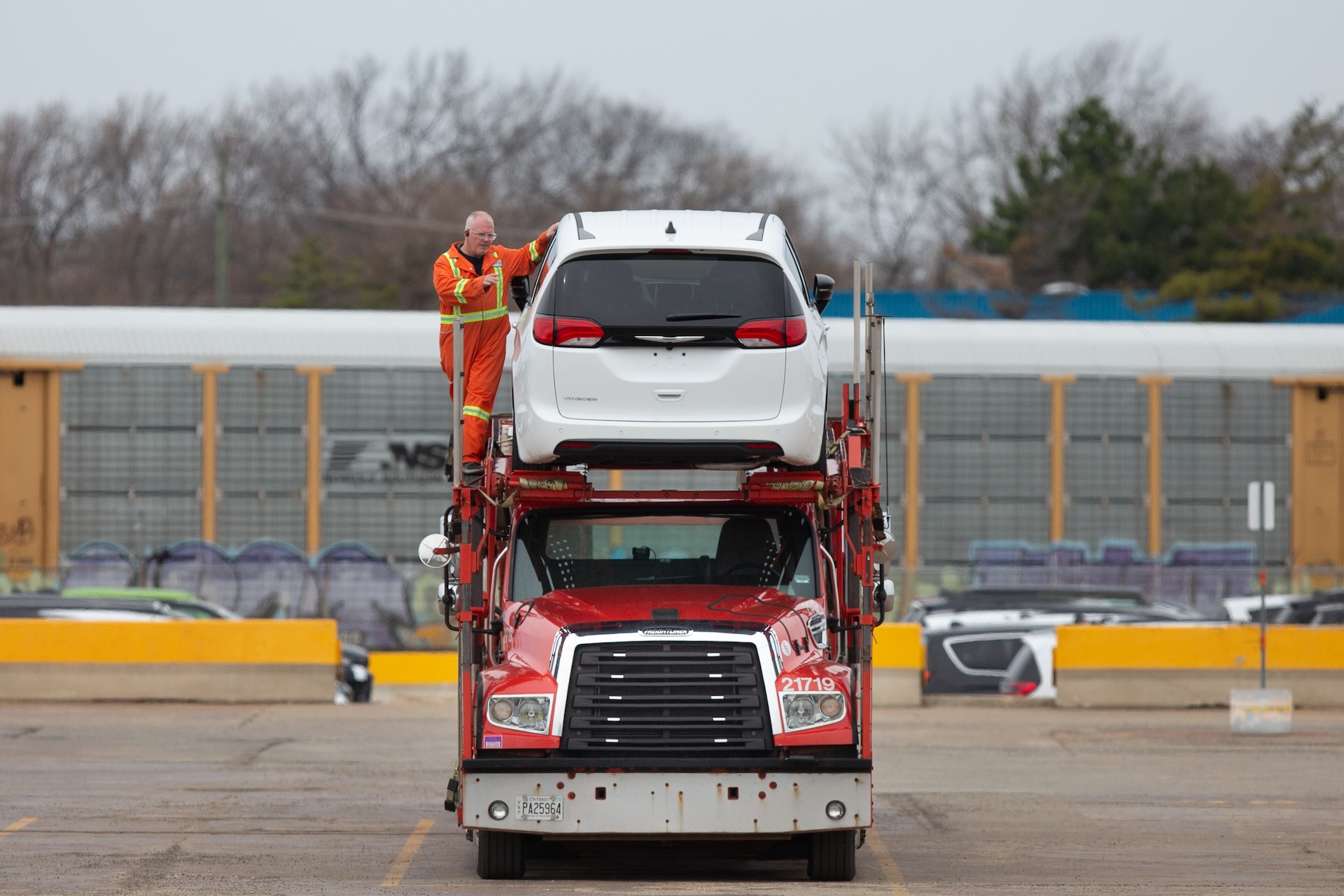 A transport truck at Stellantis in Windsor, Ont., in April. The company has pushed back production plans at both of its big Canadian assembly plants in the past four months. Photo: The Canadian Press/Dax Melmer

The Big Read
Canada’s EV dream has become a nightmare
Major projects worth tens of billions of dollars are delayed or in trouble. What Canada does next could make or break its place in the EV world order.
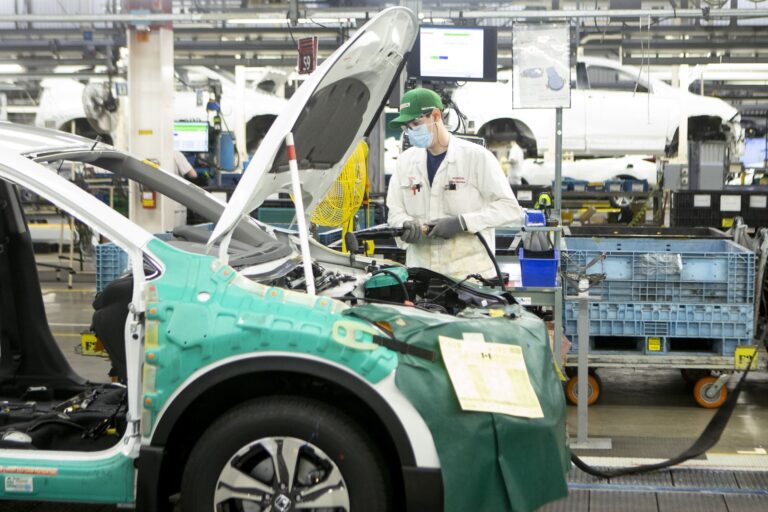
Honda employees on the vehicle assembly line at a factory in Alliston, Ont., in April 2024. About $31.4 billion in investments in Canada’s EV sector have been delayed by Northvolt, Honda, Umicore, Stellantis and Ford. Photo: The Canadian Press/Nathan Denette
OSHAWA, ONT. — It felt like the ground could move beneath Mélanie Joly’s feet at any moment. It was late May, and Joly, new to her role as Canada’s industry minister, was standing in a hemi-anechoic chamber at Ontario Tech University in Oshawa. The lab is used by major automakers to test how well their cars stand up to the elements. An unassuming steel disc on the ground can simulate the force of a violent earthquake.
Joly had no need for simulations. As of that morning, over $32 billion of Canada’s $46 billion in major electric-vehicle projects were either delayed or in major trouble. That same day, she would be in talks with Stellantis and General Motors, both of which had cut or delayed electric-vehicle production in Canada. The country’s 128,000 autoworkers feared the worst.
EVs were supposed to be Canada’s grand industrial policy experiment. For a while, some said it was the best plan in the world. Then things went wrong.
Talking Points
- Of the country’s $46 billion in EV-sector investments, over $32 billion are delayed or in trouble.
- Policy experts claim to have solutions: More support for Canadian firms, more accountability on investments, more focus on the environment, better data and business acumen for public servants and more targeted trade policy.
In the space of mere months, tariffs imposed by U.S. President Donald Trump raised car prices and shut down factories, consumer incentives programs ran out of money, and car companies realized it was impossible to undercut China’s burgeoning EV sector. Carmakers across the world hit the brakes.
Such major, rapid changes have put every part of Canada’s EV strategy up for debate. From free trade with China and the U.S. to corporate and consumer subsidies to EV sales mandates, at the centre of the crisis is a $32-billion question: is Canada’s EV dream dead?
“When you make a huge bet, you better not miss,” said Benjamin Bergen, president of the Council of Canadian Innovators. “The government’s got to make a decision here. Do you fight an impossible battle, a battle that’s going to be really hard, or do you pivot and begin to focus on areas where you can actually create wealth and prosperity?”
Related Articles


Better focus might be necessary. About $31.4 billion of investments in Canada’s EV sector have been delayed by Northvolt, Honda, Umicore, Stellantis, Ford and its former supplier, EcoPro. Ford has since committed to a non-EV project instead. Companies like Lion Electric and General Motors’ BrightDrop have preserved their long-term commitments to Canada, but face major challenges, putting nearly $1.2 billion in additional investments at risk.
If Canada were to abandon EV manufacturing, as some suggest it should, it would imperil another $13.5 billion in investments that are currently moving forward. That includes $7 billion from Volkswagen and $5 billion from Stellantis and LG to build gigafactories—the type of manufacturing that creates the most jobs in the battery supply chain. Volkswagen’s PowerCo said it is actively hiring in St. Thomas, Ont., while NextStar told The Logic that recent changes in Stellantis’s EV production plans won’t change the timelines at its joint venture with LG.
In mid-May, South Korean battery materials company POSCO announced it would increase its investments in its Canadian plant in Bécancour, Que., while Volta Energy Solutions is about to finish the exterior of its main building in Granby, Que. Two hours west in Saint-Eustache, Volvo-owned Nova Bus is also churning out electric buses.
Scores of other companies rely on these megaprojects. Smaller projects, such as those led by Montreal-based Taiga Motors, Toronto-based Li-Cycle (a client of General Motors and LG) and German battery materials firm BASF, are also struggling, although they have all received less government support than the megaprojects. Industry group Accelerate estimated there are 167 companies in Canada’s EV supply chain. These firms may also find their projects, collectively worth another $6.5 billion, at risk if deep-pocketed multinationals no longer want to buy EV parts and critical minerals in Canada.
Ontario economic minister Vic Fedeli likened the idea of Canada abandoning EV manufacturing to “driving off a cliff.” He said the province would “double down” to protect autoworkers and bring in “whatever it takes” to continue growing the industry in the province.
Some fear the government may be throwing good money after bad. Federal and provincial governments have already earmarked $52.5 billion in support for the country’s EV industry, most of which is destined for foreign multinationals. And even that might not be enough to cope with Trump’s trade war. While most of it won’t be paid out unless companies mass-produce their products on Canadian soil, some experts wonder what other high-growth industries and homegrown companies Canada could have supported if it used that money differently. “Regardless of whether Trump was there or not, this was a bad deal for Canadians,” Bergen said of the huge government support available to multinationals in Canada.
This isn’t just a Canadian problem. Advanced economies’ use of industrial policy interventions, where governments target and underwrite domestic investments to spur growth, soard in popularity in 2023 after years of being out of favour. In Canada, the EV sector has received support across the political spectrum.
That trend, supercharged by the U.S. Inflation Reduction Act, was never without its critics. In April 2024, the International Monetary Fund warned that sloppy industrial policy could spark retaliatory trade policies, while a September 2024 report from the Fraser Institute argued that countries dabbling in industrial policy faced concerns about “crony capitalism” and the lack of business acumen among bureaucrats.
Bentley Allan, a principal at the Transition Accelerator, a Calgary think tank, believes the government is right to intervene in industrial policy, but that Canada’s spending should be more targeted on parts of the EV industry where it can win. Such a move would follow similar investments in Europe, where countries are making better progress on climate goals, and China, which has a fast-growing economy.
Prime Minister Mark Carney’s government needs to make changes to the approach used by the Trudeau government, Allan argues. The previous administration’s projects lacked concrete details, such as dates to hit certain levels of hydrogen output or links between investments and key goals, like reducing greenhouse gas emissions, Allan said. Meanwhile, he said, the federal civil service wasn’t given the necessary resources to keep pace with rapid technological developments.
Allan would like to see public money divided more evenly between critical minerals and auto investments, though Canada should honour investments already underway, he argued. And while companies like Northvolt managed their money poorly, he hopes that Carney will improve the country’s policy approach. “We’re going to need our own industrial strategy to compete,” he said. “The government just doesn’t have the analytical capacity or the strategic vision to do this successfully. We don’t even have good data on the mineral supply chain.”
With so much hanging in the balance, Ottawa is caught between critics who see it falling behind in the EV transition and those who view the Trudeau government’s policies as too aggressive.
To see where Canada is falling behind, you only need to look at the headline figures. Canada made just 25,000 EVs last year, compared with Mexico’s 220,000, according to the International Energy Agency. China made 12.4 million. Despite big promises, subsidies for the EV industry has fallen to less than seven per cent of total spending on electric cars, down from about 20 per cent in 2017.
Those who argue that Canada is being too ambitious point to automakers who are pushing back their EV transitions. Groups representing automakers and dealers say that Ottawa should rethink its mandate requiring automakers to sell only EVs at new car dealerships by 2035, given all the challenges facing the industry.
Stephen Beatty, a former executive at Toyota Canada, doesn’t agree that Canada should give up on its 2035 EV transition goals—though he does see room to make major changes to the country’s EV strategy.
Canada’s 100 per cent tariff on made-in-China EVs limits the ability to take advantage of advanced technologies developed by companies like BYD, Beatty said. He argued that Canada should instead focus on making that technology meet strict cybersecurity regulations so it can benefit the Canadian EV market. “If you build those bumpers correctly, there’s room to partner with Chinese companies in a way that allows this to be safe,” he said, while keeping Canadian-made EVs affordable and technologically advanced.
Tariff relief programs could incentivize U.S. automakers to produce cars and battery materials domestically in equal proportion to their domestic sales, he said. These policy moves might be sharp departures from the status quo, but Beatty prefers them to the idea of a shrinking auto industry, which would, he argues, create a brain drain and diminish Canada’s influence over much-needed EV features, like cold-weather performance.
Others argue that a temporary dip in EV sales shouldn’t change Canada’s policy direction. Colleen Kaiser, program director for governance and innovation policy at the Smart Prosperity Institute, an Ottawa-based NGO, said that pitting climate policy against consumer demand during a cost-of-living crisis is a mistake, but added that the government should do more to explain its EV investments to taxpayers.
Rachel Samson, vice-president of research at the Institute for Research on Public Policy, a Montreal-based non-profit, agreed that the government should make its investment analysis public. It might motivate policymakers to focus on niches with strong business cases, like electric buses and heavy-duty trucks made by Canadian companies that can be supported with public procurement, she said. “The trajectory is clear: going to electric vehicles, that is the future. The challenge is the pace and scale of that transition,” said Samson.
“It certainly hasn’t been easy for the sector. If we pretend that the transition is easy and all positives, we’re doing a disservice to the people most affected.”
Joly says the government is listening. Last week, she told The Logic that the government still believes EVs are the future and that abandoning them to run back to gas vehicles will not save jobs in the auto sector.
To preserve the country’s EV sector, the government should work with experts beyond the civil service, said Kaiser. While a carbon tax fits naturally into the existing machinery of government, like the Canada Revenue Agency, managing a portfolio of struggling EV companies does not. And for that, the government needs new skills. Ultimately, Kaiser said, Canada may want to begin focusing less on the short-term aims of individual companies and more on protecting the environment.
“We’re not doing this because some new tech people want to make money on clean technology,” said Kaiser. “That may be the motivator in the interim, but if we don’t actually reduce emissions, there’s not going to be an economy by the end of the century. That’s the hard truth.”
With files from Laura Osman in Ottawa.



Loading...
Thanks for sharing!
You have shared 5 articles this month and reached the maximum amount of shares available.
CloseThis account has reached its share limit.
If you would like to purchase a sharing license please contact The Logic support at [email protected].
CloseGift the full article!
You have gifted 0 article(s) this month and have 5 remaining.
Recipients will be able to read the full text of the article after submitting their email address. They will not have access to other articles or subscriber benefits.
Photo: The Canadian Press/Nathan Denette
Toronto-based Li-Cycle filed for bankruptcy protection in Canada in May after failing to raise financing needed to rescue its global battery-recycling business.
A transport truck at Stellantis in Windsor, Ont., in April. The company has pushed back production plans at both of its big Canadian assembly plants in the past four months.
Most Popular This Week




In-depth, agenda-setting reporting
Great journalism delivered straight to your inbox.
Commentary
Carmichael: Being boxed in will help Canada focus on what matters
Briefing
Rio Tinto gets nearly $165M in additional federal funds for Quebec aluminum
U.S. to lift tariffs on some Canadian products crucial to Maine: Collins
Carney warns of tech dependence after Starlink disruptions in Ukraine
Best business newsletter in Canada
Get up to speed in minutes with insights and analysis on the most important stories of the day, every weekday.
Exclusive events
See the bigger picture with reporters and industry experts in subscriber-exclusive events.
Membership in The Logic Council
Membership provides access to our popular Slack channel, participation in subscriber surveys and invitations to exclusive events with our journalists and special guests.






