Where roads meet rail lines, cars aren’t supposed to meet trains.
I spent part of a hot afternoon this week by a ghost rail crossing in a field southwest of downtown, complete with gate arms, flashing lights and ringing bells. But the tracks stop just on either side of the road instead of running on through the grass and wildflowers.
It is probably the most scrutinized fake railway crossing in the country, said Divyanshu Kamboj, who has been studying it intensively for two years in a project backed by Transport Canada’s Rail Safety Improvement Program. Kamboj is director of strategic technology and testing at an autonomous vehicle skunkworks called Area X.O, part of the Invest Ottawa economic development agency.
Canada has about 23,000 level rail crossings; collisions at them account for a third of all railway fatalities. The sound of real train horns drifted across the field as Kamboj and I talked. A short way south of the mock crossing, six people died in 2013 when an Ottawa city bus crashed into a Via train.
“Each location will have its own unique quirk as to what is the safety challenge,” said Kamboj. This project has been trying to determine what combinations of technologies can improve safety at real rail crossings—things like road sensors, cameras and “vehicle-to-everything” (or “V2X”) signals among trains and the increasingly autonomous vehicles on Canadian streets.
Ottawa has a cluster of autonomous vehicle companies anchored by BlackBerry QNX. Area X.O’s 750-hectare facility is one of the economic development agency’s means of propelling the local sector forward.
On land formerly used as a federal experimental farm, it has mockups of city streets; fields for autonomous farm equipment; rough terrain for off-road vehicles (including military ones); and an expanse for flying drones, in a big net.
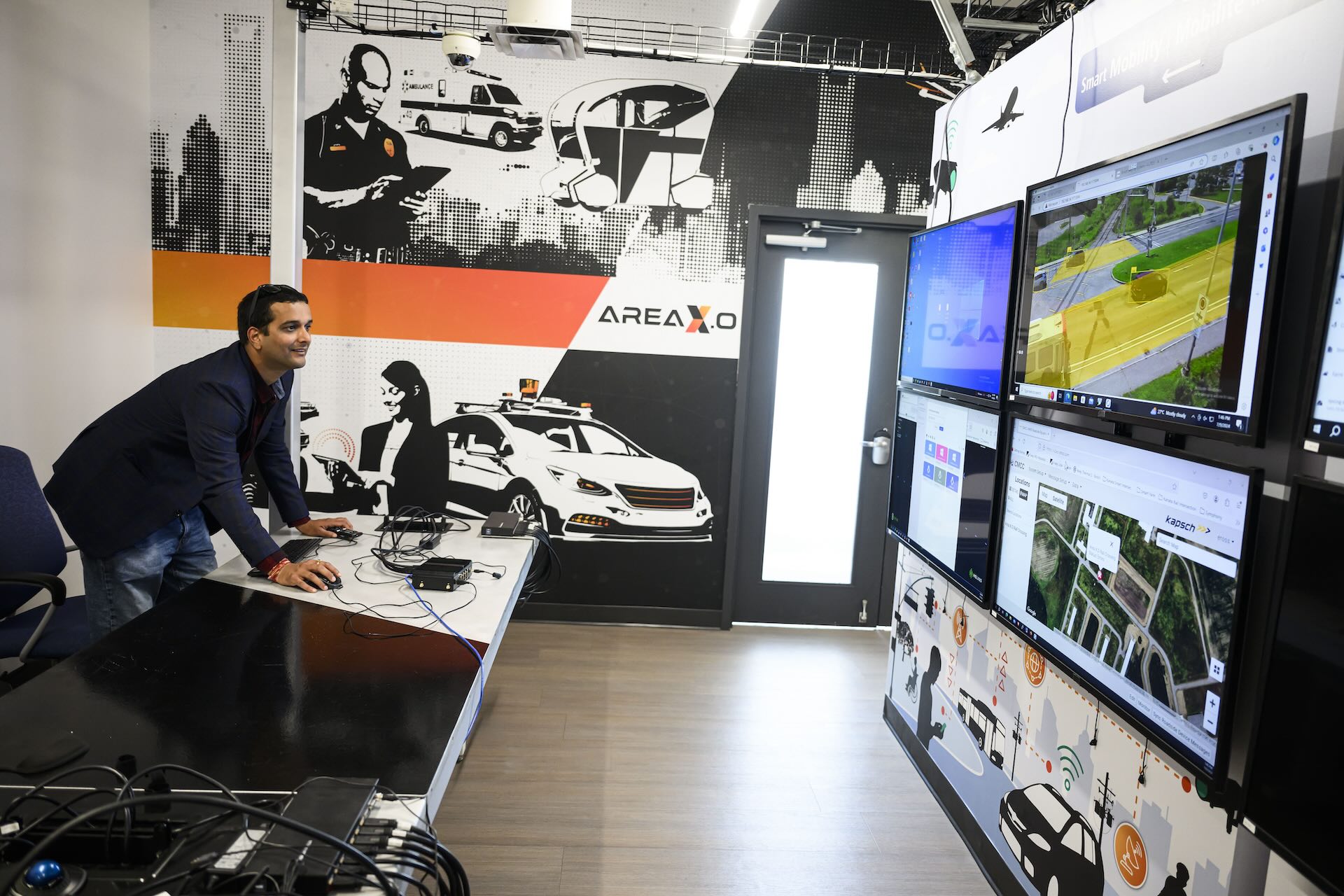
Kamboj shows a video at the Area X.O control room in Ottawa. Photo: Justin Tang for The Logic
Over Kamboj’s shoulder, an ordinary utility pole was kitted out with regular cameras, thermal imagers, lidar and radar. The imaging that works best on a steamy summer day might not work at all in a nighttime blizzard.
“How quickly are you sampling those video feeds?’ Kamboj asked rhetorically. “Are you missing frames? [If you are,] you’re not able to capture the right information.”
The rail safety project has included technology tests in all four seasons. It has participants ranging from QNX, Microsoft and Siemens to local startups like Sensor Cortek (machine vision and processing), Cheetah Networks (internet-of-things communications) and Four DRobotics (software to run autonomous industrial vehicles).
Kamboj said a key finding has been the need for “interoperable connectivity.” The data that needs to be shared in real time to keep everyone safe has so many creators, owners and potential users.
Said Kamboj: “You’re choosing different mediums of communication, and relaying the safety-critical information to the right audience of the right stakeholder group in time so that the situation can be avoided.”
Read Shift—The Logic’s authoritative weekly newsletter on automotive technology industry news—for more; and if you know someone who should be reading it, they can sign up here.