“China, China, and more China.”
That was how Birgit Matthiesen, director of North American Manufacturing at D.C.-based law and lobbying firm ArentFox Schiff, assessed Washington’s priorities when it comes to the next U.S.-Canada-Mexico trade agreement.
Matthiesen’s comments at the Great Lakes Sustainable Growth Forum in Toronto last week were timely, as Canada has launched a consultation on whether to hike tariffs on Chinese EVs.
In one camp, tariff advocates like Ontario Premier Doug Ford argue that Chinese EVs are artificially cheap because the country relies on low labour standards and dirty energy. In the other, some climate advocates say there are too few alternatives on the market today to let most Canadians drive a lower-emission vehicle at all.
Then there’s a not-so-secret, more complex third factor: a constant pressure on Canada to maintain harmony—in policy and sometimes in spirit— with the U.S., which has already enacted massive tariffs on Chinese EVs.
Daniel Ujczo, senior counsel at Thompson Hine LLP, said neither potential U.S. presidential administration is viewing the 2026 USMCA review as a rubber-stamp event, and that the sabre-rattling will soon begin on existing “irritants” in the relationship like Canada’s proposed digital services tax, the dairy industry, softwood lumber and Ottawa’s modest contributions to NATO.
So effectively, Canada’s best trade partner—the destination for 95.3 per cent of its total automotive exports and 57.7 per cent of total automotive imports, according to DesRosiers Automotive Consultants—has sent out a “save the date” for USMCA talks, and the stakes are high lest the country be called out as a fake friend.
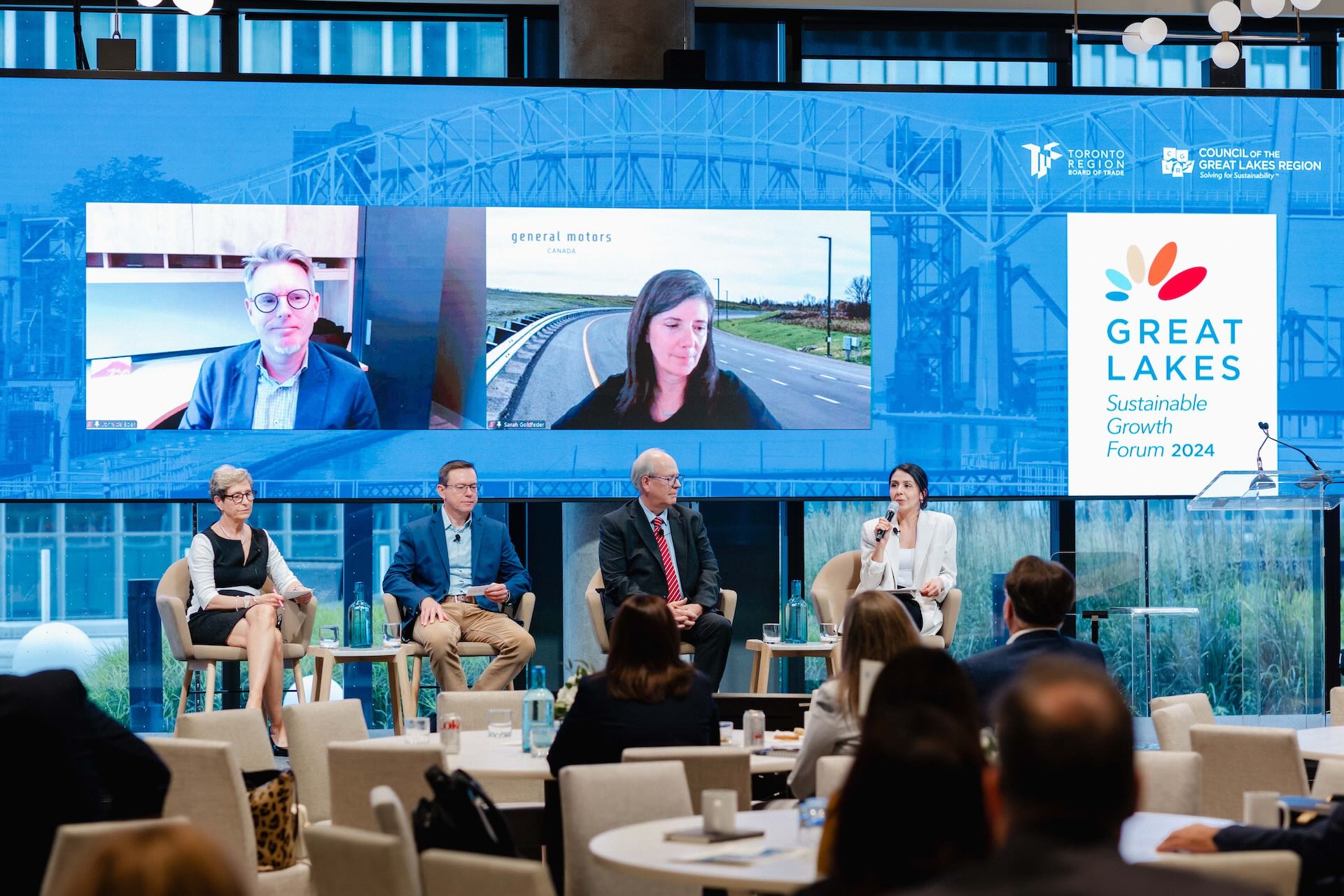
The forum, put on by the Toronto Region Board of Trade and Council of the Great Lakes Region, was a locus for auto-industry leaders from the likes of Toyota, General Motors and BlackBerry.
Auto-industry leaders from the likes of Toyota, General Motors and BlackBerry gathered in Toronto last week at the Great Lakes Sustainable Growth Forum, where trade and jobs were major discussion topics. Photo: Toronto Region Board of Trade/Handout
Trade was a main topic of discussion, both the relationship between Canada and the U.S., and the issue of how to keep jobs in the Great Lakes region—the likes of Quebec, Ontario, Michigan and Ohio—when the southern states and Mexico are building their own auto sectors.
“There has been a slowdown in battery investment … with the limited exception of the Chinese. China is buying up Mexico,” said Ujczo. “That’s going to be an irritant … Are we going to treat that as a North American-made good?”
The success of Chinese EVs “should be lighting a little bit of a fire under us” in terms of R&D, according to Bernard Swiecki, vice-president of mobility and research at the Detroit Regional Partnership. Still, other automotive leaders described the costly struggle to redesign factories built to make gas-powered vehicles at a time when uptake of EVs in North America has been “lumpy.”
“We need to be very thoughtful right now in terms of how we set up the ducks for that [USMCA] review,” said David Adams, CEO of Global Automakers of Canada.
“Especially as we transition to an electrified industry … how do we make the case now to get ourselves as close together with the U.S. as possible? So maybe we are seen in a different light than Mexico—as more of a friend.”
Read Shift—The Logic’s authoritative weekly newsletter on automotive technology industry news—for more; and if you know someone who should be reading it, they can sign up here.