OTTAWA & NEW DELHI — As Canadian institutional investors buy up billions worth of assets in India, the two countries have relaunched talks on a bilateral investor-protection agreement. But documents obtained by The Logic show India has told Canada it has little room to compromise on major sticking points from the two countries’ last failed attempt to make a deal a half-decade ago.
Skip to content
News
India told Canada it has ‘little flexibility’ on longstanding investment treaty issues, documents show
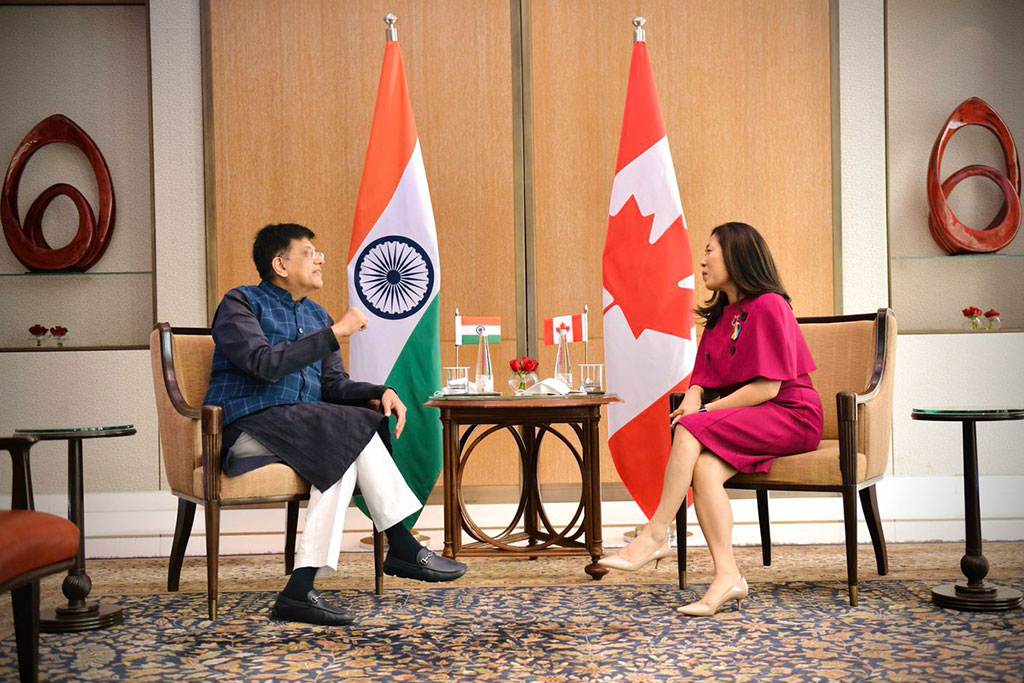
Mary Ng | Twitter Photo: Indian Commerce Minister Piyush Goyak and Canadian Trade Minister Mary Ng in New Delhi in March 2022.
OTTAWA & NEW DELHI — As Canadian institutional investors buy up billions worth of assets in India, the two countries have relaunched talks on a bilateral investor-protection agreement. But documents obtained by The Logic show India has told Canada it has little room to compromise on major sticking points from the two countries’ last failed attempt to make a deal a half-decade ago.
Talking Point
As New Delhi and Ottawa prepared to relaunch talks on a bilateral investment treaty, Indian officials told Canadian counterparts they had “little flexibility” on issues left over from more than a decade of earlier negotiations, documents obtained by The Logic show. In a February memo to Trade Minister Mary Ng, officials cited unsettled provisions including coverage of portfolio investment, which form the bulk of capital flows from Canada to India.
The two countries have been negotiating trade and investor-protection agreements on and off for over a decade, in the hopes of boosting what remains a relatively small economic relationship for each. Bilateral investment treaties typically promise to safeguard each country’s financiers and businesses against unfair treatment in the other, and allow them to seek international arbitration when their commercial rights have been violated.
In September 2004, the Liberal government of the day under then-prime minister Paul Martin launched negotiations with New Delhi on a Foreign Investment Promotion and Protection Agreement (FIPA). Canada and India announced they had reached an agreement in June 2007, but New Delhi subsequently reopened the text. The most recent round of the original FIPA negotiations took place in November 2017.
Despite the lack of a deal, significant sums of Canadian capital have flowed to the subcontinent. Canadian annual direct investment in India grew from $684 million in 2014 to nearly $2.9 billion in 2021, according to data from Statistics Canada. Over that same period, the value of Canadian portfolio investment in India—meaning assets in which an investor owns shares or debt, but which it does not control—increased from $7.25 billion to $33.97 billion.
In March, International Trade Minister Mary Ng and Indian Commerce Minister Piyush Goyal agreed to relaunch negotiations on a trade deal, as well as to “promote and protect bilateral investment, including through the intensification of negotiations toward” an investment agreement. But just a month earlier, documents reveal, officials at Global Affairs Canada (GAC) warned Ng that New Delhi had revived longstanding disputes over the FIPA.
Negotiations on the deal “are well advanced,” and the two countries had agreed on a “landing zone” during Indian Prime Minister Narendra Modi’s April 2015 visit to Canada, according to a memo the department’s Asia-Pacific sector prepared for Ng ahead of a February 2022 call with Goyal. But during a June 2021 video conference between officials, “India signalled it has little flexibility on the main outstanding issues from the landing zone.”
“Coverage of portfolio investment” was one of those issues. Such purchases form the bulk of capital flows from Canada to India. Ottawa’s current model for FIPAs, published in May 2021, applies its protections to portfolio investment, said Matthew Kronby, a Toronto-based partner at the law firm Borden Ladner Gervais. But India’s bilateral investment treaty framework, adopted in December 2015, explicitly excludes it.
The Logic in India
India will have the world’s fastest-growing economy this year, and Canada’s institutional investors are putting billions into the country’s companies and infrastructure. But foreign businesses still face significant barriers in the country and human rights groups warn about civil liberties.
For this series, The Logic‘s Murad Hemmadi takes the pulse of the countries’ commercial relationship via interviews with Canadian diplomats and investors in India.
Other stories in this series:
Canada seeking ‘trusted trading relationship’ with India, new envoy says
CPP Investments looks to back India’s digital, energy transformations
“Capital-importing countries make commitments … to protect foreign investors and their investments because it’s beneficial to their economies to encourage or attract that investment,” said Kronby, who represented Canada in FIPA negotiations with India prior to leaving the federal government for private practice in 2012. But while it’s usually clear how direct international cash injections to build a factory or mine benefits the host nation, there’s more debate over whether the host profits from overseas financiers buying and passively holding shares and bonds there.
The GAC memo identified “exhaustion of local remedies” as another sticking point. India’s model bilateral investment treaty requires foreign investors to first pursue any dispute through its court system and wait five years before taking the government to international arbitration. “That’s a long time,” said Kronby, noting that courts on the subcontinent are slow and backlogged; in April, Indian chief justice NV Ramana said the pending-case count stood at over 40 million.
Canada and India also hadn’t settled how the FIPA would apply to the actions of regional and municipal governments, nor had they agreed on standstill and ratchet mechanisms, according to the GAC memo. Standstills are carve-outs in an agreement for existing government policies and restrictions that don’t conform with the terms of a treaty, while ratchets mean that “once you liberalize, you can’t go back,” said Kronby.
Ng’s office declined to answer The Logic’s questions about the oustanding FIPA issues listed in the February memo. “As negotiations are currently ongoing we are unable to release any details on these discussions,” said spokesperson Chris Zhou in a statement, claiming the two sides “are making progress.”
“Details of the issue listed by you remain under negotiation,” said C. Gurusubramanian, a spokesperson for the High Commission of India in Canada, in response to The Logic’s question about the provisions listed in the GAC memo. Both countries have new model investment treaties in place and “would be approaching all issues, including any legacy issues … with a desire to move forward to create a balanced and just legal framework,” he said.
The two countries also appear to disagree on the form and timing of the deal. Canada typically seeks to include investment provisions in its overall trade agreements as it did with CETA and CPTPP, said Cameron MacKay, Ottawa’s new high commissioner in New Delhi, in an interview with The Logic last month. “That’s what we would prefer as an outcome” with India.
New Delhi has significantly revised its international investor policy in recent years, after it faced a raft of international disputes and two cases in which tribunals ordered it to pay millions of dollars in compensation. Between March 2017 and November 2021, India terminated 75 bilateral investment treaties, including with top trading partners like Germany, Indonesia, South Korea and the U.K.
India “has no current, modern investment protection agreements with any partner,” said MacKay. “We are hopeful that India would want to change that, which we think would lay the groundwork for even more Canadian investment into India.” New Delhi has signed treaties with Belarus, Brazil and Kyrgyzstan since September 2018, but none of those are yet in force.
Ottawa is also taking a more defensive approach to investor-protection agreements after defending a large number of disputes with investors under NAFTA and losing a few of them, according to Kronby. “Between the Canadian attitude and the Indian attitude, I’m not sure if there’s room to actually reach a deal that provides meaningful protection to investors,” he said.
Canada has modified its position on the timeline of a deal. The February GAC memo suggested Ng tell Goyal that “finalizing a high-standard FIPA would provide a meaningful result even while we consider next steps” for a trade deal. But Canada agreed with India in March to complete the investment agreement alongside the economic one, said GAC spokesperson Lama Khodr. Ng’s office did not answer The Logic’s questions about the shift.
With files from David Reevely



Loading...
Thanks for sharing!
You have shared 5 articles this month and reached the maximum amount of shares available.
CloseThis account has reached its share limit.
If you would like to purchase a sharing license please contact The Logic support at [email protected].
CloseGift the full article!
You have gifted 0 article(s) this month and have 5 remaining.
Recipients will be able to read the full text of the article after submitting their email address. They will not have access to other articles or subscriber benefits.
Photo: Indian Commerce Minister Piyush Goyak and Canadian Trade Minister Mary Ng in New Delhi in March 2022.
Most Popular This Week



In-depth, agenda-setting reporting
Great journalism delivered straight to your inbox.
Special Report
Canada pitched itself to the world’s biggest investors. Now comes the hard part
Briefing
Coinbase lets Canadians lend stablecoins out through DeFi protocol
Cohere’s Gomez says Silicon Valley giants shouldn’t get to set the rules for AI
TD pledges $150B in new financing and support in key Canadian sectors
Best business newsletter in Canada
Get up to speed in minutes with insights and analysis on the most important stories of the day, every weekday.
Exclusive events
See the bigger picture with reporters and industry experts in subscriber-exclusive events.
Membership in The Logic Council
Membership provides access to our popular Slack channel, participation in subscriber surveys and invitations to exclusive events with our journalists and special guests.