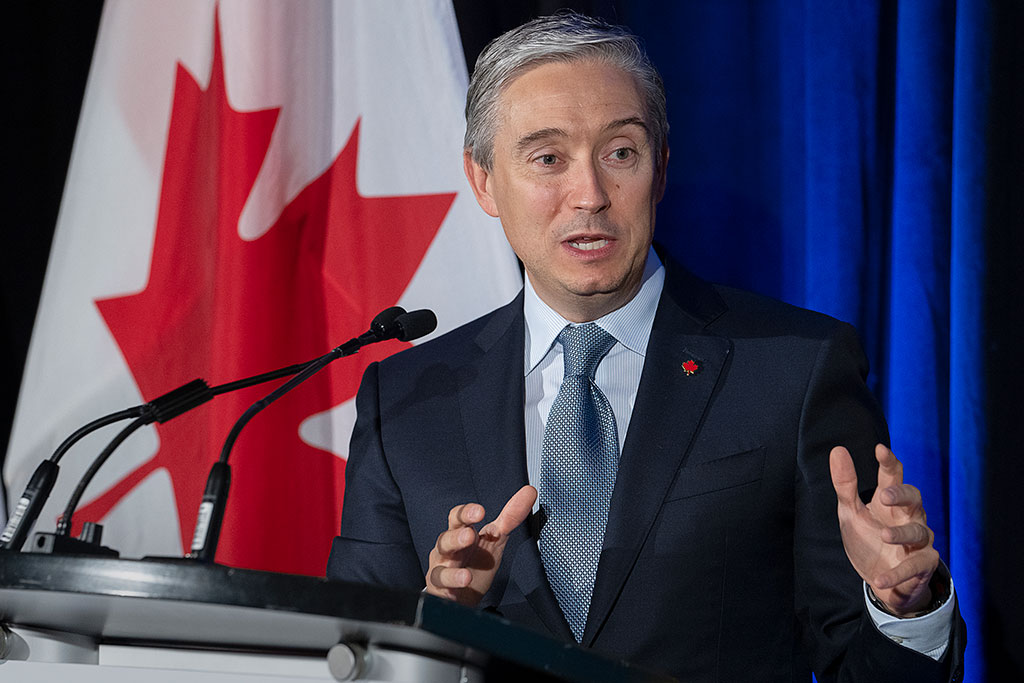
The federal government is consulting on the design of a new $2-billion research agency it’s modelling on a bureau of the U.S. defence department that helped develop the internet and autonomous-vehicle technology.
It will be a “moonshot approach to science and innovation,” Innovation Minister François-Philippe Champagne said in an interview with The Logic. But some policy experts question whether the proposed program, prompted by the recommendations of a prominent business lobby, will be able to address Canada’s long-running innovation challenges.
The Eisenhower administration established the forerunner of the Defense Advanced Research Projects Agency (DARPA) in February 1958, after the Soviet Union launched the first-ever human-made satellite. The branch has about 220 staff overseeing 250 programs, with a US$3.5-billion budget in fiscal 2020–21. The U.S. government has attempted to apply the model to fields like energy and health, while countries including Germany and the U.K. are trying their own versions.
Talking Point
Canada’s research and science ecosystem is missing a mission-driven approach to innovation, according to Innovation Minister François-Philippe Champagne. The Liberal government is moving forward with plans for a new agency modelled on the U.S. Defense Advanced Research Projects Agency, but policy experts are skeptical it will address the country’s most pressing innovation challenges.
As The Logic was first to report in March, the Business Council of Canada (BCC) called for the federal government to follow suit, establing a DARPA-like agency, focused on “high-growth sectors in which Canada has a competitive advantage,” and designed to “scale up and commercialize research.” During this summer’s election, the Liberals pledged “an initial endowment of $2 billion” to set up CARPA as “a public-private bridge for research” in “high-impact areas.” The Conservatives made a similar promise in their platform.
The new agency will be “mission-driven,” Champagne said in an interview earlier this month. “I am a big believer that this is something that is missing currently in the ecosystem of research and science that we have in Canada.” In addition to funding basic research, DARPA runs challenges, setting a goal and allowing teams of researchers and companies to tackle it however they think best.
The government is still working to define CARPA’s mandate and priorities, Champagne said, adding he’s “been talking to a number of experts around the world to make sure that we design it in the best possible way.” His office would not disclose with whom the minister has spoken; the government has yet to launch formal consultations.
The DARPA model only works when the market for a technology “isn’t large enough or not profitable enough” for the private sector to act on its own, but there’s still “a public need for it to be developed,” said Anna Goldstein, executive director of the Energy Transition Institute at the University of Massachusetts Amherst. Risk tolerance and technical expertise are key. “Prepare for failure most of the time,” she said, noting that “the success you’re going for is massive [and] groundbreaking.”
The U.S.’s clean-energy-focused ARPA-E is led by program directors “on loan to the government from their career at the cutting edge” of their field, who bring along their ideas and networks, said Goldsein. A study she led found that cleantech startups backed by the agency filed twice as many patents as their peers. But in an interview with The Logic she said ARPA-E hasn’t been around for long enough to know whether its grants helped foster private-sector success.
Some Canadian innovation-policy experts have criticized the BCC and Liberal proposals, questioning whether a DARPA-type agency can work in sectors outside defence; suggesting the country may not have enough companies capable of responding to the branch’s challenges and turning ideas into revenue-generating products and services; and noting that without sufficient market research, the bureau could focus on opportunities that lots of other countries are also pursuing or make firms dependent on government procurement.
Speaking with The Logic, Champagne cited a number of areas that CARPA could target, such as trying to “feed a percentage of the world population with plant protein,” developing “hybrid propulsion and aviation” or creating “new building materials” that reduce carbon dioxide emissions.
“Each of those sounds like a mission-oriented agency” on its own, noted Goldstein.
“Where Canada needs to do its moonshot is on climate change,” said Robert Asselin, BCC’s senior vice-president of policy. In an interview with The Logic last week, he noted critics of the proposal claim the country’s private sector doesn’t have the capacity to adopt the innovations generated by a DARPA-like agency, but “our energy sector is big enough and good enough [with] R&D to absorb breakthrough technology.” That would meet both economic and emissions-reduction goals.
The country does need an independent, well-funded innovation agency, said Daniel Munro, senior fellow at the University of Toronto’s Innovation Policy Lab. “But I don’t think the DARPA moonshot missions approach actually addresses the innovation challenges that we face in Canada.” He cited declining business spending on research and development and investment in technology; Canada already lags its OECD peers on both measures.
“I don’t think Canada really needs to be pushing the innovation frontier forward,” said Munro, noting the original DARPA has far greater resources than Ottawa is likely to afford its copy. Instead, a Canadian agency should help businesses slot into global value chains, identifying promising niches and funding product development.
Asselin said the new bureau can do both. Take electric vehicles, he said. “I’m not thinking about necessarily making Canada a leader in EV production; that will never happen,” he said. “But maybe in some part of the R&D around batteries, a CARPA could help come up with something that nobody has actually figured, [which] could be huge for Canada.” He said Ottawa should not rush to launch the agency, but consult with experts with experience operating such models.
The Liberal platform accounts for CARPA’s endowment in the 2022–23 fiscal year, suggesting it could be included in the next federal budget in the spring. Prime Minister Justin Trudeau’s mandate letter to Champagne cites the proposal, instructing the minister to “develop a new approach to support high-risk/high-reward transformative research and development” that will “drive technological breakthroughs” as well as “help Canadian companies grow and create highly skilled jobs.” It also links the DARPA-like agency to modernization of the federal research-granting councils. Champagne’s office did not directly answer a question about how that would work.
The government “is currently examining how it will be able to best leverage these investments to unleash game-changing research and innovation while building on the strengths of the current research ecosystem,” said spokesperson Laurie Bouchard, noting more details will be announced “in the coming months.”