TORONTO — Tenstorrent, celebrated as one of a new crop of Canadian hardware startups, has quietly relocated to the United States, documents seen by The Logic reveal.
Skip to content


Exclusive
Tenstorrent quietly relocates to the U.S. as AI chip race heats up
Documents seen by The Logic reveal that Canadian AI startup Tenstorrent moved its headquarters to the U.S. late last year
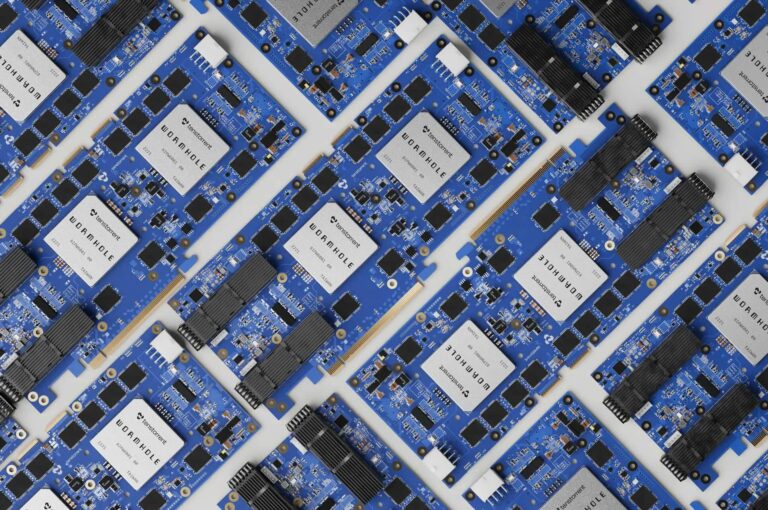
Tenstorrent now lists its headquarters as Santa Clara, a city at Silicon Valley’s geographic centre. Photo: Tenstorrent/Handout
TORONTO — Tenstorrent, celebrated as one of a new crop of Canadian hardware startups, has quietly relocated to the United States, documents seen by The Logic reveal.
Founded in Toronto, Tenstorrent moved its headquarters south in November 2023. Documents show that the startup filed amended articles with Corporations Canada that converted its shares into exchangeable shares, effectively swapping them for equity in a Delaware-registered firm called Tenstorrent Holdings. The new company, which documents identify with the shorthand “USCo,” was incorporated that August.
Talking Points
- Canadian AI chip startup Tenstorrent has quietly redomiciled to the United States and moved its headquarters from Toronto to Santa Clara, Calif., The Logic has learned
- The firm—one of a new crop of homegrown hardware companies—still has over 120 of its 550-plus employees in Canada. Its relocation comes as the country tries to secure domestic AI compute capacity and develop its semiconductor sector.
In December, Tenstorrent wound up its federally incorporated Canadian corporate entity, transferring its registration to a new company under B.C.’s business law. While federal rules require that at least a quarter of a firm’s directors be residents of Canada, the provincial system has no such stipulation.
Tenstorrent now lists its headquarters as Santa Clara, a city at Silicon Valley’s geographic centre that’s also home to chip giants AMD, Intel and Nvidia. Many of the startup’s other senior leaders are based in Austin.
The move comes as Canada jostles with other advanced economies for artificial intelligence resources and an international leadership position in the field. And it plays into long-standing fears about the country’s ability to retain promising startups as they grow.
Ljubisa Bajic, a former executive at semiconductor giant AMD, founded Tenstorrent in Toronto in March 2016. The startup makes chips designed to run AI models, promising they use less power and perform better than competitors. It sells finished hardware to data centre operators and licenses its intellectual property to companies that want to create their own.
Related Articles

Tenstorrent’s U.S. move followed a change in leadership and a major funding round. In January 2023, Jim Keller replaced Bajic as CEO. A well-known processor designer, Keller is based in Palo Alto, Calif., and previously held top roles at Intel, Tesla, AMD and Apple. In August that year, Tenstorrent announced it had raised US$100 million from backers including Korean giants Hyundai and Samsung, and U.S. financiers Fidelity Ventures and Eclipse Ventures.
Tenstorrent hasn’t left Canada altogether. The company still has over 120 employees in the country, according to Bob Grim, vice-president of corporate communications, among a total global staff of more than 550 people. Tenstorrent also still has its office in Toronto.
The company did not make Keller available for an interview for this story. “We remain committed to Canada and growing our Canadian workforce,” Grim wrote in an email.
Still, Tenstorrent’s move is a symbolic blow to the country’s resurgent semiconductor sector.
Canada needs its own AI-chip players to create economic benefits at home and ensure it’s part of emerging global supply chains, said Benjamin Bergen, president of the Council of Canadian Innovators, a scale-up lobby group. But Washington’s US$52.7-billion CHIPS and Science Act has been a “real wake-up call” for Canadian semiconductor firms on the opportunities available across the border in what is a hugely capital-intensive business, he said. “I’m not surprised, given that that pull is so huge.”
Bergen said Canada needs to ensure it has the correct policies and programs in place to encourage firms to grow and innovate here, and that public funds spent here generate a return.
Tenstorrent has long been touted as a Canadian success story. Memos prepared for senior officials in the federal Innovation Department cite the startup among “several of the world’s most promising AI firms” to which Canada is home. The Logic obtained the documents via access-to-information request.
To support the AI sector, the Liberal government has promised $2 billion to help developers and researchers gain access to the processing power needed to train and run models. Canada is one of several countries trying to secure sovereign compute capacity, to boost domestic players and reduce reliance on foreign firms.
Semiconductor executives are pushing for a “buy Canadian” approach for the new federal initiative requiring cloud firms that receive funding to use Canadian-made chips and equipment. Tenstorrent wants to sell its hardware or license its IP as part of the program, chief customer officer David Bennett told The Logic in an interview in October. “Canadian content is important,” he said, proposing that the government back industry efforts to develop greener data centres using more efficient chips.
Tenstorrent is already participating in other countries’ sovereign compute strategies. In February, it announced a deal to work with the Japanese Industry Ministry’s R&D arm on a new AI chip. The startup is aiming for more IP sales to companies and countries that want to build their own hardware. “They’re looking for a North American company that has experience with high-performance compute and AI,” Bennett said.
In that October interview, Bennett—a Canadian now based in Austin—echoed a common concern among tech executives and policymakers that Canada has failed to commercialize the AI advances made on home soil. “To see what’s come out of Canada and not see more big AI unicorns, it’s a little disappointing,” he said. “But I think there’s certainly an opportunity to build this industry.”



Loading...
Thanks for sharing!
You have shared 5 articles this month and reached the maximum amount of shares available.
CloseThis account has reached its share limit.
If you would like to purchase a sharing license please contact The Logic support at [email protected].
CloseGift the full article!
You have gifted 0 article(s) this month and have 5 remaining.
Recipients will be able to read the full text of the article after submitting their email address. They will not have access to other articles or subscriber benefits.
Photo: Tenstorrent/Handout
Most Popular This Week




In-depth, agenda-setting reporting
Great journalism delivered straight to your inbox.
News
An obscure data standard is the latest open banking holdup—and an unlikely political hot potato
Briefing
OSFI won’t dictate whether banks block AI agents, says Routledge
Deep Sea Minerals files to raise US$5M as U.S. spurs on seabed mining
Celestica expects sales to nearly double next year as AI demand surges
Best business newsletter in Canada
Get up to speed in minutes with insights and analysis on the most important stories of the day, every weekday.
Exclusive events
See the bigger picture with reporters and industry experts in subscriber-exclusive events.
Membership in The Logic Council
Membership provides access to our popular Slack channel, participation in subscriber surveys and invitations to exclusive events with our journalists and special guests.