OTTAWA — The United Kingdom and Canada are touting closer ties on artificial intelligence and a new deal to share computing power, even as the two countries hit pause on wider trade talks.
Skip to content


News
Canada and U.K. are allies, not rivals, on AI: Champagne and Donelan
Countries sign deal to cooperate on computing power, expanded tech agreement
U.K. Technology Secretary Michelle Donelan and Innovation Minister François-Philippe Champagne at the British High Commission in Ottawa on Jan. 30, 2024. Photo: Blair Gable for The Logic
OTTAWA — The United Kingdom and Canada are touting closer ties on artificial intelligence and a new deal to share computing power, even as the two countries hit pause on wider trade talks.
Talking Points
- Canada and the U.K. will explore sharing AI computing infrastructure and grow their technology ties under newly signed agreements
- While both countries are positioning themselves as major AI players, U.K. Technology Secretary Michelle Donelan and Innovation Minister François-Philippe Champagne said there’s room for cooperation on the technology’s risks and opportunities
“Who knows what the next set of models will be able to do,” said U.K. Technology Secretary Michelle Donelan. “That’s what’s fuelling the sense of urgency but also the sense that we need to collaborate.” She was speaking Tuesday evening in a joint interview with Innovation Minister François-Philippe Champagne at the British High Commission in Ottawa, amid a three-day visit to the country.
Canada and the U.K. are both positioning themselves as major AI players, as international safety initiatives focused on the technology proliferate, while multinationals and new entrants try to amass clients and market share.
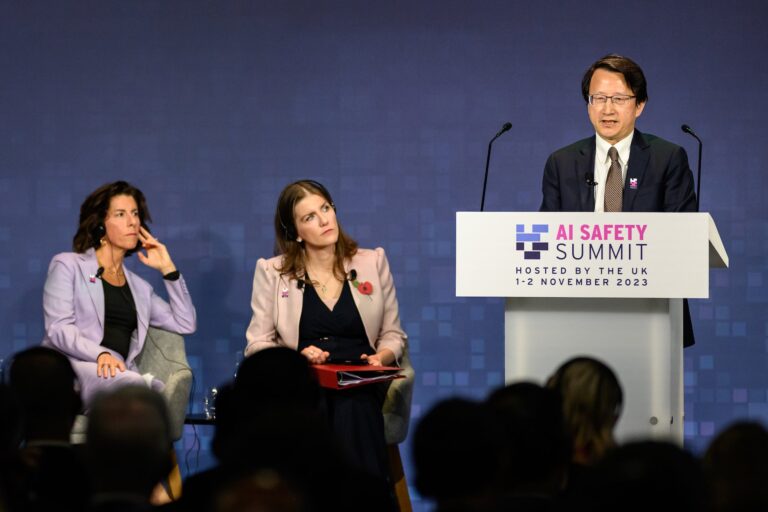
Champagne has talked up Canadian researchers’ foundational work in the field, as well as the country’s founding role in the Global Partnership for AI. Donelan in November hosted the U.K. AI Safety Summit at Bletchley Park, where 29 governments including Canada’s agreed to work together to identify and address the risks of so-called frontier systems, the largest models capable of the most applications.
Related Articles

Still, the U.S. is home to the largest AI and tech firms and the startups raising the most money, while China is making a major push in the field. On Tuesday, the ministers downplayed the idea that the two countries are competing for the same spot beside those superpowers.
“We do have a seat at the big table,” said Champagne, suggesting that countries’ AI strength be gauged not just by “dollar amount” but by “their influence and thought leadership.” He cited the Liberal government’s $568.8-million AI strategy and voluntary generative AI code of conduct as key initiatives.
Donelan said international cooperation is required to address AI’s risks and opportunities. “Every country wants to further its economic growth [and] enhance the number of high-paid jobs for their people—that’s the nature of politics,” she said, pointing to the U.K.’s regulatory approach, which it frames as pro-innovation and pro-safety. “This is bigger than that.”
Earlier on Tuesday, Donelan and Champagne signed an updated agreement on cooperation in science, technology and innovation, as well as a deal to look at ways of providing researchers and firms in both countries with affordable access to compute—the industry term for the processing power and other infrastructure required to train and run AI models.
It makes sense for governments to share those resources, Donelan said. “If you look at the amount of investment that companies like Meta are pouring year after year into compute, no government will be able to compete with that.” The U.K.’s Conservative government has promised £1.7 billion ($2.89 billion) for new supercomputers for scientists working in areas like safety and biotech.
Ottawa’s AI strategy includes $40 million for research compute, and it has signalled it’s looking into domestic compute capacity. “What I hear most from the tech sector in Canada is, ‘We have the brain. Now we need, almost, the mainframe,’” said Champagne, noting that he can use the U.K. deal to encourage participation from companies offering AI infrastructure. Champagne said he will meet this week with Nvidia CEO Jensen Huang, whose chips are the fuel for the model-making and use race.
The two governments are still working out how the compute collaboration will work in practice.
At the Bletchley summit, the U.K. also launched an AI Safety Institute to conduct research and test new AI systems ahead of their launch. Eight developers including Google, Meta and OpenAI agreed to provide the unit access to their products. The institute has already begun evaluating models, according to Donelan, though she declined to specify which ones on the basis of commercial sensitivity. The U.K will “share information around the testing and the results” with Canada, she said, noting both countries are members of the Five Eyes intelligence group.
“We are lucky, as Canada, because we have two of our greatest partners which are working on institutes,” said Champagne. (The U.S. is also launching one.) The safety institute model “makes a lot of sense,” he said, and “we need to see what Canada’s contribution can be and how we should organize that.” The ministers also noted the positive potential of AI innovation, in areas like health care.
Donelan’s day in the capital came between meetings with major figures in Canadian AI that have significant British ties. On Monday, she visited Toronto-headquartered Cohere, a generative AI startup that plans to grow its London office to about 50 workers this year. On Wednesday, she is due to meet Yoshua Bengio, the Université de Montréal professor leading a U.K.-commissioned “state-of-the-science” report on frontier systems. Donelan will also see the Montreal office of Google DeepMind, the unit of the search giant that anchors London’s AI ecosystem.
Her visit comes the week after London paused negotiations on a new trade deal with Ottawa, with both sides citing concerns over agriculture. The deal would have replaced an interim, post-Brexit pact, and the U.K. had initially sought “ambitious” digital provisions. But Donelan and Champagne downplayed the impact of the pause on technology ties, citing the innovation agreement inked Tuesday which promotes cooperation in fields like cleantech and quantum.



Loading...
Thanks for sharing!
You have shared 5 articles this month and reached the maximum amount of shares available.
CloseThis account has reached its share limit.
If you would like to purchase a sharing license please contact The Logic support at [email protected].
CloseGift the full article!
You have gifted 0 article(s) this month and have 5 remaining.
Recipients will be able to read the full text of the article after submitting their email address. They will not have access to other articles or subscriber benefits.
Photo: Blair Gable for The Logic
Most Popular This Week



In-depth, agenda-setting reporting
Great journalism delivered straight to your inbox.
News
Panel decries Canada’s chaotic way of funding world-class science
Briefing
AI is pushing insurers to become asset managers, Canadian CEOs say
Trump administration faces lawsuit over 50% tariffs on Canadian goods
Canada-U.S. trade war to reduce real GDP by 1.4% over 2024 levels after five years: PBO
Best business newsletter in Canada
Get up to speed in minutes with insights and analysis on the most important stories of the day, every weekday.
Exclusive events
See the bigger picture with reporters and industry experts in subscriber-exclusive events.
Membership in The Logic Council
Membership provides access to our popular Slack channel, participation in subscriber surveys and invitations to exclusive events with our journalists and special guests.





