TORONTO — Tenstorrent has developed a surprising side-hustle licensing its AI compute technology to countries and companies that are trying to avoid getting locked into chip giants like Nvidia and Arm.
Skip to content


News
The Canadian startup helping companies break away from Nvidia
Tenstorrent licenses IP to corporate behemoths and governments that don’t want to be locked into chip giants. Business is growing fast.
Tenstorrent’s Wormhole chips on cards that fill desktop computers and servers. Photo: Handout
TORONTO — Tenstorrent has developed a surprising side-hustle licensing its AI compute technology to countries and companies that are trying to avoid getting locked into chip giants like Nvidia and Arm.
Customers using the Canadian AI hardware startup’s intellectual property include South Korea’s Hyundai Motor and LG Electronics, Swiss consortium SingularityNet as well as a research centre backed by the Japanese government. They’re turning to Tenstorrent in pursuit of more control, better performance and savings, according to the company. “I’m targeting organizations that want to own their own computing roadmap,” said chief customer officer David Bennett.
Talking Points
- Tenstorrent has found a lucrative sideline in licensing its AI computing technology to companies and countries that want to build their own chips and hardware
- The Canadian-founded firm has sold its IP to clients like LG Electronics and Hyundai Motor, and sees opportunities in governments’ plans to increase processing power
The AI boom has driven huge demand for the hardware that fills the data centres and devices on which the technology runs. Many developers favor Nvidia’s graphics processing units (GPUs) to train their models, driving the firm from Santa Clara, Calif., to a US$3.5-trillion market capitalization. Intel and British firm Arm control the architectures—sets of instructions that guide where processors go and data flows—that chip designers most widely use.
Tech giants Amazon, Google and Microsoft have all built their own hardware for their cloud arms, which dominate the market for processing power. Apple and Tesla have also developed custom chips for laptops and autonomous vehicles, respectively. Tenstorrent CEO Jim Keller led both those efforts.
The startup, founded in April 2016, now sees an opportunity to work with firms and governments taking a similar approach. Chip shortages and growing geopolitical risks have alerted firms to the issues in their hardware supply chains, while countries like Canada are trying to build “sovereign compute” capacity within their borders to retain companies and sensitive data within their borders.
Tenstorrent sells clients the IP for its high-performance computing and AI chips, as well as its architecture, based on an open-source system called RISC-V. The startup earns royalties as customers produce hardware using its technology. Tenstorrent also sells design services. “We’re going to bring down the time-to-market for new custom silicon, and the cost,” said Bennett.
Related Articles
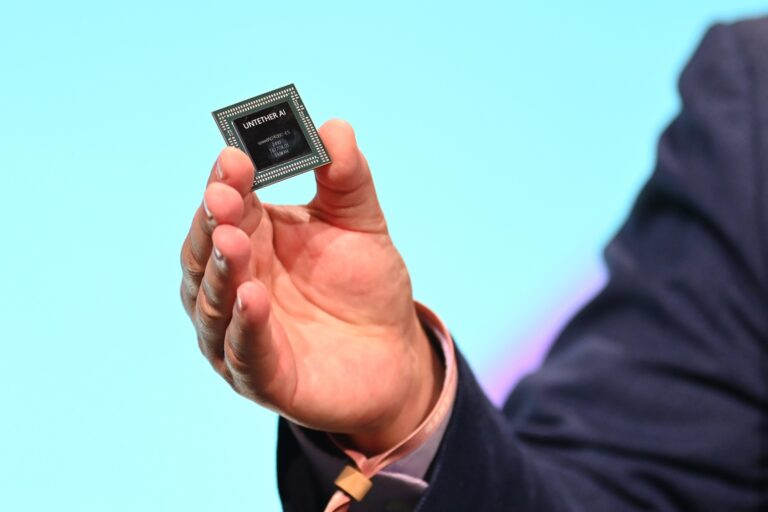

Tenstorrent’s chips are specifically designed to train and run AI—many hardware startups focus on one or the other—and can be strung together to handle large workloads. Firms can get better performance than off-the-shelf chips by designing custom hardware specifically for the kinds of AI they sell, said Gaurav Gupta, a vice-president of research and advisory at Gartner.
Buying technology from Nvidia and Arm is also expensive. The savings from developing chips in-house can be “huge,” said Gupta, noting that the chip giants’ prices include significant margins. But he argued custom hardware only makes sense for firms that need huge volumes to fill, say, massive cloud data centres or fleets of self-driving cars. That may limit the market for companies looking to license their technology.
Tenstorrent didn’t set out to be in the custom chip business. “We were building this IP for our own products,” said Bennett. The company has sold complete desktop machines and servers to firms in the data-centre and automotive sectors in Asia, Europe, and North America. It’s now receiving interest from the Middle East.
Tenstorrent eventually saw an opportunity to turn its IP into another revenue stream because customers were asking for it. It also offers its software under open-source terms.
The firm is currently in technology-licensing discussions with both major firms and government-backed organizations, according to Bennett although he did not provide specifics. “They’re looking for a North American company that has experience with high-performance compute and AI,” he said. Tenstorrent, which has over 550 employees, most recently raised US$100 million last August.
Hardware developers using RISC-V are pushing into the server business, but it’s unclear whether they’re gaining much market share from the widely used Intel or Arm architectures, Gupta said. And lots of startups are lining up to sell chips to governments building sovereign compute capacity.
Tenstorrent isn’t just trying to be a cheaper substitute for dominant hardware providers like Nvidia, but to give customers a chance to control their own processing power, Bennett said. “You have a single company who’s monopolizing the market and taking the vast majority of the profit. That’s ripe for disruption.”



Loading...
Thanks for sharing!
You have shared 5 articles this month and reached the maximum amount of shares available.
CloseThis account has reached its share limit.
If you would like to purchase a sharing license please contact The Logic support at [email protected].
CloseGift the full article!
You have gifted 0 article(s) this month and have 5 remaining.
Recipients will be able to read the full text of the article after submitting their email address. They will not have access to other articles or subscriber benefits.
Photo: Handout
Most Popular This Week




In-depth, agenda-setting reporting
Great journalism delivered straight to your inbox.
News
An obscure data standard is the latest open banking holdup—and an unlikely political hot potato
Briefing
OSFI won’t dictate whether banks block AI agents, says Routledge
Deep Sea Minerals files to raise US$5M as U.S. spurs on seabed mining
Celestica expects sales to nearly double next year as AI demand surges
Best business newsletter in Canada
Get up to speed in minutes with insights and analysis on the most important stories of the day, every weekday.
Exclusive events
See the bigger picture with reporters and industry experts in subscriber-exclusive events.
Membership in The Logic Council
Membership provides access to our popular Slack channel, participation in subscriber surveys and invitations to exclusive events with our journalists and special guests.