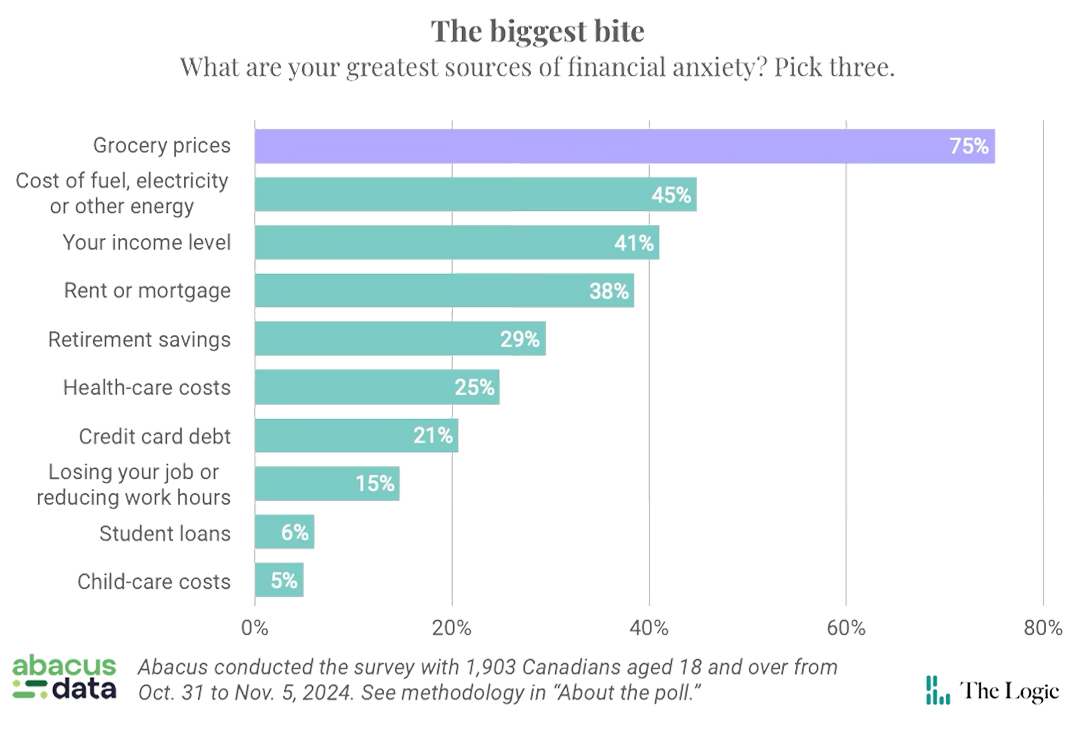
OTTAWA — The cost of food tops the list of Canadians’ anxieties about their finances, according to a new The Logic poll conducted by Abacus Data. It found grocery prices weigh on the minds of far more people than anything else does—nearly twice as many as rent or mortgage payments, and more still than health costs or student loans.
Skip to content

Exclusive
Food prices top Canadians’ financial anxieties
Costs nearly everybody has to pay are most worrying, Abacus poll for The Logic finds
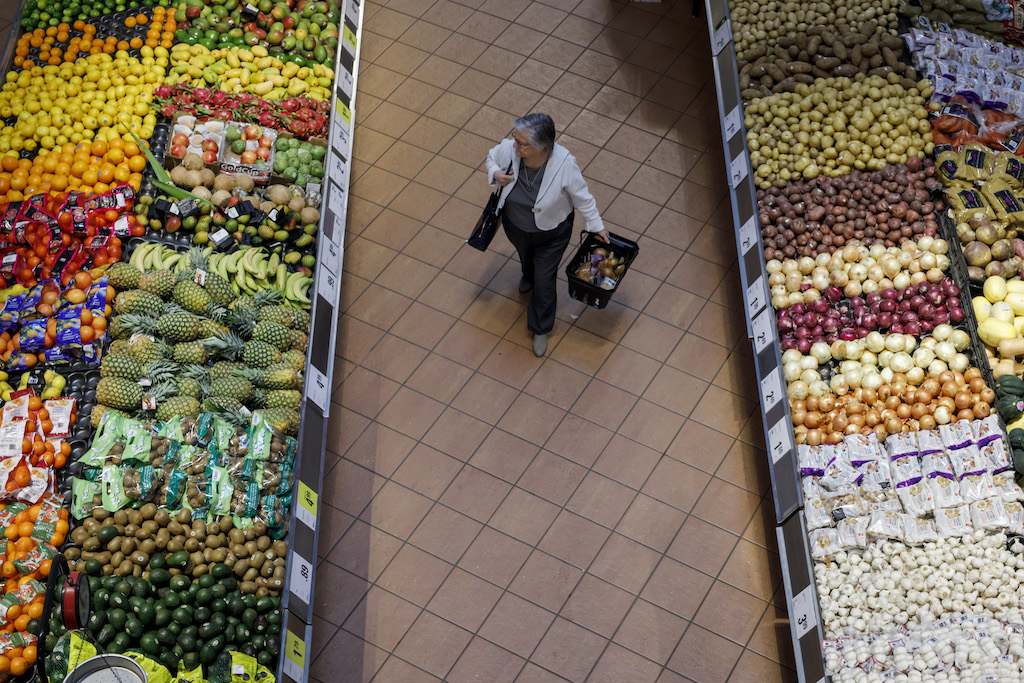
A shopper at a Loblaws store in Toronto, in April 2019. Photo: Getty Images/Cole Burston
OTTAWA — The cost of food tops the list of Canadians’ anxieties about their finances, according to a new The Logic poll conducted by Abacus Data. It found grocery prices weigh on the minds of far more people than anything else does—nearly twice as many as rent or mortgage payments, and more still than health costs or student loans.
Talking Points
- The prices of groceries, fuel and electricity are the most broadly felt sources of financial anxiety in Canada
- Expenses like child care and student loans are very worrying to people who have them, but those are tiny slices of the voting public—a worrying sign for the federal Liberals
The finding lands as politicians digest the news that Donald Trump will return to the White House in January, propelled back to the presidency by American voters’ dissatisfaction with the U.S. economy and their places in it.
Abacus asked respondents to identify three sources of their own economic anxiety. Three-quarters named grocery prices. Energy costs, a catch-all that included gas and electricity, were a major concern for 45 per cent of respondents, landing it in the second spot.
“Unlike other areas, these two are universal and impact everyone. Everyone needs to eat and almost everyone drives a vehicle requiring fuel,” Abacus CEO David Coletto told The Logic.
Overall, the poll suggests most Canadians are getting by, but a sizable minority are living close to the financial edge. Twenty-nine per cent told Abacus they can just meet their expenses—and 18 per cent are having trouble covering their bills.
Related Articles

Eighteen per cent of respondents said they’re living comfortably, while another 36 per cent say they can meet their expenses and have a little left over.
Another question asked respondents to rate the intensity of their specific anxieties. Those worried about paying for the roofs over their heads or about losing work said those fears were worse than the pressure of paying for food—but they aren’t nearly as widespread.
The federal Liberals have been working pointedly on grocery prices for more than a year. Industry Minister François-Philippe Champagne summoned industry executives for meetings in September 2023, and just before Thanksgiving he “set an expectation that all industry actors are responsible for bringing relief to Canadians.”
“Right now, I think finding policy tools that reach the most people is going to be most effective politically.”
Since then, the Competition Bureau has been digging into “property controls” in the grocery business—typically, conditions in leases that stop commercial landlords from letting other food stores open in the same complexes as existing tenants.
Loblaw and Sobeys’ owner Empire are the bureau’s named targets; both have recently said they’re OK with ending these property controls as long as it’s done universally. Champagne called that a win.
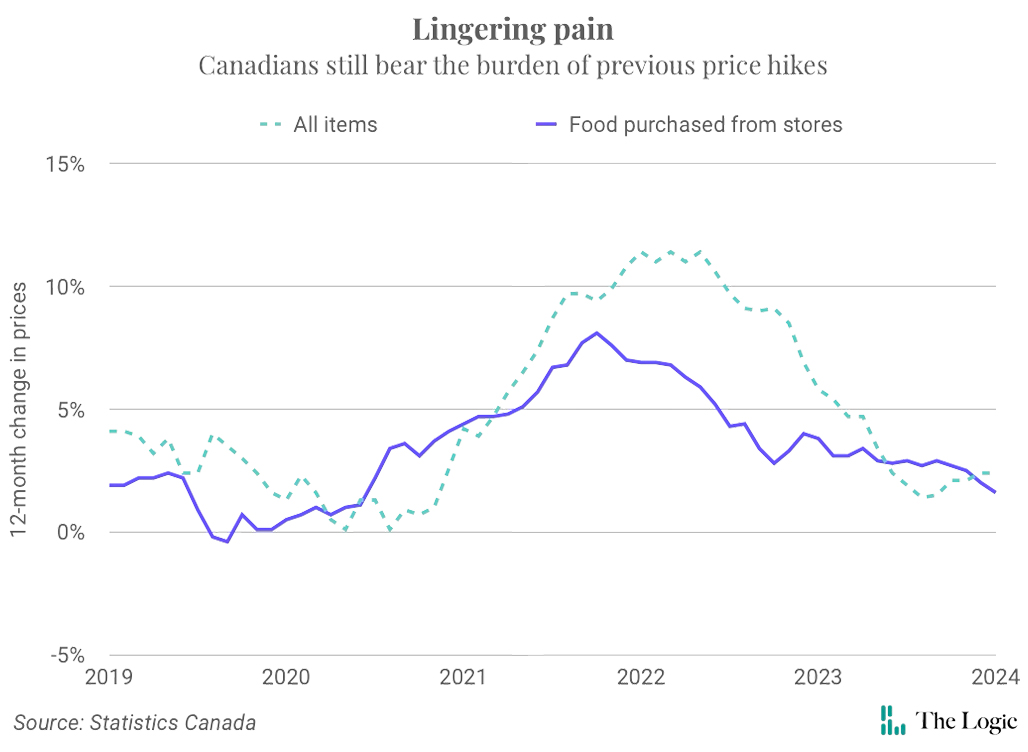
Meanwhile, though, Statistics Canada’s price index for store-bought food increased 2.4 per cent from September 2023 to September 2024. That’s a much slower increase than the 5.8 per cent in the year before—let alone the 11.4 per cent in the year before that. But bills at the checkout aren’t shrinking, and those previous price hikes are still weighing on Canadians’ finances.
Extreme weather is a factor—fires and floods kill crops and bottle up transportation by road, rail and ship—but opposition attacks have focused on things the Liberals could more readily control. The Conservatives blame the Liberals’ carbon-pricing policy. The New Democrats blame corporate greed and the Liberals’ refusal to impose price caps and a special tax on grocers’ profits.
“I think the Conservatives are winning the framing fight because it ties a policy choice to an outcome, rather than [making the issue about] the behaviour of corporations—which most Canadians assume seek to maximize profit,” Coletto wrote in an email explaining the findings.
About the poll
The Logic and Abacus Data have partnered to poll Canadians on key economic issues as the federal political parties prepare for the next election. The surveys will take stock of voters’ priorities and their views of the parties’ policies on matters ranging from affordability to making Canada more competitive. On questions of economic stewardship, we will track attitudes over time. We will also seek responses on other issues as they emerge in the public conversation. For today’s story, Abacus surveyed 1,903 Canadians aged 18 and over from Oct. 31 to Nov. 5, through an online panel. The margin of error for a comparable probability-based random sample of the same size would be 2.247 per cent, 19 times out of 20.
At The Logic’s summit in Toronto at the end of October, Loblaw chair Galen Weston argued that the grocery business is more competitive than people realize when they call for boycotts and protest-theft from Loblaw stores. Canadian chains like his, Sobeys and Metro fight for customers with international discount giants Walmart and Costco, he said.
“There are narratives about the industry that suggest we are so big and so powerful that we have major pricing power,” Weston said then. “And that’s absolutely not true.”
Other findings in the survey help explain the Liberals’ hard time getting political traction by pointing to their record.
Child-care costs, which Liberals have made a signature cause, were at the bottom of the list of worries—just five per cent of respondents said they’re worried about those (and still only 10 per cent of respondents under 30). Six per cent were worried about student loans (though that includes 22 per cent of respondents under 30).
“Right now, I think finding policy tools that reach the most people is going to be most effective politically,” Coletto told The Logic. “Targeted measures may make for better policy, but they don’t make for good politics.”
Two provincial governing parties—the Progressive Conservatives in Nova Scotia under Tim Houston and in Ontario under Doug Ford—seem not to be hurt much by inflation, Coletto pointed out. What do they have in common? They’ve put relatively small amounts of cash into a lot of pockets.
“Look to what Ford is doing in Ontario and what Houston is doing in Nova Scotia. Broad-based relief—rebate cheques, removal of licence-plate fees, removal of tolls and reducing of HST,” Coletto wrote.



Loading...
Thanks for sharing!
You have shared 5 articles this month and reached the maximum amount of shares available.
CloseThis account has reached its share limit.
If you would like to purchase a sharing license please contact The Logic support at [email protected].
CloseGift the full article!
You have gifted 0 article(s) this month and have 5 remaining.
Recipients will be able to read the full text of the article after submitting their email address. They will not have access to other articles or subscriber benefits.
Photo: Getty Images/Cole Burston
Most Popular This Week




In-depth, agenda-setting reporting
Great journalism delivered straight to your inbox.
The Big Read
Alberta’s referendum is just the start of the turmoil
Briefing
EverWind plans $10B data centre and wind development in Nova Scotia
Canada ready to force Stelco to sell its Canadian operations, Joly says
Feds plan a 60 MW defence-oriented data centre for Ottawa
Best business newsletter in Canada
Get up to speed in minutes with insights and analysis on the most important stories of the day, every weekday.
Exclusive events
See the bigger picture with reporters and industry experts in subscriber-exclusive events.
Membership in The Logic Council
Membership provides access to our popular Slack channel, participation in subscriber surveys and invitations to exclusive events with our journalists and special guests.






