The Interview
‘We have to engage’: Galen Weston on facing his critics, and changing Canada’s economic narrative
Government antagonism toward business stands in way of long-term prosperity, says Loblaw chair
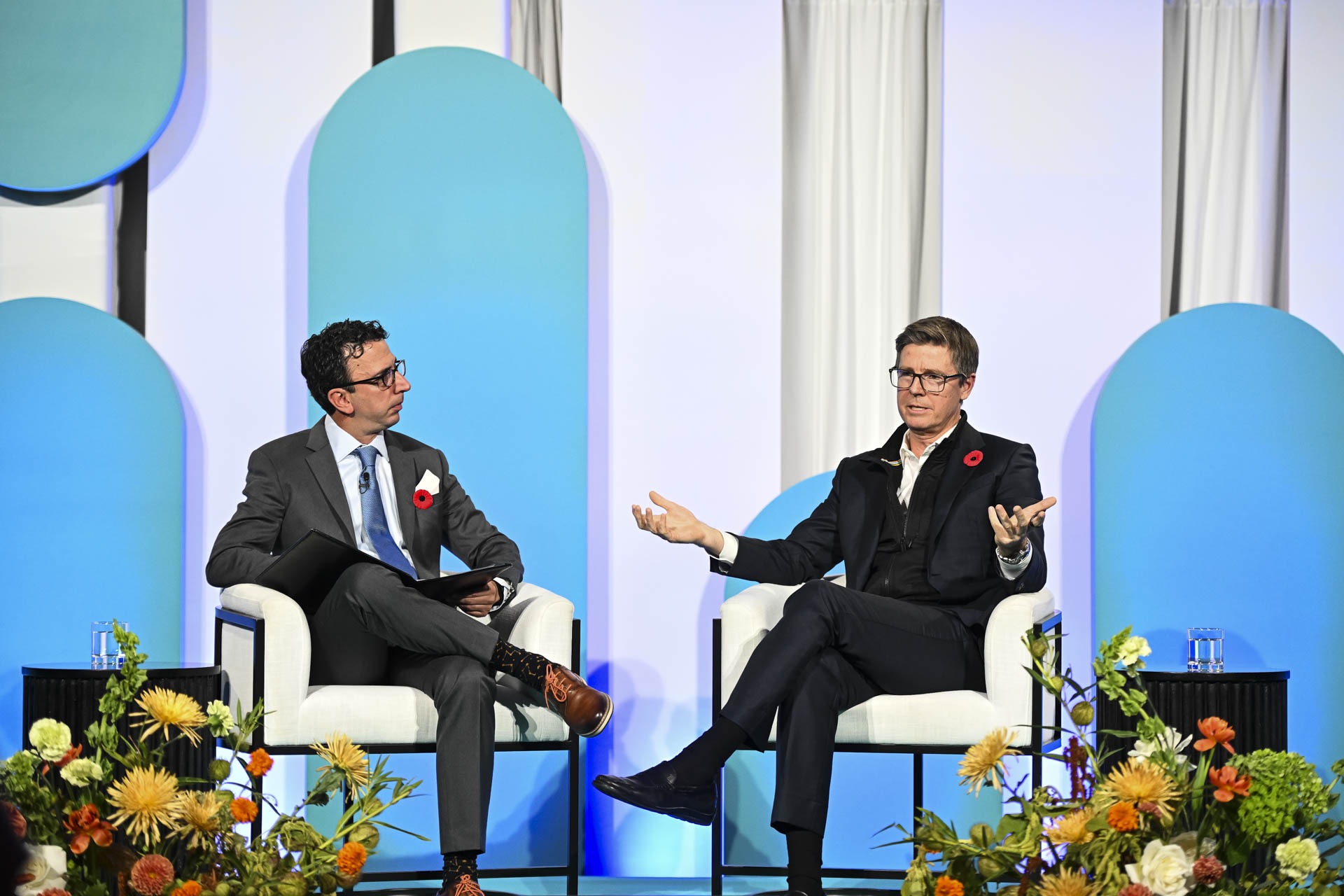
Loblaw chair Galen Weston, right, speaks to David Skok, editor-in-chief of The Logic, at The Logic Summit in Toronto, on Oct. 28, 2024. Photo: Christopher Katsarov Luna for The Logic

It’s been a tough few years for Loblaw chair Galen Weston. The head of the four-generation family dynasty behind Canada’s largest grocery retailer has fended off tough questions from politicians and personal attacks from online commenters over his perceived role in the post-pandemic food affordability crisis. After all that, he has thoughts to share on what he views as a related topic: Canada’s economic prosperity.
At The Logic Summit Monday, Weston sat down with David Skok, The Logic’s CEO and editor-in-chief, to discuss everything from productivity to health care. He also shared his thoughts on how to address the affordability crisis—and how to stop discussions about it from devolving into mudslinging.
Talking Points
- Loblaw chair Galen Weston has fended off tough questions from politicians and personal attacks from online commenters over his perceived role in the post-pandemic crisis in food affordability
- At The Logic Summit, Weston shared his thoughts on what he views as a related topic: Canada’s economic prosperity
This interview has been edited for clarity and length.
Thank you for doing this. I have to confess, when you said yes to the invitation, I was somewhat surprised. Why get up on stage and talk now?
I stepped back from my role as CEO of Loblaw just over a year ago and that’s created more time in my schedule. One of the things that’s always been very important to me is thinking about the prosperity of the country. As the country goes, our businesses go. We’re a multi-generational family business and we sell essentials. When you think in generations, the next quarter matters a whole lot less. There are some big challenges in the Canadian economy, in the Canadian social contract, and that’s something that occupies my mind. Somebody said to me once, “If you don’t engage in a conversation, you can’t complain about the result.”
What are the biggest misconceptions you would like to set the record straight about?
Related Articles

That’s a nice opportunity [laughs]. There have been lots of conversations about how the grocers are responsible for high food prices. And of course, that’s not true. Food prices grew 25 times faster than grocer profits over the last two-and-a-half years, which is a remarkable gap that in our view makes it mathematically impossible that we were the ones expanding profit margins and driving food prices up. There’s also a narrative that the reason food prices were so high over the last couple of years is because there’s not enough competition in the Canadian grocery space. Actually, Canada has the highest concentration of foreign ownership in the grocery industry of any country in the G7. This is Costco and Walmart, in particular. Those are the two biggest bricks-and-mortar retailers in the world, and both operate on a discount-based format. Yet there are narratives about the industry that suggest we are so big and so powerful that we have major pricing power. And that’s absolutely not true.
Do you feel like you are getting a fair shake in Ottawa?
[Pauses.] Not really. If I had a criticism of our industry’s engagement with Ottawa, it’s the difficulty of separating, “Let’s get in a room together and figure out what we can do to make this situation better,” versus the tendency to try to earn political points. It used to be that if you got called to committee in Ottawa, it was a pretty low-profile thing. You were there to contribute to the national conversation about an issue. What it’s devolved into in recent years is more of a score-points circus. That’s a great pity, because these committees are there to facilitate conversations about complex issues.
Do you think Canadians need to be more ambitious?
We could all do to be more ambitious. I probably have a slightly different perspective, because I see a lot of ambition in large Canadian enterprise. There is a substantial number of $25-, $30-, $40-, $50-billion Canadian companies run by not only really capable people, but also people who have a genuine interest in the prosperity of the country. The fact there are so many folks with that interest at the top of their to-do lists makes me very optimistic about what we can accomplish—if we can move away from this antagonistic relationship with government. The federal dialogue with industry over the last two prime ministers has not been constructive, as a general rule. There are good things that have happened, and great examples of collaboration, but not enough.
Affordability: It’s a real thing. There’s no doubt Canadians are feeling it. And unfortunately for you, they’re feeling it when they see that something is twice the price that it was a year ago. What do you do about that?
If you’re on a budget when you shop, you’re going to make a decision about what you are or are not going to buy for your kids, for yourself, for your family every single week. If you believe the industry is responsible for it, it can cause a great deal of angst and strain. The fact that we’re not responsible directly for this doesn’t matter. So we have to engage. The one thing I think is missing today is a real focus on medium and long-term prosperity for the country. We need to paint a picture of a positive future.
“The federal dialogue with industry over the last two prime ministers has not been constructive, as a general rule.”
And no offence to the entrepreneurs here, it’s not just about the next $200-billion company. I’m not sure that resonates with the population. It’s got to be other things. If you want people to feel bad about their country, have a health-care system where you can’t see a doctor, a health-care system where it takes 18 hours—as was the case with my mother a couple of months ago—waiting in an emergency room. These are the experiences that make up the common narrative about Canada every single day.
What are we not understanding about Canada and what it is actually capable of?
Canada’s a big country. The prospect of having eight or 10 grocers to compete at scale, with the vast logistics that need to be traversed and the intensity of store locations required to make them work, is a hard thing to fathom. We have to make sure we’re not chasing the wrong outcome. What we want is good, healthy competition that leads to lower prices for Canadians and also demands infrastructure investment, technology investment by these companies. That is happening in Canada. Perhaps not as much as some might like. But it is.



Loading...
Thanks for sharing!
You have shared 5 articles this month and reached the maximum amount of shares available.
CloseThis account has reached its share limit.
If you would like to purchase a sharing license please contact The Logic support at [email protected].
CloseGift the full article!
You have gifted 0 article(s) this month and have 5 remaining.
Recipients will be able to read the full text of the article after submitting their email address. They will not have access to other articles or subscriber benefits.