Exclusive
Tories have huge lead in economic trust—especially among young Canadians
An Abacus poll conducted for The Logic takes Canadians’ temperature on key economic issues as an election approaches
Photo: Illustration by Sumaiya Kamani; Photos from The Canadian Press
Canadians trust the Conservatives most to handle the economy, by large margins over the other federal political parties, according to a new The Logic poll conducted by Abacus Data—and their support on the issue is strongest among the youngest potential voters.
Talking Points
- Women and men of all ages, in all parts of the country, say they know the economic plans of Pierre Poilievre’s Conservative Party better than the Liberals’ or New Democrats’, which pollster David Coletto says is a fierce indictment of the governing party
- Opinion is more divided on the Liberals’ signature economic policy of subsidizing industries they believe are key to Canada’s future, but most respondents would prefer a government that tries to make the country more competitive for all businesses
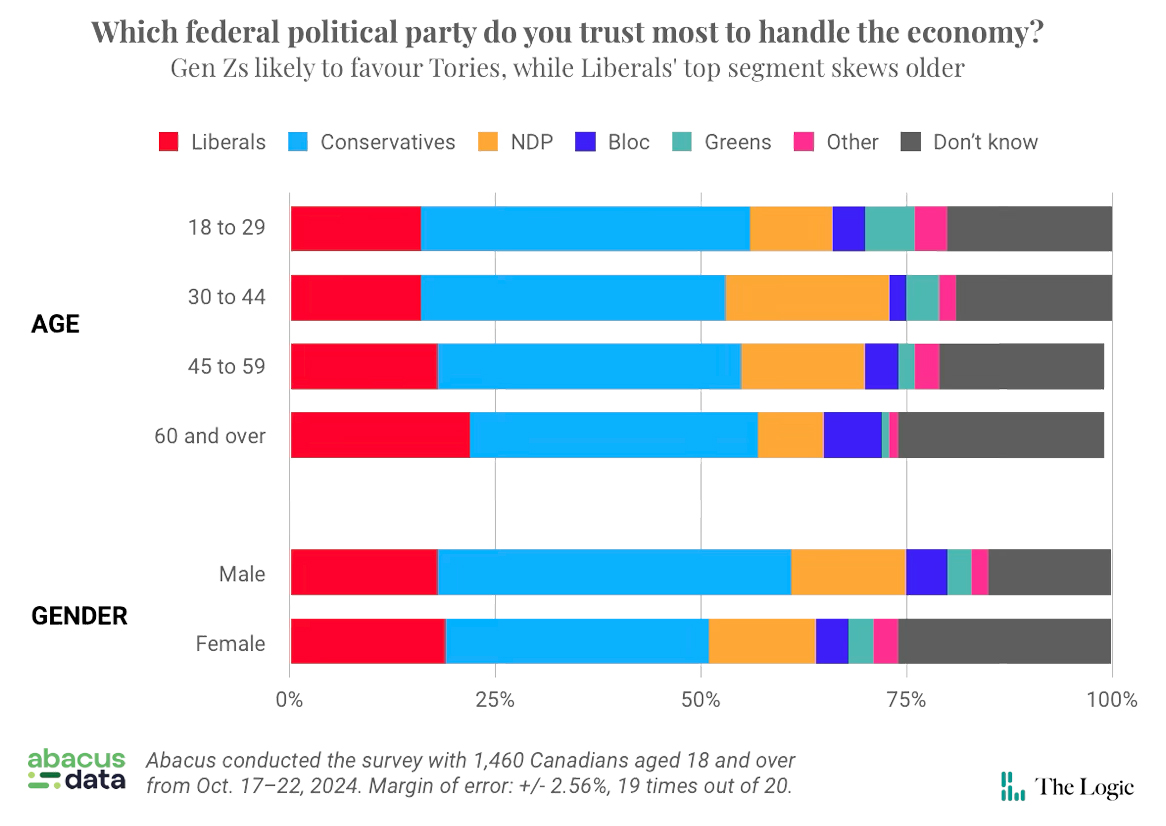
Thirty-seven per cent of respondents favoured the Tories on the economy, compared with 18 per cent who trusted the Liberals most and 13 per cent who trusted the New Democrats. Other parties were in the single digits.
Among respondents aged 18 to 29, 40 per cent trust the Tories’ economic chops most, giving them a 24-point lead over the Liberals in that group. The gap was narrowest among voters older than 60, but even in that segment the Conservatives were 13 percentage points ahead of the governing Liberals.
One asterisk: 21 per cent of respondents told Abacus they didn’t know which party they trusted most on the economy. But among those with opinions, the Tories ran the table, leading across all age, gender and geographic categories.
Pocketbook issues such as the cost of housing are at the top of people’s minds, said Abacus CEO David Coletto. When people feel prosperous and hopeful, economic issues might fade in importance; when people feel squeezed, that’s good for Tories, he said.

“There’s a bias to think that conservative parties are better on economic issues,” he said. “That may be actually true or not, but that’s the perception.”
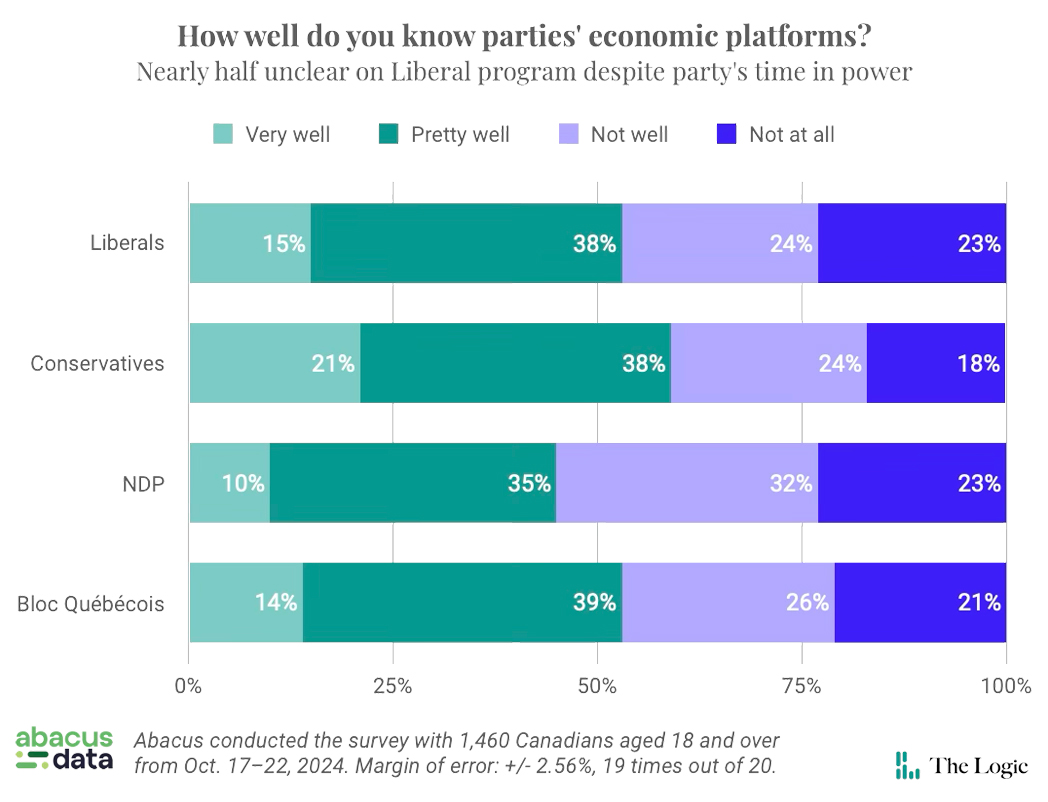
A lethal threat for the governing party, in his view, is that respondents collectively said they understood the opposition Conservatives’ plans for the economy better than the Liberals’—even though the Conservatives haven’t laid out a detailed plan.
“That, to me, is a really telling stat about how bad it is for the Liberals,” he said. “More people think they know what the Conservatives are going to do than they do the Liberals—who’ve been in power for nine years.”
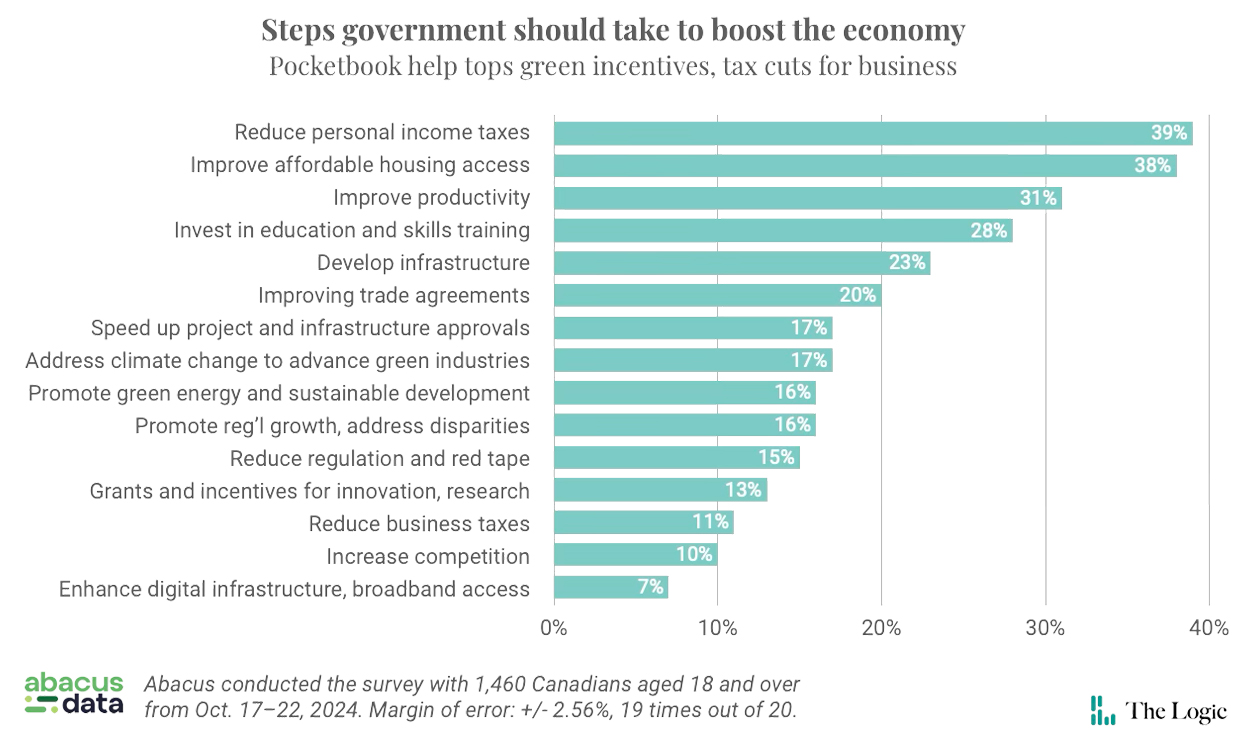
Asked to choose three economic policies they thought would be most helpful, more respondents chose personal income tax cuts than anything else—39 per cent. Also in the top five:
Related Articles

- More affordable housing for workers (38 per cent)
- Improved economic productivity (31 per cent)
- Investments in education and skills training (28 per cent)
- Developing infrastructure for economic growth (23 per cent)
Kent Fellows, an assistant professor of economics at the University of Calgary, said a government that tried to do all those things would end up running deeper deficits and likely make inflation worse again. What economists think the economy needs and what individuals think will help their own finances aren’t always compatible, he said, and that’s a challenge for politicians setting policy.
“I don’t blame people for answering that way, but I think that one in particular is probably one of those cases where you’ve got survey respondents thinking independently, rather than thinking about the economy as a whole,” he said.
Fellows said he was pleased to see productivity improvements rank so high, though.
“I think that’s square on. That’s a big one,” he said.
“The conversation around Canada’s poor productivity performance might be starting to break through.”
Coletto found it noteworthy, too: “The conversation around Canada’s poor productivity performance might be starting to break through.”
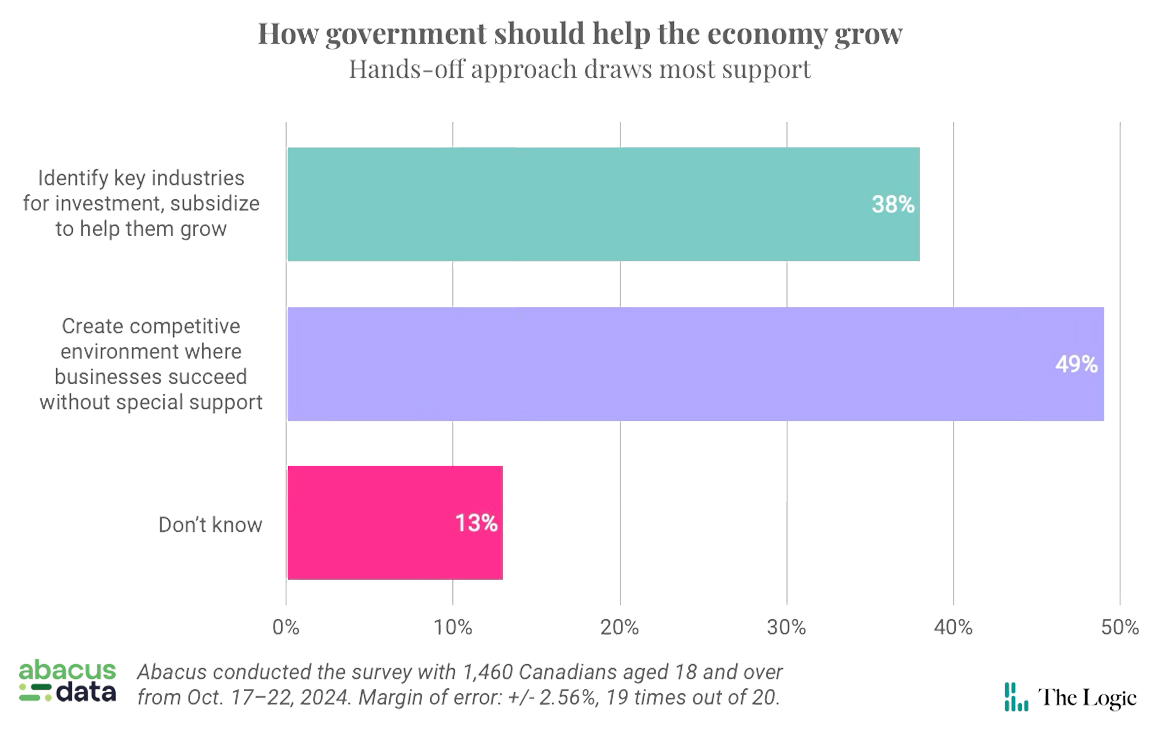
The Logic poll found weak support for the Liberals’ signature approach to economic development. Asked to choose between two broad approaches to economic growth, respondents preferred policies that would create a more competitive environment for businesses to succeed (49 per cent support), versus identifying key industries to support with investments and subsidies (38 per cent).
The Liberal government has invested heavily in corporate and industrial subsidies since it took office in 2015. The Strategic Innovation Fund has provided loans and grants (“transformative investments in all sectors of the economy to help Canada prosper in a global, knowledge-based economy”) since 2017, for instance, pumping $9.5 billion into 129 projects.
More recently, the Liberal government has backed massive factories in the supply chains for electric vehicles, with hundreds of millions of dollars for companies like Ford and Umicore.
About the poll
Today marks the first instalment in a partnership between The Logic and Abacus Data to poll Canadians on key economic issues as the federal political parties shift into election mode. The surveys will take stock of voters’ priorities and their views of the parties’ policies on matters ranging from affordability to making Canada more competitive. On questions of economic stewardship, we will track attitudes over time. We will also seek response on other issues as they emerge in the public conversation. For today’s story, Abacus surveyed 1,460 Canadians aged 18 and over from Oct. 17 to 22, through an online panel. The margin of error for a comparable probability-based random sample of the same size would be 2.56 per cent, 19 times out of 20.
Even those are trifles compared to production subsidies for banner projects like Volkswagen’s battery plant in St. Thomas, Ont. Federal payouts for just that factory could run up to $13 billion, depending how many units the company cranks out and on what schedule.
But that project shows why it can be hard to say what being “competitive” with other jurisdictions means: the Volkswagen subsidies reportedly matched what the German automaker could have gotten for putting its factory in the United States, thanks to green-economy measures in the Inflation Reduction Act.
Fellows, who’s been critical of the Liberals’ EV subsidies, said the U.S.’s recent policies put Canada in a tough spot.
This country can’t expect to go toe-to-toe with American subsidies and win over the long term, he said, and economic theory says even if the U.S. is throwing billions of dollars around, there will be something Canadians can do better and we can focus on that. Finding that thing and starting to do it, however, isn’t necessarily easy or quick.
Abacus’s detailed breakdown of preferences on the subsidy question reveals an oddity.
The youngest respondents, the ones under 30 who trust the Conservatives most on the economy, favoured government subsidies for key industries the most—by 48 per cent to the 37 per cent preferring a government that seeks generally good business conditions.
“Young people are voting Conservative primarily because they’re so upset about the state of their microeconomic situation,” said Coletto. “They’re just looking for change in any way out of the situation they’re in.”
Meanwhile, the oldest respondents—those over 60 who are least likely to trust the Conservatives—preferred less intervention. Only 27 per cent of them favoured subsidizing key industries, versus 61 per cent who preferred policies aimed at creating a broadly competitive environment.
Fellows speculated that older respondents’ skepticism of subsidies is driven by experience: “If you’re 60 and over, you’ve got more of that population that’s been in the trenches and has seen the consequences of government doing some of these subsidies and targeting specific industries that haven’t really worked out,” he said.



Loading...
Thanks for sharing!
You have shared 5 articles this month and reached the maximum amount of shares available.
CloseThis account has reached its share limit.
If you would like to purchase a sharing license please contact The Logic support at [email protected].
CloseGift the full article!
You have gifted 0 article(s) this month and have 5 remaining.
Recipients will be able to read the full text of the article after submitting their email address. They will not have access to other articles or subscriber benefits.