Skip to content

Canada's Business and Tech Newsroom

  • Professional Subscription
  • Partnerships & Advertising
  • Licensing & Syndication
Log In Subscribe
Welcome,
  • My Account
  • Log Out
  • Business
  • Tech
  • National
  • The Big Read
  • Briefings
  • Commentary
Search
Log In Subscribe
Welcome,
  • My Account
  • Log Out
News

Canada’s EV rebate hits a sweet spot in the auto market, says new report

Listen Now
0:00
News

Canada’s EV rebate hits a sweet spot in the auto market, says new report

By restricting eligibility to vehicles under $50,000, the incentive targets the part of the market where going electric costs the most, says Clean Energy Canada

By Joanna Smith
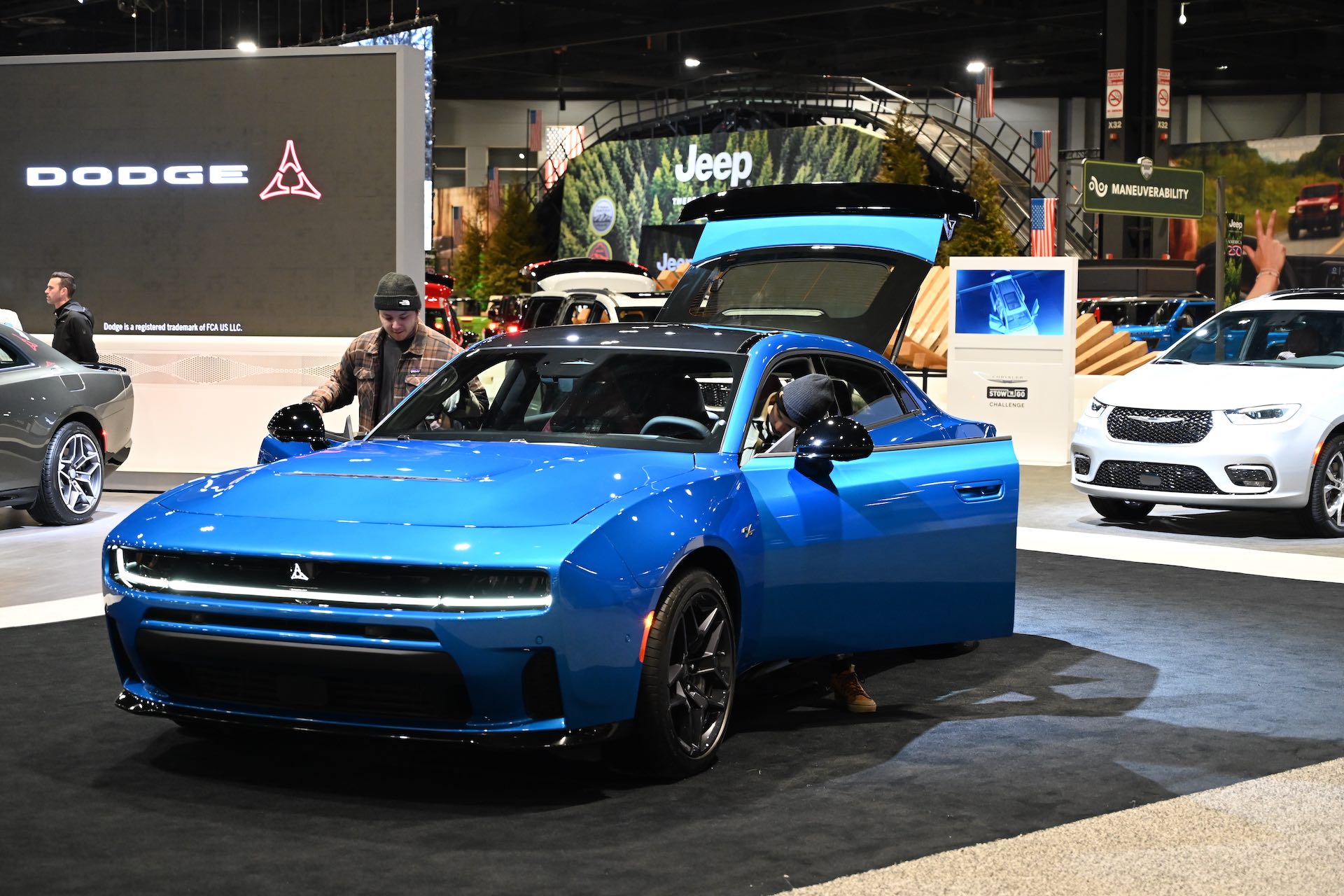
A shot of a blue Dodge Charger on the floor of an auto show, with its doors and trunk open and attendees checking out the interior.
The all-electric Dodge Charger, seen here at the Chicago Auto Show in February, is exempt from the price cap for federal EV rebates because it’s manufactured in Canada. Photo: Anadolu via Getty Images/Jacek Boczarski
Apr 7, 2026
A A
A Small A Medium A Large
Share

Gift

Share

Listen Now
0:00

OTTAWA — An analysis of electric vehicles eligible for the new federal rebate suggests the $50,000 price cap targets models that sell for substantially more than their gas-powered counterparts—where the subsidy is more likely to influence consumer choices.

“While some may have wished the new $5,000 federal incentive included more eligible EVs, our analysis finds the program has a logic as designed,” says Clean Energy Canada in a forthcoming report that examines the potential efficacy of the rebate. The energy think tank based at Simon Fraser University gave The Logic an early look at the findings, which are part of a larger report on household savings linked to electrification and energy efficiency.

Talking Points

  • An analysis by Clean Energy Canada suggests the $50,000 cap for the federal EV rebate closes the largest price gaps between electric and gas-powered vehicles
  • Estimates from Transport Canada data show Canadian-made EVs accounted for five per cent of eligible sales last year

On Feb. 5, the federal government announced a new consumer rebate program for EVs and plug-in hybrids as part of a national auto strategy that also put an end to the federal sales mandate. The revamped program limits eligibility to new vehicles with a final transaction value no higher than $50,000, including optional features and dealership fees. 

While Electric Mobility Canada welcomed the return of the rebate, it lamented the cap as “too restrictive,” saying it “risks excluding many vehicles Canadians need, particularly for families, rural residents, and tradespeople who need larger vehicles.” The previous iZEV program was available to cars with a base model price under $55,000, or $60,000 for SUVs, pickup trucks and minivans, but the final transaction value could be higher.

Related Articles

Mark Carney stands at a lectern on the floor of an auto parts plant, with workers and others gathered behind him.

Carney kills EV sales mandate and sets aside $3B for carmakers in bid to save auto sector

By Joanna Smith and Laura Osman
An aerial shot of a lot full of Tesla cars. The company's logo is painted in yellow on the asphalt.

Feds knew EV fund was running out weeks before Tesla took its last big bite

By Anita Balakrishnan

There is no price cap for any eligible vehicles manufactured in Canada, but there are only two of them: the Chrysler Pacifica, a plug-in hybrid that Stellantis is phasing out, and the all-electric Dodge Charger. Both are assembled at the Stellantis plant in Windsor, Ont. (The Chrysler parent company postponed production of the 2026 Charger EV last year due to U.S. tariffs.)

The $2.3 billion the federal government earmarked for the five-year incentive, now called the Electric Vehicle Affordability Program, will cover up to $5,000 off battery-electric and fuel cell electric vehicles or up to $2,500 off plug-in hybrid vehicles. The amounts will drop each year until the incentive ends in 2031.

Citing examples, Clean Energy Canada’s report says the conditions on the rebate mean it helps consumers when they need it most. The electric BMW i4, for one, has too high a price tag for the incentive, yet costs only about $2,500 more than its gas-powered equivalent. “As a result, the electric version breaks even on costs in about a year even without any rebate—and saves money every year after,” says the report to be published Thursday. 

“More affordable EVs like the Kia EV4, Hyundai Kona and Chevrolet Equinox have pre-rebate prices that are $12,000 to $15,000 higher than their gas counterparts,” it continues. “Incentives help close price gaps where they’re largest—improving EV access for middle-class cars in a fair and targeted way.”

That argument is weaker when it comes to plug-in hybrids. “Unlike gas cars and conventional hybrids,” the report says, “plug-in hybrids are not necessarily cheaper than their all-electric counterparts upfront, and they cost more to drive and maintain.”

Meanwhile, the Conservatives are highlighting how much of the federal money is flowing outside Canada.

Last month, Transport Canada provided internal estimates to the House of Commons that suggest Canadian-made EVs would account for five per cent of those eligible for the subsidy. There were 682 Chrysler Pacificas and 678 Dodge Charger EVs sold in 2025, the data shows, compared to 25,951 foreign-made EVs or plug-in hybrids below $50,000. Thirty-six per cent of the latter were from Japan, 28 per cent from the U.S. and 26 per cent from South Korea. Canadian vehicles made up a similar share of EV and plug-in hybrid sales in the two previous years.

“The vast majority of these subsidies are going to go to foreign countries, including the United States, whose president has declared war on our auto industry. I don’t know how you justify that,” Conservative MP Kyle Seeback, who sought the numbers in an order paper question, told Industry Minister Mélanie Joly Feb. 9 when she appeared before the House of Commons industry committee. Seeback was not available for an interview, but wrote in a social media post: “Your money [is] funding foreign cars.”

Trevor Melanson, communications director at Clean Energy Canada, said exempting Canadian-made EVs from the cap is another kind of incentive. “It’s primarily a consumer policy,” he said, but noted that it is also designed to encourage automakers to produce cars in Canada. “That aspect of it is actually an industrial strategy.”

The rebate is restricted to imports from countries with which Canada has a free trade agreement. The 49,000 Chinese-made EVs per year that Canada is exempting from 100 per cent tariffs do not make the cut. To address affordability, Ottawa is reserving a portion of its Chinese EV quota for vehicles priced below $35,000. It estimates that share will exceed 50 per cent by 2030.

There is another way Chinese EVs could become eligible for the rebate. The Liberal government hopes the deal that Prime Minister Mark Carney struck in Beijing will drive Chinese carmakers to form joint ventures that set up production in Canada. Bloomberg reported last week that Stellantis is in talks with its Chinese partner Leapmotor about making EVs at its idled plant in Brampton, Ont., although Joly joined Ontario Premier Doug Ford and Unifor in rejecting the idea of a “knock-down kit” factory, saying any plans by Stellantis must support the local supply chain.

Gift the full article

The federal government said the $2.3 billion set aside for the incentive is enough to cover about 840,000 vehicles by 2031, an average of 168,000 per year. Judging by current sales, that’s a lofty target. In 2025, only 27,321 models eligible for the rebate program were sold in Canada.

That was the same year Ottawa paused its iZEV program. Joly later told The Logic that Ottawa was committed to its return. Would-be EV buyers were in wait-and-see mode, Melanson said, reluctant to purchase a new vehicle that might have qualified for a rebate if they had waited a few months. That makes it hard to extrapolate much from last year’s data, he said. “Everybody was just waiting on the sidelines.”


#Clean Energy Canada #climate #economy #electric vehicles #EV rebates #National

Loading...

Thanks for sharing!

You have shared 5 articles this month and reached the maximum amount of shares available.

Close
This account has reached its share limit.

If you would like to purchase a sharing license please contact The Logic support at [email protected].

Close
Want to share this article?

Upgrade to all-access now

Close
Gift the full article!

You have gifted 0 article(s) this month and have 5 remaining.

Copy link and gift
Copy Link
Email to a friend
Send Email
Gift on Social Media

Recipients will be able to read the full text of the article after submitting their email address. They will not have access to other articles or subscriber benefits.

A shot of a blue Dodge Charger on the floor of an auto show, with its doors and trunk open and attendees checking out the interior.

Photo: Anadolu via Getty Images/Jacek Boczarski

Most Popular This Week

News

Bay Street backs Canada’s AI strategy, but warns the devil is in the details

By Anita Balakrishnan and Chaimae Chouiekh
A diptych showing Mark Carney on the left, and CIBC CEO Harry Culham on the right.
News

Diversifying trade requires banks to take bigger risks, official advised Carney before CIBC meeting

By Joanna Smith
The image shows the inside of Toronto Stadium on a sunny day. The rows of seats are empty; an empty green field is visible.
News

Toronto and Vancouver aren’t getting a World Cup bookings boom

By Chaimae Chouiekh
A yellow ambulance is pictured outside of a hospital in Montreal. A red sign in the foreground reads, “Urgence / Emergency.”
Commentary: Quebec Ink

Quebec just found out what not having digital sovereignty really means

By Martin Patriquin

In-depth, agenda-setting reporting

Great journalism delivered straight to your inbox.

Evan Solomon in a suit and tie, gesturing with his left hand as he speaks, Several people sit and stand behind him looking in other directions. There's an orange curtain behind him lit from above.
News

Canadians could demand firms delete their personal data under new privacy bill

By Laura Osman

Briefing

IPOs need to be easier for startups if Canada wants 1,000 Shopifys, Champagne says

By Anita Balakrishnan   |   Jun 15, 2026 | 3:05 PM ET

Nuvei to acquire cross-border payments company Payoneer for US$2.75B

By Claire Brownell   |   Jun 15, 2026 | 3:01 PM ET

Joly to visit carmakers on 10-day trip to China and Japan

By David Reevely   |   Jun 15, 2026 | 2:59 PM ET

Best business newsletter in Canada

Get up to speed in minutes with insights and analysis on the most important stories of the day, every weekday.

Exclusive events

See the bigger picture with reporters and industry experts in subscriber-exclusive events.

Membership in The Logic Council

Membership provides access to our popular Slack channel, participation in subscriber surveys and invitations to exclusive events with our journalists and special guests.

Recent Popular Stories

Commentary: Quebec Ink

Quebec just found out what not having digital sovereignty really means

By Martin Patriquin   |   Jun 8, 2026
A yellow ambulance is pictured outside of a hospital in Montreal. A red sign in the foreground reads, “Urgence / Emergency.”
News

OMERS investment chief departs for Singapore’s Temasek

By Chaimae Chouiekh   |   Jun 10, 2026
News

Diversifying trade requires banks to take bigger risks, official advised Carney before CIBC meeting

By Joanna Smith   |   Jun 9, 2026
A diptych showing Mark Carney on the left, and CIBC CEO Harry Culham on the right.
News

Canada’s surprise plan to buy Saab command jets leaves competitors seeking answers

By David Reevely   |   May 29, 2026
A closeup of a scale model of a jet covered in pixellated camouflage, with sensor equipment attached to the top of its fuselage. There are civilians and uniformed military personnel milling in the background.
The Big Read

We found every data centre in Canada

By Murad Hemmadi, David Reevely, Aleksandra Sagan, Chaimae Chouiekh, Martin Patriquin and Catherine McIntyre   |   Apr 8, 2026
Four vertical slices of aerial view photos. From left, a building in downtown Toronto housing several data centres, a picture of the Albertan wilderness where the proposed Wonder Valley data centre would go, a lit-up QScale data centre in Quebec, and a data centre at a Hydro-Quebec dam.
News

Toronto and Vancouver aren’t getting a World Cup bookings boom

By Chaimae Chouiekh   |   Jun 8, 2026
The image shows the inside of Toronto Stadium on a sunny day. The rows of seats are empty; an empty green field is visible.

Canada's most influential executives and policymakers are reading The Logic

  • CPP Investments
  • Sun Life Financial
  • C100
  • Amazon
  • Telus
  • Mastercard
  • bdc
  • Shopify
  • Rogers
  • RBC
  • General Motors
  • MaRS
  • Government of Canada
  • Uber
  • Loblaw Companies Limited
logic-logo

Canada's Business and Tech Newsroom

100% human-crafted journalism

Newsroom

  • News Tips
  • AI Policy
  • Editorial Disclosures
  • Story Pitches

Company

  • About Us
  • Terms of Service
  • Privacy Statement
  • Corporate Information

Contact

  • Contact Us
  • Advertise
  • FAQs
  • Work at The Logic

© 2026 The Logic Inc. All Rights Reserved.

Trusted by leaders

Error

Account creation failed.

Please email us at [email protected].

Create Account

[wppb-register form_name=”cozmo-registration-form-for-modal”]

I do have an account
Login
or

[wppb-login]

I don’t have an account