Skip to content

News
Carney kills EV sales mandate and sets aside $3B for carmakers in bid to save auto sector
The government says it still believes in electric vehicles, unveiling a new auto strategy that restores EV rebates and promises tougher tailpipe emission rules
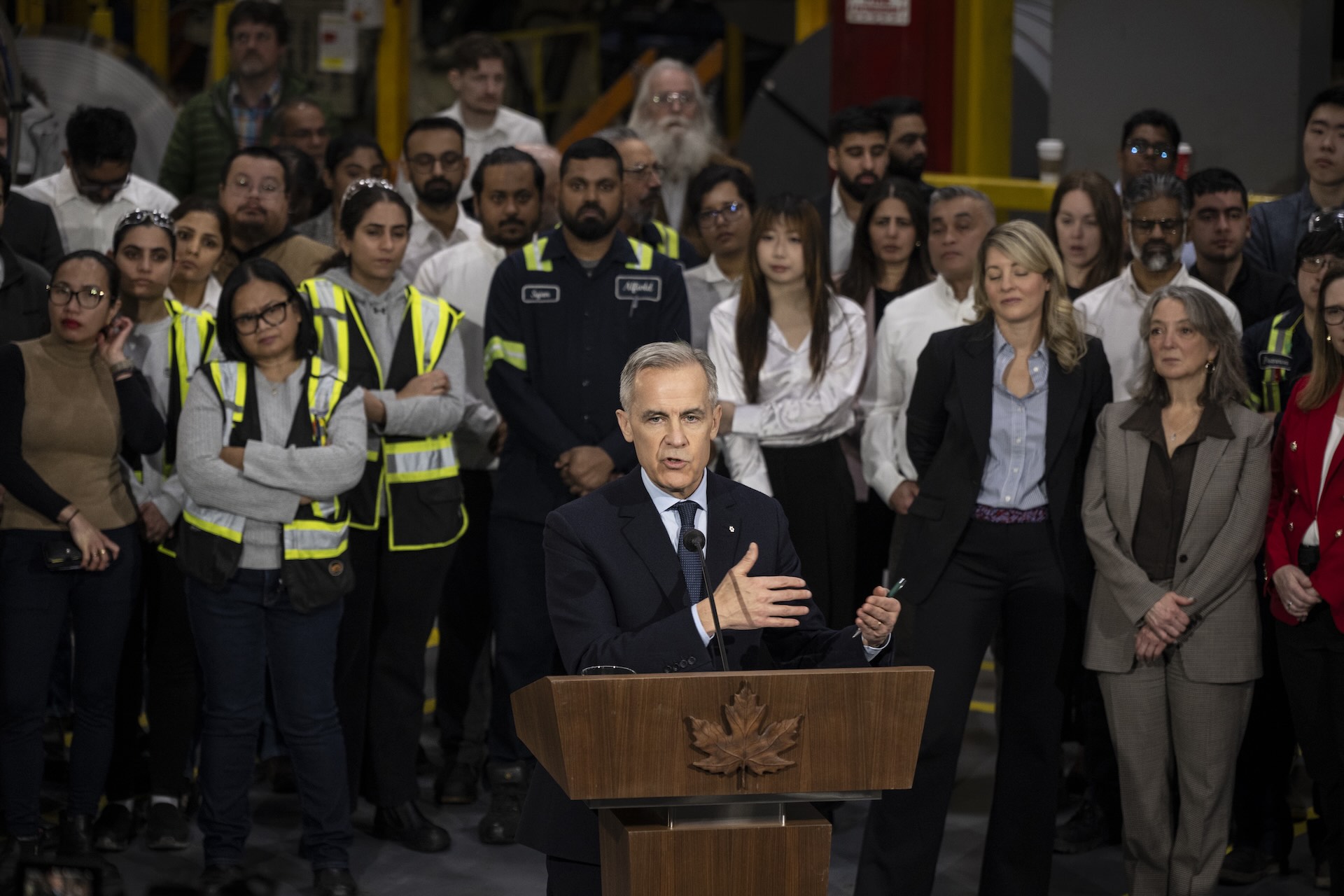
Prime Minister Mark Carney unveiled a new strategy for Canada’s auto industry on Thursday at a parts plant in Vaughan, Ont. Photo: The Canadian Press/Eduardo Limae
OTTAWA — Prime Minister Mark Carney announced a national strategy to boost the struggling automotive industry on Thursday, including by ending the federal sales mandate for electric vehicles and giving global automakers more incentives to invest, or remain, in Canada.
Death of a sales mandate: After keeping the auto industry—and everyone else—in the dark for months about the future of the federal EV sales mandate, Carney announced Thursday that his government will repeal it.
Instead, it will set new greenhouse gas emissions standards intended to drive a 75 per cent EV adoption rate by 2035—lower than the previous target of 100 per cent—while giving automakers flexibility in how they meet these standards. In other words, if the industry can reduce emissions in the transportation sector through greater fuel efficiency and innovations besides EVs, then so be it. The government said it is also setting an “aspirational goal” of 90 per cent EV adoption by 2040.
Related Articles


Global Automakers of Canada had encouraged such a technology-neutral approach. “I mean, they both are trying to theoretically achieve the same goal of greenhouse gas emissions reduction,” president David Adams said in an interview with The Logic last November.
Question marks on climate targets: In a technical briefing for media, senior government officials said Thursday they have not yet set the emission standard for 2027, or done modelling to see the effect this change would have on Canada’s overall emissions reduction effort. (The officials provided the briefing on the condition they not be named.) While the 2035 target was framed as “more than doubling the stringency” of emissions-reduction targets, they have not yet figured out the annual targets along the way.
Return of the rebate: Even as it gets rid of the stick, the federal government is bringing back the carrot.
To help boost the sluggish demand for EVs, it is launching a new rebate program for consumers for vehicles with a final transaction value no higher than $50,000. That cap would not apply to any Canadian-made EVs, which officials noted would right now include the Dodge Charger and the Chrysler Pacifica, both made at the Stellantis assembly plant in Windsor, Ont. The rebate would apply to both battery-electric vehicles (up to $5,000 this year) and plug-in hybrids (up to $2,500 this year), with the amount decreasing until it ends in 2030.
A senior official told the media briefing they foresee the incentive applying to 840,000 EVs over the next five years with $2.3 billion in funding. But it could run out early, as the last one did, they added.
The rebate is available only on cars produced in Canada—or countries with which Canada has free trade agreements, which includes the U.S. and Mexico (through the USMCA), Europe, Japan and Korea. It does not include vehicles made in China, such as any Teslas built in Shanghai. It would also exclude Chinese-made EVs to be sold in Canada through the deal Carney announced last month after meeting President Xi Jinping in Beijing.
Conservative industry critic Raquel Dancho called the rebate an “insult” that will mainly benefit American EV makers, including those that relocated to the U.S. from Canada in response to American tariffs.
EV charging infrastructure: It’s another kind of carrot, as consumers with range anxiety need to know their cars will get them where they are going. The auto strategy commits $1.5 billion through the Canada Infrastructure Bank to help the private sector add charging infrastructure across the country quickly, including by helping make buildings EV-ready.
A practical approach: The shift signals a more pragmatic approach to reducing emissions, and one that’s in “lockstep” with the industry, said Charles Bernard, chief economist at Canadian Automobile Dealers Association. Essentially, the rebate alleviates some financial pressure on consumers considering EVs, rather than putting the onus on automakers, he said. Brian Kingston, president of the Canadian Vehicle Manufacturers’ Association, said that Ottawa’s decision to repeal the EV sales mandate in particular will give the industry some “welcome policy stability.”
The plan offers some direction on issues the industry has sought clarity on for a long time, said Adams in a statement Thursday. The details, though, which have yet to be decided, will ultimately determine the strategy’s impact on the industry, said Adams, whose organization represents Toyota and Honda, among other vehicle makers.
Environmental groups, however, are less impressed. The David Suzuki Foundation called the decision to scrap the EV mandate a major step backward for clean transportation. “Incentives work best when they’re backed by clear, enforceable regulations,” the foundation’s senior climate manager Thomas Green said in a statement.
Unifor, the union representing the majority of auto workers in Canada, also expressed support for the plan, but said in a statement it remains concerned about the government’s recent EV deal with China. Workers want to see safeguards against a surge in Chinese-made electric vehicle imports, the statement said.
From innovation to industrial relief: With the launch of the auto strategy, the government has completed the transformation of the Strategic Innovation Fund into a program designed to give tariff-hit industries a lift.
The fund had traditionally focused on boosting large private-sector investments in research and development, and building industrial capabilities in Canada’s innovation ecosystem. In September, Carney announced that, while it will still support innovation-focused projects, a large portion of money from the rebranded Strategic Response Fund would support companies in the steel and aluminum, automotive and forestry industries—as well as any other sectors that might find themselves in the crosshairs of U.S. President Donald Trump’s tariff agenda.
As of Thursday, the auto sector looked to be the big winner. Under the strategy, $3 billion of the $5 billion set aside for the fund over six years will be dedicated to support investments in vehicle manufacturing. Carney said the money will help automakers respond to trade disruptions, retool their plants and invest in advanced manufacturing. Officials said there will be a “heavy focus” on electric vehicles and “connected-vehicle” technologies.
Notably, the three projects announced since Carney rebranded the program have all been traditional innovation investments, including in IBM semiconductor manufacturing, a Nokia research and development campus in Ottawa and a Hitachi Energy transformer test lab.
Retaliatory tariffs and remissions: Last April, the federal government slapped countervailing levies on U.S. autos after Trump imposed 25 per cent national security tariffs on all foreign autos, with only a partial carve-out for vehicles that move through the United States-Mexico-Canada Agreement (USMCA). Carney said Thursday those counter-tariffs—25 per cent on non-USMCA vehicles and 25 per cent tariffs on the non-Mexican or non-Canadian content of USMCA-compliant vehicles—would remain as long as Trump keeps his tariffs in place. What is changing is the relief that Ottawa will grant from those counter-tariffs to encourage auto production and investment in Canada.
Under the current remissions framework, automakers producing vehicles in Canada could import some vehicles free of counter-tariffs if they keep their operations going and stick with planned investments in this country. That did not stop Stellantis from shifting its planned production of the Jeep Compass from its plant in Brampton, Ont., to Illinois as part of a pledge to invest US$13 billion in U.S. manufacturing.
On Thursday, the Liberal government said it is launching consultations on a new remissions framework that would include a tradeable import credit system. If a company sets up production or invests in Canada, it would earn credits. Firms with a surplus of those credits could sell them to other companies that want to import vehicles into Canada but avoid the counter-tariffs on U.S. autos. “Companies that sell vehicles in Canada are strongly incentivized to produce in Canada,” Carney said.
Editor’s note: This story was updated to include comment and industry reaction.



Loading...
Thanks for sharing!
You have shared 5 articles this month and reached the maximum amount of shares available.
CloseThis account has reached its share limit.
If you would like to purchase a sharing license please contact The Logic support at [email protected].
CloseGift the full article!
You have gifted 0 article(s) this month and have 5 remaining.
Recipients will be able to read the full text of the article after submitting their email address. They will not have access to other articles or subscriber benefits.
Photo: The Canadian Press/Eduardo Limae
Most Popular This Week




In-depth, agenda-setting reporting
Great journalism delivered straight to your inbox.
Commentary
Carmichael: Canadian ignorance about India is a strategic weakness
Briefing
Aritzia shares pop after earnings rise 204%
First Nation in Alberta goes to court over fast-tracked oil pipeline
Chinese EV maker Geely Auto Group to launch in Canadian market in 2027
Best business newsletter in Canada
Get up to speed in minutes with insights and analysis on the most important stories of the day, every weekday.
Exclusive events
See the bigger picture with reporters and industry experts in subscriber-exclusive events.
Membership in The Logic Council
Membership provides access to our popular Slack channel, participation in subscriber surveys and invitations to exclusive events with our journalists and special guests.





