A months-old venture led by two founders of the travel app Hopper has entered its first partnership to build a facility to capture carbon dioxide from ocean water, a major step toward its goal of building “the world’s first gigaton-scale” carbon-removal company.
Skip to content

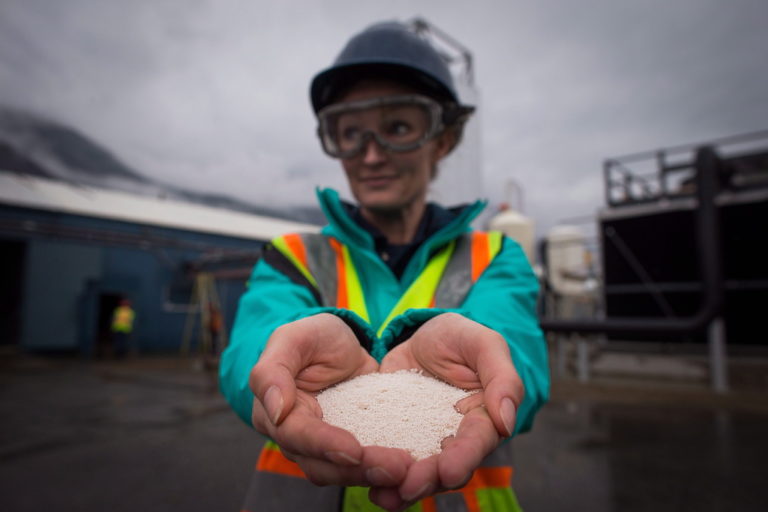
 Captura’s future commercial facilities will be able to capture up to one million tons annually, according to the company. Photo: Deep Sky/Handout
News
Deep Sky to build direct-ocean carbon capture project in Quebec
Montreal firm led by two of Hopper’s founders has entered deal for pilot project with California-based Captura
Captura’s first pilot in Newport Beach, Calif. Deep Sky and Captura plan to build multiple direct-ocean capture facilities in Canada, starting with a pilot in eastern Quebec. Photo: Captura/Handout
A months-old venture led by two founders of the travel app Hopper has entered its first partnership to build a facility to capture carbon dioxide from ocean water, a major step toward its goal of building “the world’s first gigaton-scale” carbon-removal company.
The system, to be built by Montreal-based Deep Sky, will use an experimental process developed at a California university that separates CO2 from seawater before returning it to the ocean, where it can then absorb more carbon dioxide from the atmosphere. The facility will be Captura’s first in Canada, though the technology has been tested on a smaller scale in the United States.
Talking Points
- Hopper co-founder Fred Lalonde and his partners started Deep Sky in September to build direct-air and -ocean capture facilities in Canada at a mass scale
- The startup has signed a partnership with California-based Captura to build a pilot facility in eastern Quebec to demonstrate how to remove carbon dioxide from ocean water
- Deep Sky has raised $10 million to help fund the facility, expected to begin operating next year
Fred Lalonde, co-founder and CEO of Montreal-based Hopper, started Deep Sky along with two others in September after concluding that Hopper’s reforestation program, meant to offset the emissions from its customers’ flights and other travel activities, was doing too little to combat climate change.
He took an interest in direct carbon capture, the process of removing CO2 from the air or oceans, then either storing it underground or repurposing it into other products such as fuel. “We’re going to have to remove billions of tons,” he said. “It is obviously the biggest mistake we’ve made as a civilization.”
Deep Sky will work with companies that have developed methods of direct removal, licensing their technology and selling carbon credits. It will build the necessary infrastructure in Canada, which Lalonde said is “uniquely suited” for the process due to geological features that provide space to store carbon dioxide underground, and abundance of renewable energy to power the industry.
Deep Sky’s first project will be the direct-ocean capture facility in eastern Quebec developed in partnership with California-based Captura. Deep Sky is still evaluating potential locations based on geology, ocean proximity and other factors, but expects to have the plant operating next year.
Related Articles

Founded in 2021 out of the California Institute of Technology, Captura created a process to remove carbon dioxide out of the ocean. Oceans are “an extremely efficient carbon-removal device,” said CEO Steve Oldham, noting they suck up about 30 per cent of the world’s emissions. Oldham, a Canadian, previously led Carbon Engineering, a Squamish, B.C.-based direct-air capture firm.
“The ocean and the air basically exist in equilibrium with respect to CO2 content,” he said, citing the rule known as Henry’s law: if carbon dioxide is removed from the ocean, the ocean responds by filling that void with more CO2.
Captura’s facilities in their current form operate either inside a lab or on a dock. One will soon be located on a barge on the water. The company’s leaders envision commercial plants built onshore, alongside existing desalination and thermal power plants; or offshore, adjacent to oil and gas platforms.
The systems pull a continuous stream of ocean water from a shallow layer above the 100-metre level, using a filter to avoid bringing in fish and other flora and fauna. A small percentage of the water is removed from the stream, further cleansed into pure brine, then put through electrodialysis, in which the brine’s molecules are reformed into an acid and alkaline base.
The acid is returned to the plant’s ocean-water flow, which causes the CO2 to bubble out. The alkaline base is then added back to the leftover ocean water to neutralize it, which then flows back into the ocean. “And, as a result, Henry’s law says, ‘Oh, I have to absorb CO2 from the atmosphere,’” said Oldham.
The company has been running a small pilot in Newport Beach, Calif., since August that can pull up to a ton of CO2 from the ocean a year, as well as a second pilot in Pasadena with a larger capacity—up to 100 tons a year—that is moving to the Port of Los Angeles this summer for a trial run.
The Deep Sky collaboration will be able to capture 100 tons a year and is looking to prove its viability for wide-scale deployment in the country. “It’s the intention that we build multiple plants in the Canadian region,” said Captura’s Oldham, adding that he’s “happy to bring this technology” to his country.
Deep Sky will tackle everything other than the pure technology aspect—natural-resources development, operating the plants and scaling them. “There’s all these problems that nobody’s starting to even work on,” Lalonde said. “Imagine you have 3,000 of these units running,” he offered as an example. “What’s the software to run them on? How do you use every hour of power the grid isn’t using?”
The startup will pay to build the first pilot out of its equity funding. Deep Sky closed a $10-million round in May, co-led by Investissement Québec. “The initial pitch, back in November, was something along the lines of, ‘We think civilization is going to collapse because of climate change,’” Lalonde recalled. “And instead of calling security on me, they actually wrote a first cheque.”
He’s currently closing a Series A, with a reported $50-million target. The seasoned fundraiser declined to provide specific figures. “We’re going to be announcing something pretty big soon,” he said, adding, “The speed at which the private sector, family offices, the pension system … have responded has been shocking.”
To capture one billion metric tons of CO2 from the atmosphere and oceans, Lalonde knows he has to think big, beyond the pilot plant. When asked how many plants he wants to build with Captura, he answered, “Every time, I say, ‘All of them.’” He and Oldham believe the scope of the problem calls for at least a thousand.
That’s not to say Deep Sky will limit itself to one partnership. It’s also working with three direct-air capture startups: England-based Mission Zero, Netherlands-based Carbyon, and Sherbrooke, Que.-based Skyrenu. Lalonde was’t ready to announce pilot details from those alliances, but said, “We will scale whatever works as quickly as possible.”



Loading...
Thanks for sharing!
You have shared 5 articles this month and reached the maximum amount of shares available.
CloseThis account has reached its share limit.
If you would like to purchase a sharing license please contact The Logic support at [email protected].
CloseGift the full article!
You have gifted 0 article(s) this month and have 5 remaining.
Recipients will be able to read the full text of the article after submitting their email address. They will not have access to other articles or subscriber benefits.
Photo: Captura/Handout
Captura’s future commercial facilities will be able to capture up to one million tons annually, according to the company.
Most Popular This Week




In-depth, agenda-setting reporting
Great journalism delivered straight to your inbox.
News
National Bank CEO warns AI alone won’t give banks a lasting edge
Briefing
Canada and Ontario commit over $5B to support tariff-hit steel sector
Hackers will see cars as major targets in next 3 years, 83% of car-tech workers say
EA shutting down Edmonton studio BioWare
Best business newsletter in Canada
Get up to speed in minutes with insights and analysis on the most important stories of the day, every weekday.
Exclusive events
See the bigger picture with reporters and industry experts in subscriber-exclusive events.
Membership in The Logic Council
Membership provides access to our popular Slack channel, participation in subscriber surveys and invitations to exclusive events with our journalists and special guests.





