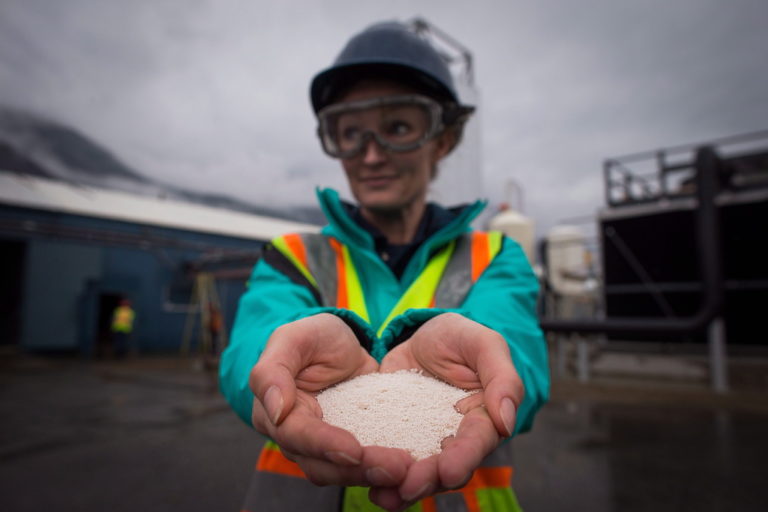
CALGARY — Climeworks, a Swiss company specializing in direct carbon-capture, announced this morning that it has for the first time sucked carbon dioxide out of the atmosphere, stored it underground and given paying customers a credit for the reduction in emissions.
The news marks a significant milestone in the long and gradual growth of the direct carbon-capture industry, which proponents hope will be a major new green technology. It also lends credibility to the nascent financial markets that could underpin such carbon-removal efforts.
Tech companies including Shopify, Microsoft and payments giant Stripe paid Climeworks to remove the pollutants, receiving carbon credits in exchange which they can in turn sell on the open market.
Here’s what you need to know:
What is direct carbon-capture?
The technology Climeworks uses works differently than industrial carbon capture, utilization and storage (CCUS), which sees equipment installed directly onto the exhaust pipes of heavy-emitting oil sites or facilities. Direct carbon capture uses vacuum-like technology to gather carbon directly from the atmosphere, then stores it or converts it into other sources of energy like low-carbon fuels.
Why does it matter?
While other direct carbon-capture companies, like B.C.’s Bill Gates-backed Carbon Engineering, have also deployed the technology successfully, Climeworks’ latest effort was reportedly done at a greater scale. Crucially, a third party verified the process of storing and selling the credits, giving carbon-credit buyers like Microsoft or Shopify added assurance that their purchases are actually lowering emissions.
“It’s about demonstrating that there’s now a full methodology, from start to finish,” Stacy Kauk, Shopify’s head of sustainability, told The Logic in an interview.
That verification process is highly important, Kauk said, at a time when carbon offsets are under fire from critics who say they give businesses an avenue to avoid environmental scrutiny while not lowering emissions. Through its sustainability fund, the company is currently set to buy credits from 28 companies, including four direct carbon capture developers.
Shopify wouldn’t disclose how many credits it purchased from Climeworks, but Kauk said the company paid an “early adopter premium” for the credits.
“We wish it was cheaper, but this is what we want to buy,” she said.
What’s next?
The CCUS industry is growing fast. Global CCUS investment is expected to grow 136 per cent in 2023, according to Rystad Energy research, more than six times the pace of other technologies like solar, wind and hydro.
It’s not clear how much of that capital will flow into direct capture schemes, but work is underway. Climeworks recently broke ground on its first commercial direct capture plant in Iceland. Carbon Engineering, meanwhile, plans to develop 70 new sequestrations projects by 2035.
Shopify already has carbon purchase agreements with Carbon Engineering, as well as other direct capture companies like San Francisco-based Noya and North Carolina-based Sustaera. More companies might soon become buyers as ESG pressures intensify.