When Kyrollos Maseh realized the price of a family home within an hour’s commute of the Toronto pharmacies he works at was far above what he was willing to pay, he began looking for a more affordable alternative. That decision ended up costing him hundreds of thousands of dollars more than he expected.
Skip to content

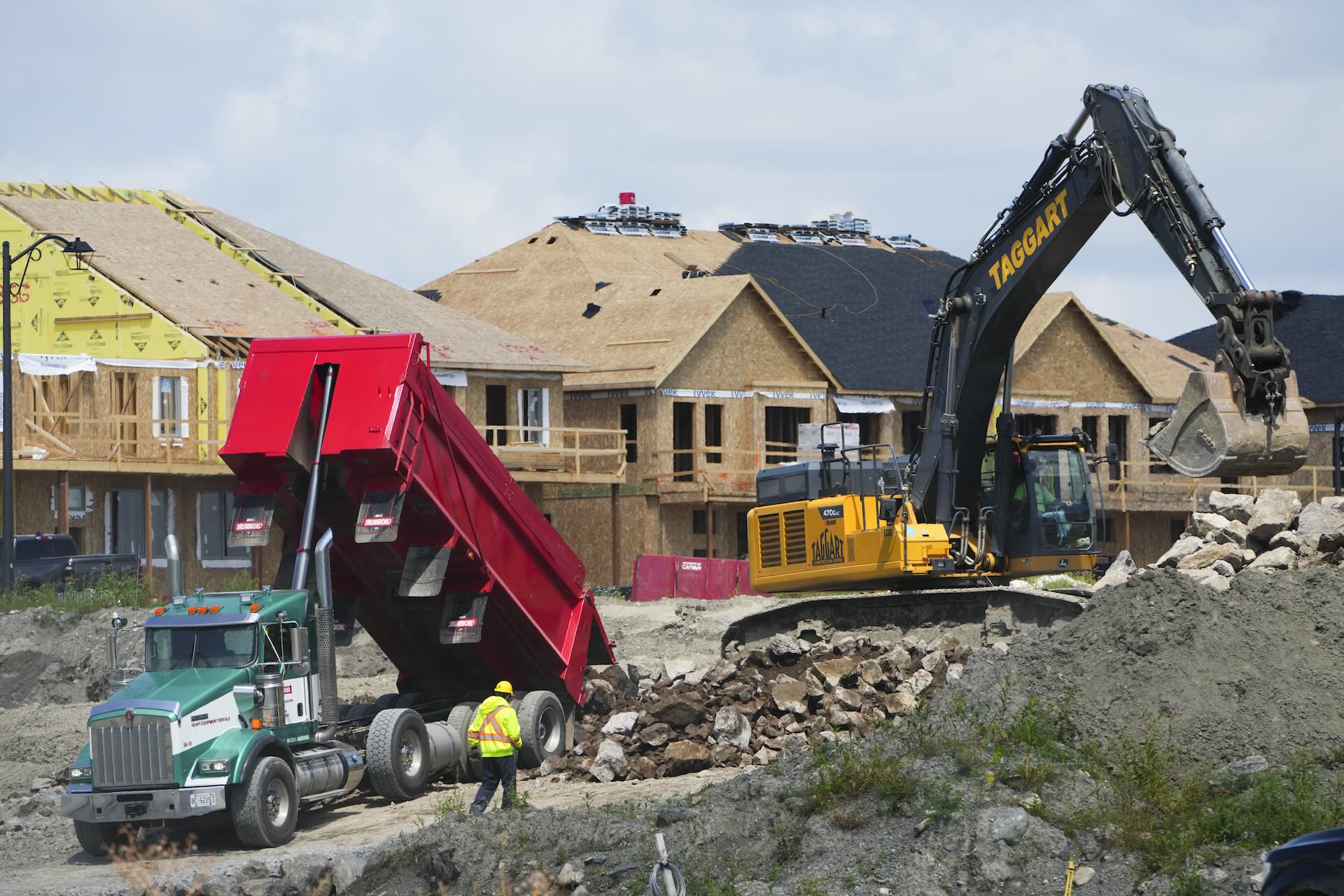 New homes under construction in Ottawa on Monday, Aug. 14, 2023. Photo: The Canadian Press/Sean Kilpatrick

News
Crumbling condos show the risk in Carney’s housebuilding plan
The prime minister has pledged to spark a building boom. Some warn Canada’s workforce and regulators may not be up to the task
A construction worker carries material at the Cogswell District Project in Halifax on April 11, 2025. Photo: Darren Calabrese/The Logic
When Kyrollos Maseh realized the price of a family home within an hour’s commute of the Toronto pharmacies he works at was far above what he was willing to pay, he began looking for a more affordable alternative. That decision ended up costing him hundreds of thousands of dollars more than he expected.
Maseh and his wife bought a rundown bungalow in 2019 and borrowed money from family to tear it down and build a new one. He ended up locked in a battle with his contractor over lengthy building delays, incomplete work and the builder’s requests for more and more cash.
Talking Points
- Prime Minister Mark Carney hopes his housing plan will set off a generational building boom, but experts urge Ottawa to guard against construction scandals that have marked past housing frenzies
- CMHC says keeping an eye on building quality will be important if home developers ramp up production over the next few years, but for now it’s nearly impossible to get a sense of how often home construction goes wrong
The to-and-fro dragged on for years, even as other houses on the block sprung up around the property, as the builder warned about a lack of materials and manpower. When he fired the builder, he learned things were worse than he realized. “There were city inspections that were failed from a year prior,” Maseh said. Among the problems: issues with the framing that were covered up with drywall and paint before the inspector could inspect the builders’ fixes, or make sure that they had been fixed at all.
Maseh told a tribunal earlier this year that the house needed more than $150,000 worth of repairs, in addition to the time and money he has spent trying to get some compensation from the builder. “There’s no accountability,” he said.
Prime Minister Mark Carney made the ambitious pledge to double the number of homes built each year to nearly 500,000, so families like Maseh’s aren’t priced out of the market. The promise raises the prospect of more cases like Maseh’s, which unfolded during the renovation mania that intensified during the COVID-19 pandemic. There’s been no word about how the government plans to protect those new homes from the kind of shoddy work that marked construction frenzies in the past.
Related Articles


“If you want a building boom, you have to have safety measures to make sure that consumers are protected,” Maseh said.
Achieving Carney’s housing goals will require a pace of building not seen in Canada since the 1970s, when the oil industry expanded in Alberta; and during the 1980s as the concept of condo buildings took off in Toronto and British Columbia’s Lower Mainland, according to the Canada Mortgage and Housing Corporation (CMHC). But those boom years were marked with construction scandals that left some homeowners bankrupt, with nowhere to live.
A rash of leaky condos in Vancouver built in the 1980s cost homeowners between $600 million and $1 billion in repairs, according to a 1999 commission of inquiry—as much as $1.8 billion in today’s dollars. Rampant demand led to poor building practices that emerged in Vancouver’s soggy climate, creating a crisis for homeowners “tantamount to a natural disaster,” the commission found. B.C felt the economic repercussions for years.
“The litany of horrific experiences, personal tragedies and dashed dreams is a challenge to the integrity of the industry and to the professionalism of those who operate within it,” the commission said.
Less dramatic examples have gone by with little public notice, but they can be no less devastating. Some, like Maseh’s, were individual house projects gone wrong. Others affected entire neighbourhood developments. Peter Weeks, an independent house inspector in the Ottawa area, has seen some homes that look like they were built in less than a month as developers churned out new communities to meet demand. “The builders were under pressure to produce more and more homes. Some of the contractors that were being used were perhaps not as skilled,” said Weeks, president of the Canadian Association of Home and Property Inspectors.
The government’s goals to aggressively ramp up housing will likely come up against a shortage of skilled trades and materials, Weeks said. “I’m a little concerned about what’s going to happen if they’re really being pushed to push out these many homes.”
In 2023, CMHC called for 3.5 million more homes to be built by 2030 to restore housing affordability. Carney’s housing plan to meet the target involves reforms to the national building codes, eliminating duplicative inspections and fast-tracking builders with proven track records. Carney also wants to see municipal development fees for multi-unit homes cut in half, with Ottawa helping make up the shortfall by paying for some of the underlying water and power infrastructure.
It’s a herculean effort that will require the focus of all levels of government, and speedier regulatory approvals. That doesn’t necessarily imply skimping on quality, said Aled ab Iorwerth, deputy chief economist at the CMHC who was part of the team that identified the 3.5-million unit shortfall. “I think it’s important to keep an eye on that, and that there are sufficient resources to monitor building quality,” he said.
Carney’s new housing minister, former Vancouver mayor Gregor Robertson, did not respond to The Logic’s request for an interview.
For now, there is no central agency keeping an eye on housing quality at a national level, and it’s nearly impossible to know how often home-building goes awry. CMHC used to have a role in monitoring and assuring that houses were safe and sound investments, but that job mainly falls now to provinces, as well as towns and cities that inspect the construction.
Many are already struggling to keep up with that work, though. Earlier this year in Ottawa, a scathing audit found some local homeowners may have been allowed to move in before inspectors confirmed “critical” faults in their houses—including “life safety elements”—had been repaired. In Toronto, a 2023 audit made similar findings. City management at the time blamed the volume of construction and lack of resources for the oversights.
Governments may be assuming the quality of new homes is a given, said Karen Somerville, president of Canadians for Properly Built Homes, a national group that advocates for consumer protections for homeowners. “If that’s the case, we’re certainly disappointed about that.” She rarely hears about the millions of new homes that are delivered without issue, but she’s received enough calls when things go wrong to convince her that quality shouldn’t be taken for granted. Mould outbreaks are the most common complaint her organization hears, but it sometimes comes across even more serious cases, such as homes that are structurally unsound.
Somerville, a longtime housing advocate, said Canada doesn’t even have a definition of what constitutes good housing quality. Of course, homes should meet building codes for their jurisdictions, she said: “That’s fundamental to health and safety for the occupants.” But that’s not the same as ensuring quality, and even those minimum local standards aren’t always reached, she said. “We’re still trying to get the various levels of government to ensure that the building codes are met. That is a huge problem.”
Though there are warranties on new homes, many homeowners have had to battle for compensation, Somerville said, and sometimes it doesn’t cover the full cost of repairs.
She argues that, if the federal government plans to get more involved in home building, it must also take a role in ensuring homes are safe to live in. “It’s not sufficient to only focus on the quantity,” she said. “Quality needs to be considered.”
To Weeks, that means Ottawa must help cities make sure each house is inspected properly before anyone moves in. Still, he says, it could be a generation before it’s clear whether the houses were built to last. “We probably won’t know the results of how it went for another 15 to 20 years,” he said.
Maseh says governments and home builders should use that time to figure out how to protect homeowners like him and his wife, who put everything they had into their new home, and then some.



Loading...
Thanks for sharing!
You have shared 5 articles this month and reached the maximum amount of shares available.
CloseThis account has reached its share limit.
If you would like to purchase a sharing license please contact The Logic support at [email protected].
CloseGift the full article!
You have gifted 0 article(s) this month and have 5 remaining.
Recipients will be able to read the full text of the article after submitting their email address. They will not have access to other articles or subscriber benefits.
Photo: Darren Calabrese/The Logic
New homes under construction in Ottawa on Monday, Aug. 14, 2023.
Most Popular This Week




In-depth, agenda-setting reporting
Great journalism delivered straight to your inbox.
News
Tech firms want AI models to create better versions of themselves
Briefing
Lightspeed cuts 250 jobs through layoffs and attrition
Oil tycoon Adam Waterous aims to build new Canadian energy player with US$1B fund
Data centre infrastructure firms 3C and Datalec merge, plan Calgary expansion
Best business newsletter in Canada
Get up to speed in minutes with insights and analysis on the most important stories of the day, every weekday.
Exclusive events
See the bigger picture with reporters and industry experts in subscriber-exclusive events.
Membership in The Logic Council
Membership provides access to our popular Slack channel, participation in subscriber surveys and invitations to exclusive events with our journalists and special guests.