TORONTO — As generative AI companies seek revenue to back up their multibillion-dollar valuations, Cohere is enlisting the help of global consulting firms McKinsey and Accenture to help it win the business of marquee clients.
Skip to content

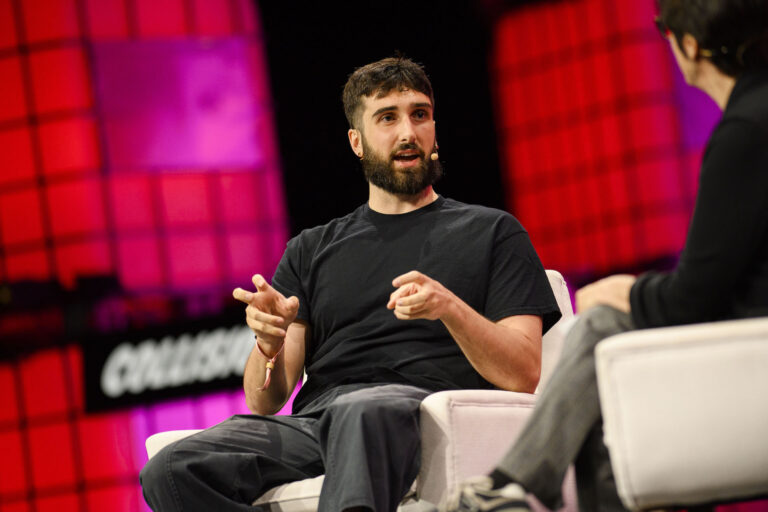
 Cohere CEO Aidan Gomez called 2023 “the year of the proof of concept” for generative AI. This year, the firm has focused on turning tests into tools. Photo: Chris Katsarov Luna for The Logic

News
Cohere taps consulting giants McKinsey, Accenture to help push generative AI products
Startups are forming alliances with professional services firms as all compete for enterprise dollars
Cohere is enlisting the help of global consulting firms McKinsey and Accenture to expand the reach of its generative AI products. Photo: Illustration by Costfoto/NurPhoto via Getty Images
TORONTO — As generative AI companies seek revenue to back up their multibillion-dollar valuations, Cohere is enlisting the help of global consulting firms McKinsey and Accenture to help it win the business of marquee clients.
Founded in September 2019, the Toronto-headquartered startup is among a still-small group of companies—including OpenAI, Google and Anthropic—that makes large language models (LLMs). Its artificial intelligence systems answer queries, pull and summarize information from a variety of sources, and produce more context-aware search results.
Talking Points
- Cohere has tied up with consulting giants Accenture and McKinsey to expand the reach of its generative AI products
- The Toronto-based startup is working with its partners to develop applications for clients, which all three firms hope will turn into resellable products that can span industries
Cohere sells access to its technology directly to businesses, via application program interfaces, as well as through cloud providers such as Amazon Web Services and Microsoft Azure. But it’s also forging ties with the consulting firms that help major corporate players build or renovate their tech infrastructure.
In July 2023, it announced a partnership to work with McKinsey’s AI arm, QuantumBlack, on generative AI applications for its clients. And this March, Cohere struck a similar deal with Accenture. Between them, the two professional services giants made about US$80 billion last year working with most of the world’s largest companies and governments.
That opens opportunities for Cohere, said Vinod Devan, the startup’s global head of partnerships. “The shopping windows that these [firms] provide give us access [and] scale that we would not be able to achieve by ourselves.” Devan projects that within three years, the majority of the company’s revenue will come through a network of consulting firms, cloud providers and product integrations.
Faced with figuring out which LLMs are best suited for their needs, and how to roll them out at scale, many businesses are calling consulting firms for help. OpenAI, the early LLM market leader, found its first major clients among consumer-facing technology firms like Instacart, Shopify and Snap. Deals with consultants can help Cohere break into “markets that do not naturally come to new technologies,” Devan said, like automotive, finance, government, healthcare and retail.
Related Articles

Clients come with questions about how to choose vendors, train workers and measure returns, said Ben Ellencweig, the McKinsey senior partner who leads alliances, acquisitions, and partnerships for QuantumBlack. “People actually need more help than before in architecting this.”
Cohere doesn’t “just provide access to models,” said Devan. The startup’s engineers join the consulting firms’ data scientists and developers to design and assemble applications for their business clients.
For example, Cohere and McKinsey recently built a virtual shopping assistant for a luxury retailer. “The task at hand was: How can I replicate a white-glove experience in a store online?” said Ellencweig.
The two firms strung together a series of models and tied them to the retailer’s catalog and inventory. Shoppers can browse via a chatbot, which takes in their queries, extracts the attributes they’re looking for—handmade, from a French designer, say—and suggests available items that fit the bill. (Cohere and McKinsey declined to identify the client, citing commercial confidentiality).
The new tool drives sales, and frees up the retailer’s staff to offer “a better customer experience—spend time, ask questions and build the relationship,” said Ellencweig. “This is very transferable to many other industries where there’s human interaction.”
While many of these applications start out as custom builds for a particular client, Cohere and its consultant partners are looking for opportunities to turn them into products they can sell to other businesses. “That’s the way to get scaled,” said Devan. It’s also how generative AI might find more widespread adoption. “We want to be helping thousands of companies,” said Lan Guan, Accenture’s chief AI officer. “This could be the turbo-charged digital thread” for enterprises.
Generative AI companies need that scale to make the financial math of the technology work. Since they may spend tens of millions of dollars to train and run each new LLM, they are taking on huge amounts of capital from tech giants and megafunds that are rushing into the space even as the broader venture market slows.
Cohere itself has raised US$890 million to date, according to PitchBook data. In June, Reuters reported that the startup had secured US$450 million at a US$5 billion valuation, and had brought in US$35 million in annualized revenue in the first quarter.
The startup keeps its pricing the same whether a customer is buying directly or via a consulting firm, according to Devan, though he noted the consulting firms may set their own terms with their clients. Ellencweig declined to disclose McKinsey’s revenue split, while Guan said Accenture has yet to set it.
Alliances between model-makers and consulting firms are proliferating. McKinsey has other AI partnerships, including with ChatGPT maker OpenAI, Aleph Alpha, Anthropic and Mistral AI. Each of those firms has other tie-ups of their own. OpenAI recently signed up PwC as a reseller of its enterprise offering, for example. “There’s no shortage of proposals to collaborate,” said Ellencweig. McKinsey—and its clients—want to work with AI companies that are financially viable, focused on business applications and that train their LLMs in robust and legally defensible ways.
Cohere’s strategy of building for enterprise users rather than consumers made it an attractive partner. “A B2B mindset is very different,” said Ellencweig, noting that Cohere was one of the first providers to let clients run its models on their own servers to maximize control, privacy and security.
Guan cited the startup’s focus on retrieval-augmented generation, a process that lets models pull in information from additional sources like a company’s internal documents. The responses they generate are typically more accurate and up-to-date as a result, and can include citations. “It’s a great way of reducing hallucinations, and also improving the groundedness of the insights,” Guan said.
Both consulting giants have built Cohere into tools for their own workers. McKinsey uses the startup’s LLMs in a co-pilot that helps staff conduct research and write proposals. At Accenture, Cohere’s Command system powers a virtual agent that summarizes financial results and issues alerts for its internal treasury team.
Cohere CEO Aidan Gomez called 2023 “the year of the proof of concept” for generative AI. This year, the firm has focused on turning those little tests into tools that their clients are using in their everyday businesses, Devan said. While the firms declined to provide numbers, he said Cohere’s deal pipeline with its consulting partners has “grown multiple-fold.”
“There is a race to prove your capabilities to the firms that matter,” Devan acknowledged. Cohere’s approach is to demonstrate to prospective partners the use cases for which its models are particularly suited. The company asks them, “Do you believe we are either the best or in the top two?” Devan said. “And if the answer is ‘yes,’ that’s the race that we want to win.”



Loading...
Thanks for sharing!
You have shared 5 articles this month and reached the maximum amount of shares available.
CloseThis account has reached its share limit.
If you would like to purchase a sharing license please contact The Logic support at [email protected].
CloseGift the full article!
You have gifted 0 article(s) this month and have 5 remaining.
Recipients will be able to read the full text of the article after submitting their email address. They will not have access to other articles or subscriber benefits.
Photo: Illustration by Costfoto/NurPhoto via Getty Images
Cohere CEO Aidan Gomez called 2023 “the year of the proof of concept” for generative AI. This year, the firm has focused on turning tests into tools.
Most Popular This Week




In-depth, agenda-setting reporting
Great journalism delivered straight to your inbox.
News
Adam Waterous proposes massive crude exports to Asia by rail through northern B.C.
Briefing
Rivals may be ‘horrified’ to realize how exposed their investments are to AI, Aviva CIO warns
Shopify, Sequoia co-lead US$200M investment in online-selling platform Whop
Amid revenue gains, 1Password bets on tools to protect data from AI agents
Best business newsletter in Canada
Get up to speed in minutes with insights and analysis on the most important stories of the day, every weekday.
Exclusive events
See the bigger picture with reporters and industry experts in subscriber-exclusive events.
Membership in The Logic Council
Membership provides access to our popular Slack channel, participation in subscriber surveys and invitations to exclusive events with our journalists and special guests.







