Listen Now
0:00
OTTAWA — Satellite companies the world over are facing a traffic jam in getting their equipment into orbit and Canada is years away, at best, from being able to solve the problem for its own space sector.
SpaceX, whose Falcon 9 medium-lift rockets have been the workhorses of private orbital launches, has stopped taking new Falcon 9 bookings beyond 2028. The Elon Musk-led company plans to replace them with its next-generation Starship rockets, which keep exploding.
Talking Points
- Canadian space startups are struggling with how they’ll get new satellites into orbit as SpaceX has stopped taking new commercial bookings on its heavily used Falcon 9 rockets
- Although Canada is working on building its own launch capability, a domestic replacement is years away at best
The launch crunch came up again and again last week at SpaceBound, the annual Canadian space industry conference.
On one panel at the Canadian Museum of History in Gatineau, Que., across the Ottawa River from Parliament, Kristen Cote, chief technology officer of Edmonton-based Earth-observation company Wyvern, said potential investors are challenging the company about it as it seeks to raise fresh capital to expand.
“I think this is the first time where we’ve had serious questions from investors about, ‘You have all these plans—that’s great. How are you going to launch all these satellites?’” Cote said.
Even if SpaceX were taking new bookings, Canadians might prefer to not entrust space missions to a company that unexpectedly throttled Ukraine’s access to its internet service in the middle of a war, and whose CEO has advocated for provinces to quit Confederation.
Related Articles
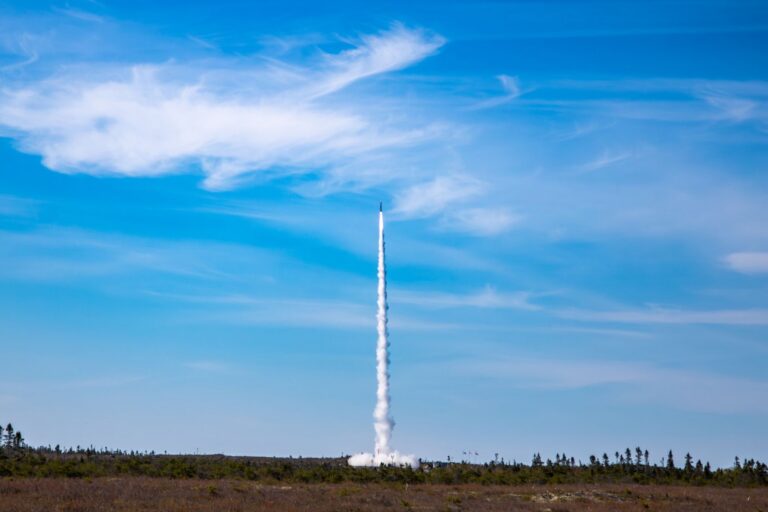
Although Canada has launch-pad companies and rocket makers, none has launched anything into orbit yet.
When they do, the first rockets to go up will almost certainly be light-lift ones. Those are the launch vehicles the federal government prioritized with a competition called Launch the North, which is paying out $25 million in incentives to three companies.
Like sturdy little hatchback cars, light-lift rockets have plenty of uses, but are no help when what you need is a tractor-trailer like the Falcon 9. (Meanwhile, if a medium-lift rocket like the Falcon 9 is an 18-wheeler, the super-heavy-lift Starship is one of those giant mining trucks where the driver climbs a ladder to reach the cab.)
The gap between what Canada wants and what it’s in a position to do was clear in SpaceBound talks by two different heavyweights of the sector: Industry Minister Mélanie Joly and Dan Goldberg, the CEO of venerable space-communication company Telesat.
Joly presented a vision of a full stack of Canadian space capabilities, including launching satellites. Canadian sovereign infrastructure is critical for the government’s plans for things like coast-to-coast-to-coast communications, she said.
The federal government is already investing $200 million in Maritime Launch Services’ launch site near Canso, N.S., through a 10-year contract. “Our space launch capability, based in Nova Scotia, will also be key to building on this ambition and maintaining Canada’s leading position in the space race,” Joly said.
Telesat and MDA Space are working together on Telesat’s Lightspeed commercial (but heavily government-backed) satellite network and a secure version for military communication in the Arctic. Joly said she expects to see future Telesat and MDA satellites launched from Nova Scotia.
On the same stage, shortly after Joly spoke, Goldberg all but nuked the idea that Telesat will be launching satellites in quantity from Atlantic Canada any time soon.
His company has 225 satellites to launch for its Lightspeed communication constellation. Telesat has them booked to launch with SpaceX before the Falcon 9 phaseout, so as long as the Lightspeed satellites are ready as scheduled, the issue is moot. But no alternative, Canadian or otherwise, is even theoretically feasible, Goldberg said.

He said Telesat needs a launch company that can take a lot of satellites up at a time, multiple times each week, at a good price. He’d love it if Canada had one, but it doesn’t.
After all, Telesat’s new satellite network is going into a battle against global powers like SpaceX’s own Starlink, Amazon and Chinese state enterprises. In this economy, Telesat can’t afford too much patriotism.
“For us to be competitive, all of our cost inputs need to be world-class competitive,” Goldberg said.
Telesat is expecting to spend about 20 per cent of Lightspeed’s budget on launching the satellites, or about US$1 billion, Goldberg said. “If launch services were three per cent or five per cent of our total cost inputs, you could say, ‘Yeah, you can maybe afford to pay a little bit higher to work with a particular provider.’ But it’s not the case.”
Stephen Matier, the CEO of Maritime Launch Services, said his Canso, N.S., launch site has the necessary approvals for medium-lift rockets—it once worked with a Ukrainian rocket company that would have supplied them, before the Russian invasion scuppered those plans. MLS isn’t currently preparing for such launches.
“I’ve got the designs already for the facility and flame trenches and buildings and everything else,” he said in an interview. “We could start construction tomorrow. I just need a rocket to put there.”
There is no such Canadian rocket.
The Canada Rocket Company, one of the participants in Launch the North, is working on a medium-lift vehicle but it isn’t ready. The company plans to test engine components in December. That’s a long way from an orbital launch.
(Another would-be rocket maker, Reaction Dynamics, just announced plans to rush toward a medium-lift model by 2031.)
It takes between six to eight years to get any new rocket ready to reach orbit, Canada Rocket Company CEO Hugh Kolias told The Logic, though “we’re targeting the closer end of the spectrum.” It’ll also cost about $1 billion, he estimated.
“We have an opportunity of capturing a very underserved market,” Kolias stressed, and to help the broader Canadian space ecosystem. But not by 2028.
Matier said Maritime Launch Services could absolutely be part of replenishing the Telesat constellation as satellites inevitably fail over time. But that’s a matter of launching in “ones and twos, not fives and tens. And right now, SpaceX is going to do 40s and 50s,” he said.
MLS’s main competitor, NordSpace, is developing a launch site in Newfoundland. Its CEO, Rahul Goel, called the idea of launching a Telesat-scale constellation from Canada “aspirational.”
Like MLS, NordSpace is currently focused on being able to launch rockets (its own, in NordSpace’s case) that could carry a couple of Telesat satellites up to replace broken ones or expand the Lightspeed constellation slightly.
But Goel agreed that launching the whole set would take a fleet of medium-lift rockets and the facilities to support them, and that’s a tall order.
“Would we like to have all of that in Canada? Absolutely,” Goel said. “Could that happen any time soon? Probably not.”