Listen Now
0:00
Canada’s Big Six banks beat third-quarter earnings expectations, driven by strong capital markets activity and solid growth in their businesses outside the country. The results landed just days after Canada walked away from trade negotiations with the U.S., putting the spotlight on the lenders’ exposure to tariff uncertainty and how much risk they see ahead.
Tariff stance: Bank CEOs struck a measured tone on the escalation of the Canada-U.S. trade war. BMO and Scotiabank’s chief executives Darryl White and Scott Thomson both described the impact of tariffs as “manageable.” White pointed to the limited share of Canadian exports affected and government support measures, while Thomson said Canada’s economic fundamentals remain solid despite the uncertainty.
National Bank CEO Laurent Ferreira said that although the trade dispute will weigh on businesses and consumers, the push to reindustrialize Canada and invest in infrastructure, defence and energy is creating opportunities for banks to deploy capital at home. Meanwhile, TD CEO Raymond Chun said the two economies remain deeply interconnected and expressed hope that Canada and the U.S. ultimately find common ground.
Related Articles

Still, the banks are preparing themselves for a worse outcome. RBC’s chief risk officer said that while the latest tariffs alone are not expected to materially change the bank’s economic forecasts, the lender continues to assign more weight to a downside scenario in which an escalating trade war could trigger a North American recession.
TD chief risk officer Ajai Bambawale said the bank remains well-positioned and has set aside $500 million for tariff- and trade-related risks. CIBC has similarly been building additional reserves for tariff risks since fiscal 2025. Chief risk officer Frank Guse said the business loans most vulnerable to tariffs represent less than one per cent of the bank’s total loan portfolio.
Charles St-Arnaud, chief economist at Servus Credit Union, said the tariff fallout has so far fallen short of the expected “doom and gloom.” But he warned that banks would not be immune if a significant escalation in the trade war pushed Canada into recession, as weaker business revenues and higher unemployment could eventually translate into greater loan losses.
Gimme more U.S.: Other than National Bank, the other five large Canadian lenders are deepening their U.S. presence through different parts of their businesses.
BMO, which already has a sizable and growing U.S. presence, has been repositioning the franchise toward higher-growth markets such as California. Scotiabank is leaning more heavily into U.S. capital markets and wealth management, acquiring Oklahoma-based MapleMark and upping its investment in KeyCorp this year. RBC is building on its acquisition of Los Angeles-based City National and its U.S. capital markets business, which generates roughly half of the division’s revenue coming from outside Canada.
TD faces a bigger constraint: an asset cap on its U.S. consumer and commercial bank. Even so, it plans to open 100 branches and add about 450 bankers, expanding its U.S. branch footprint by roughly nine per cent. It is also continuing to invest in capital markets, which are not subject to the cap. CIBC, meanwhile, continues to expand its U.S. commercial banking and wealth-management franchise.
“It would be strange to tell [the banks] that because of the whole trade war, they have to stop their activity in the U.S.,” St-Arnaud said. “There’s a business need for them, whether it is diversification of activity [or] diversification of exposure.”
Capital choices: Ahead of earnings, TD Cowen analyst Mario Mendonca expected U.S. loan growth to keep improving while Canadian lending remained sluggish, though he anticipated a more optimistic outlook.
The results broadly bore that out, although disclosures are not directly comparable across banks. BMO’s Canadian commercial loans grew three per cent year over year, compared with one per cent in the U.S., though U.S. commercial loan growth accelerated to four per cent quarter over quarter. RBC’s City National wholesale loans rose seven per cent year over year, versus roughly four per cent growth in Canadian commercial banking. CIBC posted nine per cent U.S. commercial loan growth compared with seven per cent in Canada.
TD’s U.S. mid-market lending jumped 15 per cent, outpacing the eight per cent growth in its Canadian business loan book. Scotiabank also saw business and government loan growth increase $7 billion across Canada, the U.S. and Mexico. National Bank, meanwhile, benefited from stronger lending in its home market of Quebec.
Shalabh Garg, an investment analyst at Veritas Investment Research, said the divergence largely reflects the relative strength of the two economies. Loan growth tends to track economic growth closely, he said, making stronger U.S. lending unsurprising given the gap in GDP growth.
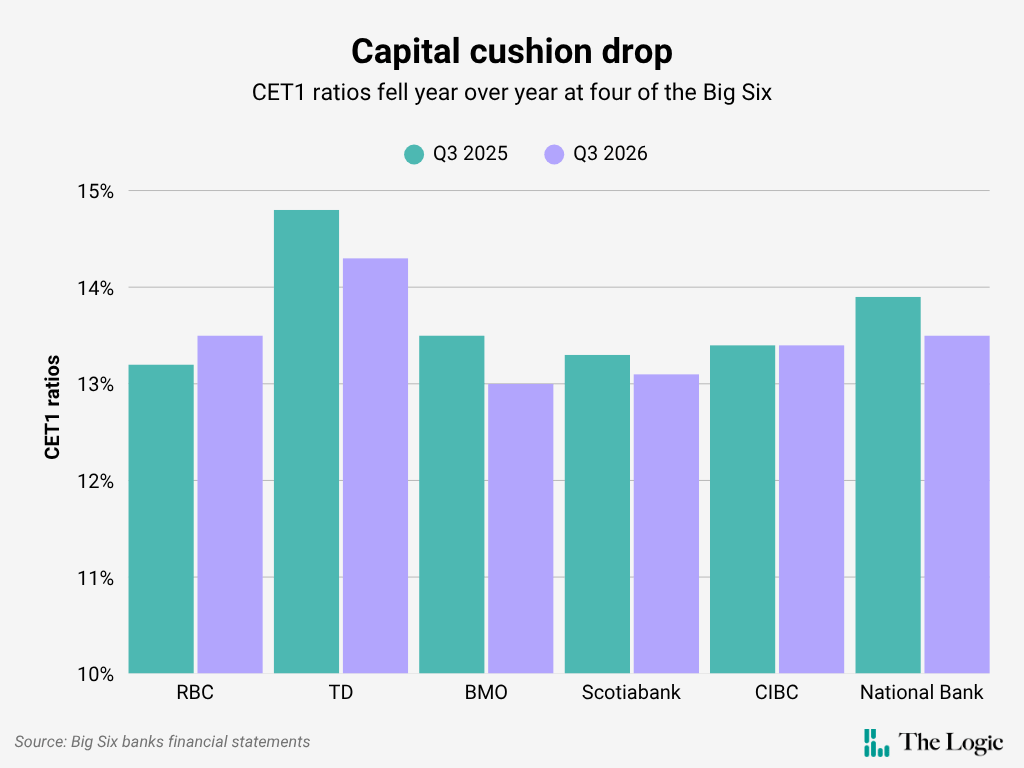
Room to lend: The Office of the Superintendent of Financial Institutions (OSFI) cut the domestic stability buffer to three per cent from 3.5 per cent in June, giving banks more room to deploy capital. Yet even as CET1 ratios—a measure of a lender’s ability to absorb losses—at four of the Big Six have fallen from a year ago, executives have not signalled that the extra capacity will meaningfully change their lending strategies.
BMO’s White said the lower buffer would not slow the bank’s capital targets or alter its risk appetite, and that excess funds would be returned through dividends and buybacks. Scotiabank’s Thomson was more explicit about potential opportunities in Canada, saying the bank has reorganized parts of its business to pursue defence financing and sees room to deploy more capital across infrastructure and commercial lending.
“OSFI cannot mandate what the banks do with the excess capital,” Garg said.
St-Arnaud was less convinced that weak demand tells the whole story. He said Canada’s weak business investment also reflects a risk-averse banking system that has historically favoured mortgages over business lending.
Canada’s investment needs are immense, he said, adding that ensuring businesses have access to capital will be critical. “If banks do not want to play or do not see it as a profitable business, it will be hard to push them to do it.”