Listen Now
0:00
OTTAWA — The top executive for the European Union has given a name to the stronger relationship Canada is striving to forge with the 27-nation bloc, but the transatlantic partners have a lot of work to do before it becomes reality—whatever they decide to call it in the end.
What did she say?
European Commission President Ursula von der Leyen devoted a portion of her annual state of the union address on Wednesday to shared values between the EU and Canada, as both try to diversify trade amid tariffs and expansionist threats from President Donald Trump.
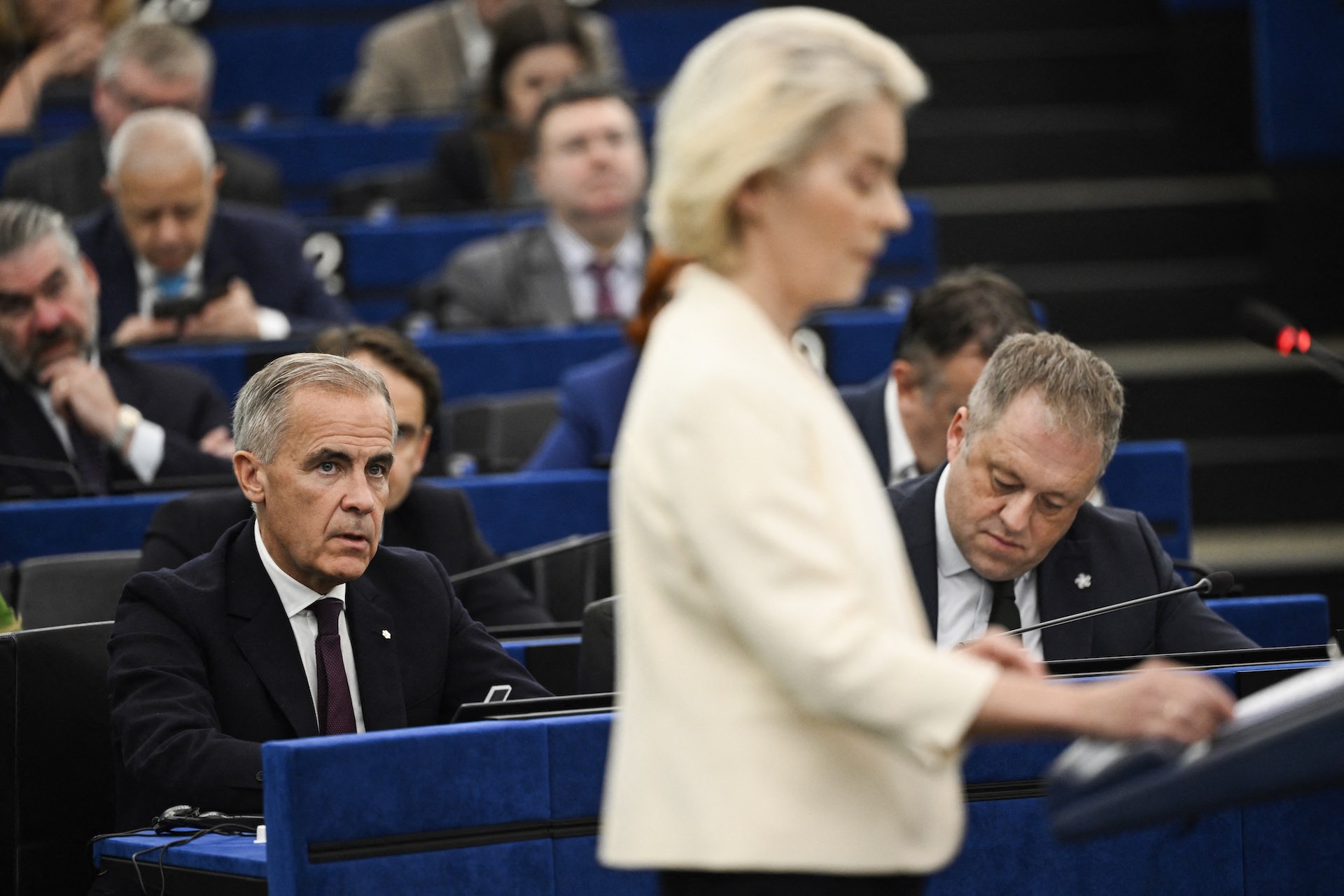
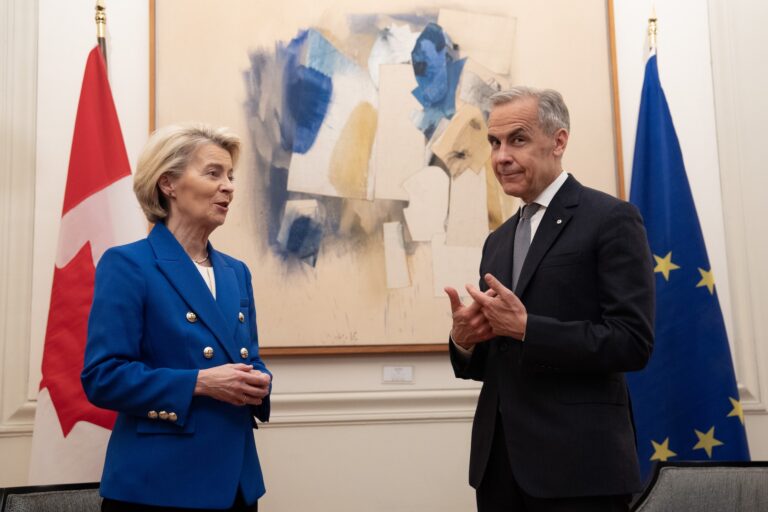
Prime Minister Mark Carney was seated nearby in the audience at the European Parliament in Strasbourg, France, where he is set to give his own speech Thursday. Addressing the visiting leader directly as “dear Mark,” von der Leyen said: “I would like to work with you on opening the door for Canada to be the first associate member of the EU. We share one ocean, one set of values, one way of seeing the world. And we will now build our shared future as well.”
Related Articles
What does “associate member” mean?
The founding treaty of the EU restricts bids for formal membership to “European states.” No amount of talk about shared values can move a land mass across the Atlantic Ocean, so Canada cannot follow Ukraine in becoming a recognized candidate.
There are other models for close co-operation with non-member countries. Norway, Iceland and Liechtenstein are formally part of the European common market. The United Kingdom, notably, left the EU in 2020 but reached a free trade and co-operation agreement.
“Those provide some flexibility for the EU and Canada,” said Emmanuel Brunet-Jailly, co-director of European Studies at the University of Victoria. But even the conditions of full membership vary by country. Just six are party to all of the EU’s treaties, with the other 21 picking and choosing the rest. Ireland, for example, is not part of the border-free travel zone known as the Schengen area. Switzerland, which is not in the EU, is in that zone.
Switzerland withdrew its EU membership bid in 2016, but signed a series of new bilateral agreements with Brussels in March. Toronto-based trade lawyer Barry Appleton suggested Wednesday that they serve as an example—and a warning—of what integration could mean for Canada. According to the Swiss government, the changes would require amending 32 of its laws and creating three new ones. “That is the price of Swiss-level access, stated by the government that negotiated it and tabled for its own legislature,” Appleton wrote in a blog post.
In any case, both sides have described the desired arrangement as new and different. On Sunday in Toronto, Carney said they are discussing “a unique alliance.” Geneviève Tuts, the EU ambassador to Canada, told The Logic the relationship “cannot simply mirror” those with other countries. “The idea is to have something new and more ambitious,” she said in an interview last week.
Did von der Leyen go too far?
In Brussels last week, ambassadors from the 27 members of the EU reportedly expressed broad support for closer ties with Canada—including those from countries, such as Italy, typically wary of provoking Trump. On Wednesday, however, Politico reported that some governments were caught off guard by the “associate member” phrasing and unclear on the extent of political and economic integration Canada seeks—or even what is possible.
A spokesperson for Chancellor Friedrich Merz told reporters in Berlin that Germany is open to talking about new models for partnership with Canada that reflect the closer ties, but that the EU “should reconsider the terminology” von der Leyen chose.
In Canada, Conservative Leader Pierre Poilievre pointed to the evolving phrasing and warned against going too far. “The prime minister can’t seem to get his story straight about the ‘associate membership,’ ‘unique alliance,’ or whatever else he is negotiating with the EU,” Poilievre wrote in a post on social media. “Conservatives are clear: we support the decades-old free trade and NATO defence alliance with Europe. But no EU taxes, no EU laws, and no EU open-border immigration policies should be imposed on Canadians.”
What do we know?
The phrasing that von der Leyen used got the most attention, but she also shed some light on areas where Ottawa and Brussels want to co-operate beyond the existing Canada-EU Comprehensive Economic and Trade Agreement (CETA), which 10 EU countries have yet to ratify.
“We will move from CETA to an alliance for the future to create a common prosperity and economic security space,” she said in her address. “We will work on intelligent manufacturing. We will create a tech alliance. We will integrate defence industrial bases. We will make the Arctic a flagship joint project. We will work on energy, critical minerals and batteries. On AI, quantum, cyber and economic security.” Then, in an apparent bid to get ahead of negative reaction by Trump, von der Leyen added: “This is a partnership not against anyone else, but for our common strength. In short, we want to bring the relationship with Canada to the highest level possible.”
Some of that is already in motion. Last year, Canada became the first non-member to join the EU’s €150-billion military procurement fund. Ottawa and Brussels are also negotiating a digital trade agreement to complement CETA.
More details on the outcome of those negotiations, which Carney first announced during his visit to Brussels in June 2025, are expected to come at the next Canada-EU summit on Oct. 29-30 in Montreal.
Editor’s note: This story has been updated with analysis from trade lawyer Barry Appleton.













