OTTAWA — Donald Trump’s stated goal of annexing Canada can’t be used to drive a wedge between the United States and Britain, the United Kingdom’s Prime Minister Keir Starmer said in a news conference with the U.S. president.
Skip to content

News
Threat to annex Canada can’t be used to divide U.K and U.S., Starmer says
British prime minister passes up chance to defend Canada against Trump’s takeover threats
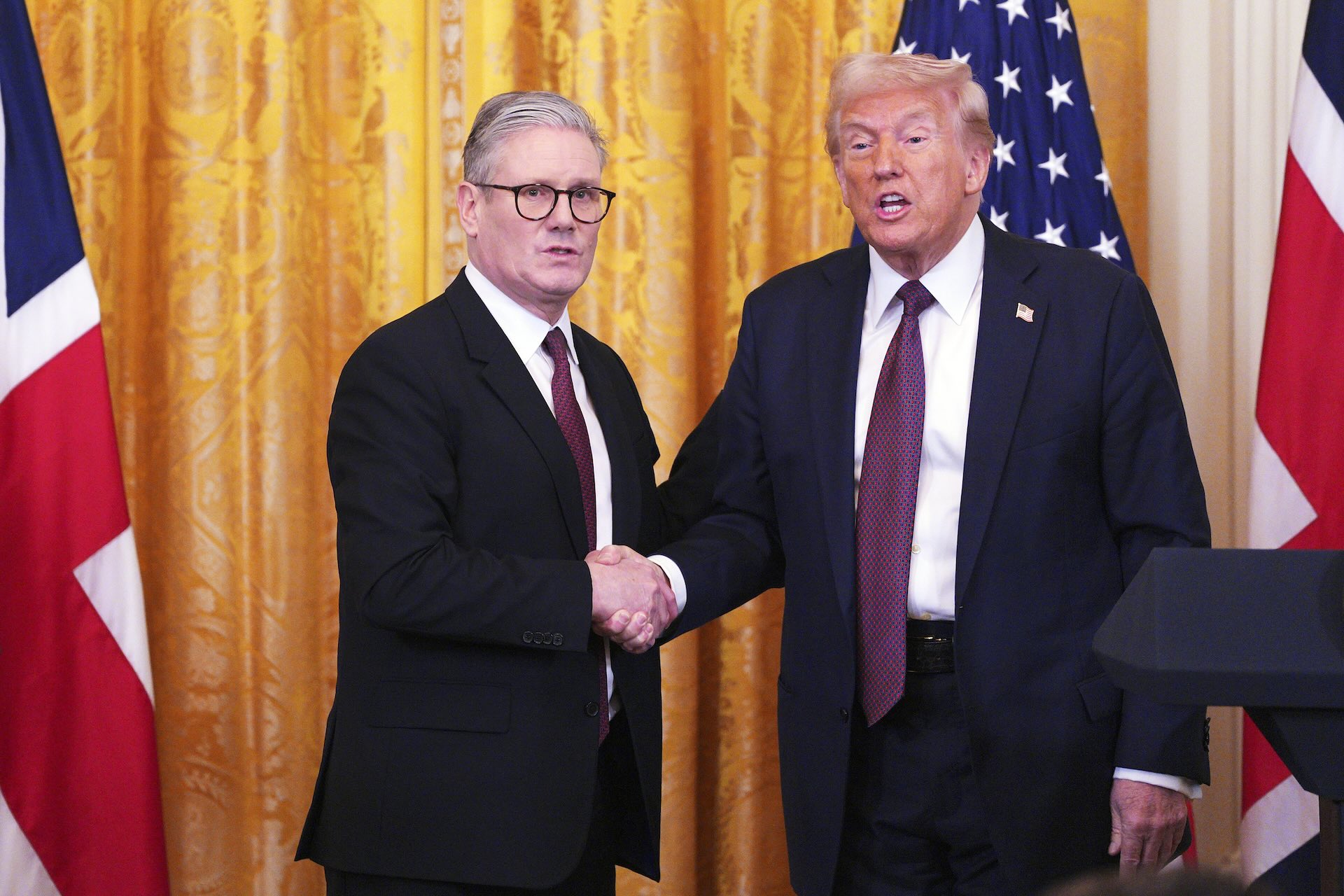
British Prime Minister Keir Starmer has praised the United Kingdom-Canada relationship without addressing Trump's annexation threats. Photo: Carl Court/Pool Photo via AP
OTTAWA — Donald Trump’s stated goal of annexing Canada can’t be used to drive a wedge between the United States and Britain, the United Kingdom’s Prime Minister Keir Starmer said in a news conference with the U.S. president.
Canada is looking for international allies as Trump threatens harsh tariffs on Canadian goods over a shifting list of complaints, such as border security, the U.S.’s trade deficit and American banks’ access to the Canadian market.
Talking Points
- In a news conference with U.S. President Donald Trump, U.K. Prime Minister Keir Starmer chided a reporter for suggesting that Trump’s threats against Canada might be a point of difference between their two countries
- Canada has been seeking support from allies in Europe as it faces Trump’s economic coercion, so far with very limited success
Trump has said he will use “economic force” to coerce Canada into becoming the 51st American state and posted again about it to his Truth Social network on Wednesday evening.
Starmer is in Washington, D.C., for meetings with Trump. On Thursday afternoon, a reporter asked whether the two had discussed Trump’s dreams of annexation, and whether King Charles—who formally occupies separate offices as King of Canada and King of the United Kingdom of Great Britain and Northern Ireland—had expressed any concerns about Trump’s goal.
“I think you’re trying to find a divide between us that doesn’t exist,” Starmer replied. “We’re the closest of nations and we had very good discussions today. But we didn’t discuss Canada.”
“That’s enough,” Trump interjected, and moved onto the next question.
Starmer’s reticence drew a sharp reaction on social media.
“Disappointing, considering the trips that Trudeau has taken to the U.K.,” commented Conservative MP Dan Albas on X.
“Canadians died for the U.K. by the tens of thousands. He could have opened his bloody mouth to speak up for us,” wrote Artur Wilczynski, a former Canadian ambassador to Norway and senior official at the Communications Security Establishment.
Related Articles

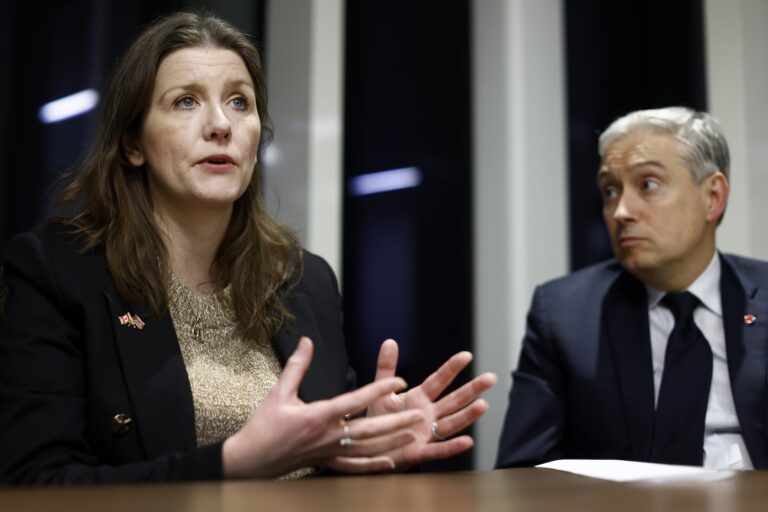
The Logic asked the British High Commission in Ottawa what the U.K.’s position is on whether Canada should be the 51st state.
Spokesperson Megan Lalonde answered that Starmer and Trump didn’t discuss Canada, and referred to an exchange on Wednesday in the House of Commons in London, when a Conservative MP asked Starmer whether he would use his Washington trip to call out “this childish nonsense of a 51st state.”
Starmer’s response praised the British-Canadian relationship without addressing annexation.
“The U.K. and Canada are close allies and have been for a long time, with a partnership based on a shared history and a shared set of values and a determination to be an active force for good in the world,” Starmer said. “We work closely with Canada on issues of the Commonwealth, on NATO and, of course, Five Eyes intelligence sharing. We will work to strengthen that relationship.”
When The Logic asked Lalonde again to spell out Britain’s view on Canada’s independence, she did not respond.
A Conservative MP asked Starmer whether he would use his Washington trip to call out “this childish nonsense of a 51st state.”
The two countries have had difficult, and so far unsuccessful, negotiations on a new trade agreement to replace the terms the U.K. gave up when it left the European Union.
Although Britain isn’t facing a tariff deadline like Canada’s—25 per cent levies on most exports, to kick in just after midnight eastern time on Tuesday—it would be affected by other tariffs Trump is promising on all the U.S.’s trading partners.
Canadian leaders, including Trudeau and Conservative Leader Pierre Poilievre, have flatly rejected annexation. “There isn’t a snowball’s chance in hell,” Trudeau has said.
The apparent difference between the elected governments in Canada and Britain puts King Charles in an awkward position. The constitutional monarch’s duty is to act on advice from his prime ministers, which occasionally means being deployed as a diplomat.
In Washington, Starmer extended an invitation to Trump—technically on the King’s behalf—for an unprecedented second state visit to the U.K. He was asked in a Fox News interview what King Charles makes of Trump’s calls for Canada to join the U.S.
“That’s not for me to say. His Majesty will obviously express himself in his own way,” Starmer said.
Buckingham Palace declined The Logic’s request for comment Friday. “This is not something we would comment on,” the palace press office said in an email. Gov. Gen. Mary Simon, the King’s representative in Canada, said through a spokesperson that she would not “engage in public discourse on foreign or domestic policy matters.”
However, the statement went on, “the Governor General is pleased to see Canadians coming together to show their pride in their country and in the values that define and unite us from coast to coast to coast.”
Foreign Affairs Minister Mélanie Joly said in a Vancouver news conference that she had spoken to U.K. Foreign Secretary David Lammy and Starmer’s national security advisor Jonathan Powell after Starmer’s Washington appearance. Canada and the United Kingdom are indivisible, she said.
“We’re close because of our history, because of our people, because of our trade,” she said. “It is just in our DNA to be close to the U.K.”
The times demand co-operation, she added. “We need to work together on addressing the unpredictability that is coming out of the White House.”
Last week, Joly said she had been reaching out to European allies to deliver what she described as a “wake-up call,” after she realized many were not all that plugged in to what was happening in either Canada or the United States.
German Ambassador Tjorven Bellmann said in Ottawa this week that joining the United States would be a decision that is up to Canada.
“The Canadian people and the Canadian political spectrum has been very clear that this is not on the agenda,” she said Wednesday.
She also said outgoing German Chancellor Olaf Scholz has been “very clear that territorial integrity and the respect for borders” is an international principle. “It’s not just a question that we discuss around Ukraine, but a question that is universally a part of international law, and therefore we expect everybody to adhere to it.”
This story was updated to add reaction to Starmer’s remarks



Loading...
Thanks for sharing!
You have shared 5 articles this month and reached the maximum amount of shares available.
CloseThis account has reached its share limit.
If you would like to purchase a sharing license please contact The Logic support at [email protected].
CloseGift the full article!
You have gifted 0 article(s) this month and have 5 remaining.
Recipients will be able to read the full text of the article after submitting their email address. They will not have access to other articles or subscriber benefits.
Photo: Carl Court/Pool Photo via AP
Most Popular This Week



In-depth, agenda-setting reporting
Great journalism delivered straight to your inbox.
The Big Read
Beacon is building an AI empire by fixing Main Street’s software
Briefing
Inovia raises US$200M for new VC fund as it eyes AI’s impact
43% of eligible Albertans voted ahead of Monday’s referendum
AI chip company Tenstorrent raises US$1.5B, valuing it at US$6.2B
Best business newsletter in Canada
Get up to speed in minutes with insights and analysis on the most important stories of the day, every weekday.
Exclusive events
See the bigger picture with reporters and industry experts in subscriber-exclusive events.
Membership in The Logic Council
Membership provides access to our popular Slack channel, participation in subscriber surveys and invitations to exclusive events with our journalists and special guests.







