OTTAWA — The United States could stop buying Canadian-made cars, dairy and lumber to force Canada into becoming the 51st state, president-elect Donald Trump said Tuesday.
Skip to content


News
Trump says he could use ‘economic force’ to annex Canada
U.S. doesn’t need Canadian cars, lumber or dairy, president-elect says
U.S. president-elect Donald Trump addressing reporters at Mar-a-Lago on Jan. 7, 2025, when he mused about using economic power to force Canada to accept annexation by the U.S. Photo: AP Photo/Evan Vucci
OTTAWA — The United States could stop buying Canadian-made cars, dairy and lumber to force Canada into becoming the 51st state, president-elect Donald Trump said Tuesday.
Trump has previously posted to his Truth Social network about how Canada should be an American state and called Prime Minister Justin Trudeau “Governor Justin Trudeau,” but in a two-hour news conference at his Florida estate, he sketched out potential means of forcing Canada into the union.
Talking Points
- President-elect Donald Trump sharply escalated his rhetoric against Canada, saying he’s prepared to use “economic force” to make the country accept annexation as a 51st American state
- Whether he’s serious or not about pursuing the idea, his tone wasn’t jokey and his declaration suggested some tweaks to border security won’t be enough to head off an economic battle between the two countries
Whether he was serious or not, it sharply escalated his talk about imposing 25 per cent tariffs on Canadian goods unless Canada meets his demands to stop cross-border traffic in illegal drugs and migrants.
Trump said Tuesday that he wouldn’t rule out invasions of Greenland and Panama (for control of the Panama Canal), but he’d take a different approach to annexing Canada.
“Economic force,” Trump said. “Because Canada and the United States, that would really be something.”
The U.S. could halt imports of key products from Canada, he said.
“They send us hundreds of thousands of cars. They make a lot of money with that. They send us a lot of other things that we don’t need,” Trump said. “We don’t need their milk. We’ve got a lot of milk. We’ve got a lot of everything.”
And the U.S. buys Canadian wood only because “stupid people” restricted cutting in American forests, he said.
Related Articles

In this part of the news conference Trump did not mention oil, the single biggest category of U.S. imports from Canada. He did talk at other times about sharply increasing U.S. fossil fuel production and assailed President Joe Biden’s new restrictions on offshore oil and gas drilling.
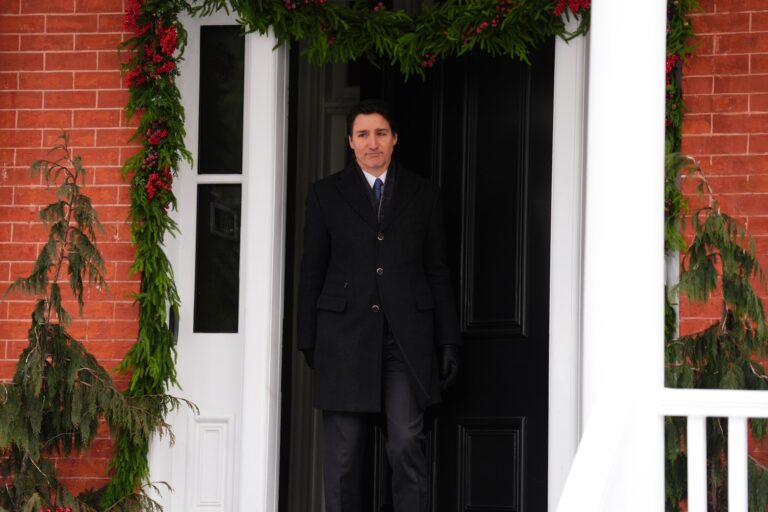
Asked for Trudeau’s response, spokesperson Simon Lafortune referred The Logic to a post on X (formerly Twitter) the prime minister made after Trump spoke: “There isn’t a snowball’s chance in hell that Canada would become part of the United States,” Trudeau wrote. “Workers and communities in both our countries benefit from being each other’s biggest trading and security partner.”
Lafortune did not answer questions about whether the government’s moves on border security seem like enough now to head off an economic battle with Canada’s biggest trading partner. LeBlanc announced those before Christmas while he was still minister of public safety.
Many are now in abeyance, as Parliament sits idle because Trudeau prorogued it on Monday. It can’t pass legislation to enhance the powers of Canadian border guards or share more information with U.S. authorities, for instance, as promised in the government’s fall economic statement.
Gabriel Brunet, a spokesperson for LeBlanc (and, for the moment, his successor at Public Safety, David McGuinty), did not respond to questions about what elements of the package can go ahead despite the prorogation.
At different points in the same answer to a reporter’s question, Trump said the United States subsidizes Canada through a combination of the goods it buys and the military protection it provides. He said he complained to Trudeau about it when the prime minister went to Mar-a-Lago for dinner in November.
“Why should we have a $200-billion deficit and add on to that many, many other things that we give them in terms of subsidy?” Trump said he asked. “That’s OK to have if you’re a state, but if you’re another country, we don’t want to have it.”
The U.S. trade deficit with Canada in 2023 was about US$40.6 billion, according to the American government’s Bureau of Economic Analysis. That’s a bigger gap between imports and exports than was normal in the 2010s, when the U.S. often even ran a trade surplus with Canada, but much less than in the 2000s.
Since 1999, as far back as the bureau’s readily available statistics go, it has never reached US$75 billion in a year, let alone US$200 billion.
Canada is a persistent laggard in meeting defence spending commitments to its North American Treaty Organization (NATO) partners. But a 2022 analysis by the Parliamentary Budget Office put the shortfall at about $14 billion to $15 billion a year. Even if it made sense to add that to the U.S. trade deficit with Canada, the result is nowhere close to US$200 billion.
Trump also said Canada is an unwanted tag-along in buying icebreaking ships: “We’re buying icebreakers, and Canada wants to join us in the buying of icebreakers. I said, ‘You know, we don’t really want to have a partner in the buying of icebreakers. We don’t need a partner.’”
This seemed to be a reference to an agreement announced in November among Canada, the U.S. and Finland to share expertise on building icebreakers—with the goal of selling ships to other countries. Canada ordered two new icebreaking ships from Canadian shipyards in 2021.



Loading...
Thanks for sharing!
You have shared 5 articles this month and reached the maximum amount of shares available.
CloseThis account has reached its share limit.
If you would like to purchase a sharing license please contact The Logic support at [email protected].
CloseGift the full article!
You have gifted 0 article(s) this month and have 5 remaining.
Recipients will be able to read the full text of the article after submitting their email address. They will not have access to other articles or subscriber benefits.
Photo: AP Photo/Evan Vucci
Most Popular This Week




In-depth, agenda-setting reporting
Great journalism delivered straight to your inbox.
Commentary
Carmichael: Canadian ignorance about India is a strategic weakness
Briefing
Aritzia shares pop after earnings rise 204%
First Nation in Alberta goes to court over fast-tracked oil pipeline
Chinese EV maker Geely Auto Group to launch in Canadian market in 2027
Best business newsletter in Canada
Get up to speed in minutes with insights and analysis on the most important stories of the day, every weekday.
Exclusive events
See the bigger picture with reporters and industry experts in subscriber-exclusive events.
Membership in The Logic Council
Membership provides access to our popular Slack channel, participation in subscriber surveys and invitations to exclusive events with our journalists and special guests.





