LONDON — Deep learning pioneer Yoshua Bengio said he supports the creation of a Canadian AI safety institute, as he embarks on a six-month sprint to deliver a landmark assessment of advancements in the field, designed to help the world’s policymakers better appreciate what he believes are the potentially catastrophic risks of the technology.
Skip to content


News
Bengio backs creation of Canadian AI safety institute, will deliver landmark report in six months
Governments ‘won’t be able to regulate something that they don’t master’
Yoshua Bengio, scientific director of Mila, during the AI Safety Summit in Milton Keynes, England, in November 2023. Photo: AP Photo/Alastair Grant
LONDON — Deep learning pioneer Yoshua Bengio said he supports the creation of a Canadian AI safety institute, as he embarks on a six-month sprint to deliver a landmark assessment of advancements in the field, designed to help the world’s policymakers better appreciate what he believes are the potentially catastrophic risks of the technology.
At the AI Safety Summit this week at Bletchley Park, the U.K. and U.S. both announced plans to create organizations that will test artificial intelligence models and examine the technology’s potentially harmful capabilities. Canada’s Innovation Minister François-Philippe Champagne said Thursday he’s also considering setting up such a body.
Talking Points
- Yoshua Bengio has backed proposals for a Canadian AI safety institute, and reiterated calls for a licensing regime for advanced models
- The Université de Montréal professor also said the state-of-the-science report he’s been tapped to lead will improve policymakers’ understanding of the technology’s development and risks
In an interview with The Logic in London on Friday, Bengio—scientific director of the Montreal-based AI institute Mila and co-chair of the federal government’s AI advisory council—expressed support for the initiative. “I think we need that,” he said. “We’re lucky in Canada to have an amazing talent pool that could contribute to [solving] this global problem.”
Meanwhile, he has his own task. At the close of the summit on Thursday, British Prime Minister Rishi Sunak announced that Bengio, a celebrated AI researcher and lately one of the most prominent voices warning of its potential dangers, will lead the writing of a “state-of-the-science” report. The paper will detail the capabilities of so-called frontier systems, the multi-purpose models that power applications like ChatGPT.
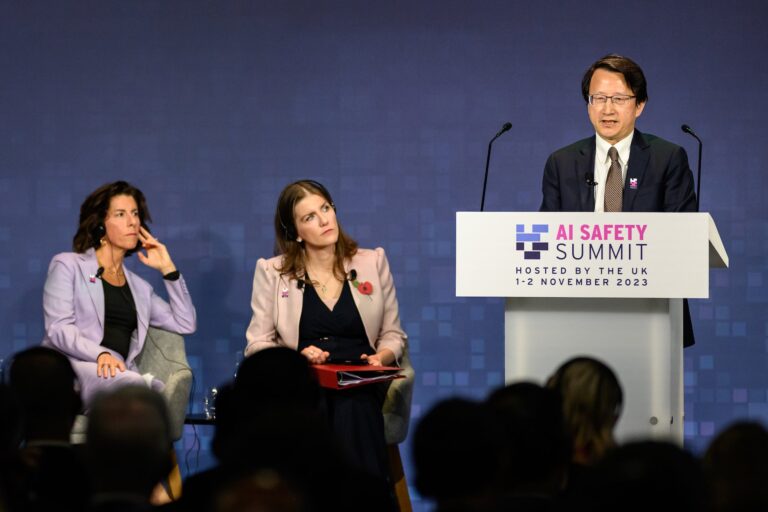
The two-day event saw 29 governments, including the U.S. and China, sign the Bletchley Declaration, agreeing to cooperate more closely on AI safety. The summit helped improve policymakers’ grasp of the problem and create some alignment on the need to solve it, according to Bengio.
“There are a lot more governments—and especially among the important ones—that understand much better the risk [of AI] and have an informal commitment to do something,” he said, citing the need for both research resources and domestic rules. “They won’t be able to regulate something … that they don’t master.”
Related Articles

Bengio’s report is meant to summarize the scientific literature on the technology, helping governments understand it. “There’s a rapid increase in the number of papers being written and submitted in machine learning on the topic of AI safety [and] governance,” said Bengio, crediting the increased research output to public discussions, media coverage and open letters about the technology’s risks. He’s signed at least three notable ones, calling for a pause to the development of more powerful models; for mitigating extinction risks to be made more of a priority; and for more spending on safety.
To write the report, Bengio expects to call on experts in AI and other fields, including ethics, national security, biosafety, chemical weapons, and the social and political sciences. “Some of the questions are about the impact of technology on society,” he said, while he’s also expressed concern about malicious actors using AI to generate disinformation or new munitions. However, the report will not make recommendations to participating governments.
Some AI scholars have said warnings focused on the technology’s catastrophic risks—such as those expressed by Bengio and fellow Canadian AI pioneer Geoffrey Hinton—are a distraction from present concerns about bias, discrimination and labour displacement. At an event hosted by Tortoise Media in London on Friday, Bengio said governments should be trying to address both sets of issues.
The initiative Bengio will lead is based on the Intergovernmental Panel on Climate Change (IPCC), established in 1988. Countries with large resource sectors and industry firms have reportedly lobbied the UN to water down the IPCC’s conclusions. Bengio told The Logic he’s worried his work could face similar pressures, but said the tight timeline on which he’s working could limit the potential for interference.
Eight major tech firms—including Amazon Web Services, Anthropic, Google, Meta, Microsoft and OpenAI—agreed at the summit to give the U.K. and partner countries access to their models for testing. But Bengio said governments should require that AI companies demonstrate to government-commissioned independent scientists that their products are safe, rather than making authorities search for misuse. “In order to get your licence, you have to show that your system is OK,” he said. “And if you don’t behave properly—and you’re going to be monitored—then we take out your licence.”
In an interview with The Logic on Thursday, Champagne did not rule out such a licensing regime, but said he would watch whether allies adopt one, and that any measure would need to be coordinated internationally.



Loading...
Thanks for sharing!
You have shared 5 articles this month and reached the maximum amount of shares available.
CloseThis account has reached its share limit.
If you would like to purchase a sharing license please contact The Logic support at [email protected].
CloseGift the full article!
You have gifted 0 article(s) this month and have 5 remaining.
Recipients will be able to read the full text of the article after submitting their email address. They will not have access to other articles or subscriber benefits.
Photo: AP Photo/Alastair Grant
Most Popular This Week




In-depth, agenda-setting reporting
Great journalism delivered straight to your inbox.
Commentary
Carmichael: Canadian ignorance about India is a strategic weakness
Briefing
Aritzia shares pop after earnings rise 204%
First Nation in Alberta goes to court over fast-tracked oil pipeline
Chinese EV maker Geely Auto Group to launch in Canadian market in 2027
Best business newsletter in Canada
Get up to speed in minutes with insights and analysis on the most important stories of the day, every weekday.
Exclusive events
See the bigger picture with reporters and industry experts in subscriber-exclusive events.
Membership in The Logic Council
Membership provides access to our popular Slack channel, participation in subscriber surveys and invitations to exclusive events with our journalists and special guests.





