OTTAWA — With its new budget, the federal government is walking a tightrope, under the attack from inflation, the need to green a fossil-fuel–dependent economy, and a rapid restructuring of the global economy accelerated by Russia’s invasion of Ukraine.
Skip to content

Analysis
As crisis piles on top of crisis, Liberals forced to take chances with 2022 budget
Deputy Prime Minister and Finance Minister Chrystia Freeland speaks at a news conference in the media lockup, ahead of the tabling of the federal budget, in Ottawa, on April 7, 2022. Photo: The Canadian Press/Justin Tang
OTTAWA — With its new budget, the federal government is walking a tightrope, under the attack from inflation, the need to green a fossil-fuel–dependent economy, and a rapid restructuring of the global economy accelerated by Russia’s invasion of Ukraine.
Talking Point
After years of letting Canada’s productivity wane, the shocks of the pandemic, climate change and the war in Ukraine are forcing the federal government to contend with multiple severe problems at once, fast, under pressure.
Fighting inflation usually means controlling government spending. The green transition demands the government spend a lot more. The restructuring of the global economy has the Liberal government worried that Canada will be left behind, making Finance Minister Chrystia Freeland believe the government needs to move.
“Talking about productivity is not something a smart politician does,” Freeland said in a press conference. “Because the eyes glaze over when you say, ‘Hey, you know, we’re a great government, we’re going to increase productivity.’”
But, she said, productivity is about increasing Canada’s prosperity, and making sure future generations live better than we do.
That means making big bets on new innovation policy—the first time in recent memory it’s been so overtly a government priority for Canada to do better at turning good ideas into functioning products and services—amid massive uncertainties, for a country full of people whose lives and finances feel incredibly fragile.
Freeland’s new budget does not talk about “building back better” after the COVID-19 pandemic. Instead, with the war at the top of the government’s mind, Freeland’s budget speech talks about the need to “build a country that we would all be willing to fight for.”
The budget document projects a deficit of $52.8 billion this fiscal year to help do it, with annual declines taking the deficit to $8.4 billion in 2026–27. And it’s worth noting that despite all the measures to strengthen the economy in the budget, it forecasts annual real growth will slide from 3.9 per cent this year to 1.8 per cent in 2026.
Russia’s invasion has sped up a global process that was already pretty scary—China’s willingness to use its market power and growing U.S. protectionism were bad enough. Now, Russia is being carved out of the global economy, fast.
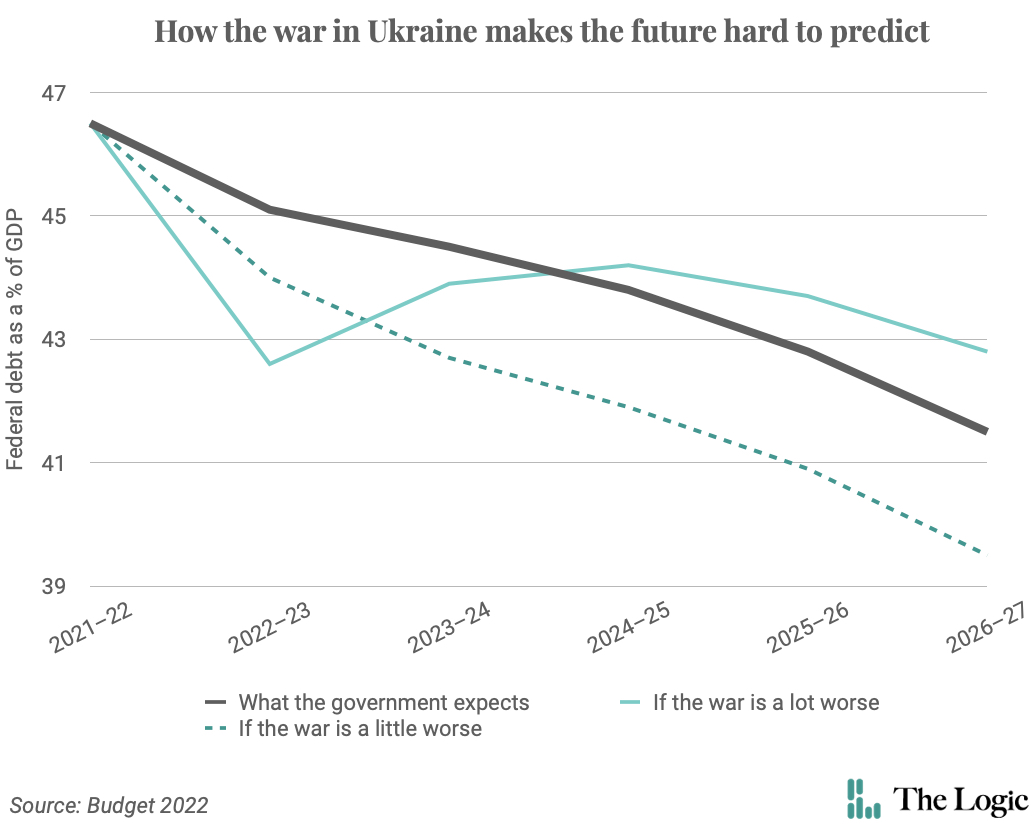
One chart, on page 243 of the federal budget book, shows the uncertain consequences. Freeland’s declared “fiscal anchor” is Canada’s debt-to-GDP ratio; the government wants that number to go down, and projects a decline from 45.1 per cent this fiscal year to 41.5 per cent in 2026–27. Finance Canada ran several sets of numbers for what the war in Ukraine could mean: from high commodity prices to worse consumer anxiety, to higher inflation and higher interest rates to try to beat the higher inflation down.
The government is using relatively conservative assumptions for the 2022 budget. According to its modelling, a slightly worse scenario for Ukraine would be slightly better for Canada, with higher commodity prices helping our economy (and government revenues) more than the other effects hurt. But a drawn-out war in Ukraine, after initially spiking those commodity prices, would soon begin undermining global demand and then the Canadian government’s fiscal plans.
What will actually happen? Of course, nobody can be sure. Transitioning the Canadian economy off fossil fuels without causing needless pain, which might have been the defining national issue for this Liberal government before 2020, feels almost like a quaint problem (though, like climate change, it’s still there).
Inflation, these days at 30-year highs, is bad for Canadians’ sense of financial security and makes business forecasting tough. And a big component of inflation in Canada is housing costs, which the Liberals promised in the 2021 election campaign they would bring under control—even while making it easier for new buyers to get into the market. They promised that “1.4 million homes will be built, preserved, or revitalized” by 2025–26.
The budget revises that target, pledging to double the number of new homes Canada will build. That means boosting construction by 1.9 million residences, according to Mike Moffatt, senior director at the Ottawa-based Smart Prosperity Institute.
Besides being a problem for anyone who needs to pay for housing, high prices are a challenge for businesses: it’s hard to attract talent if talented people have nowhere they can afford to live.
“This must become a great national effort,” Freeland’s budget speech said.
The budget proposes using substantially the same tools the Liberals promised last summer, especially a $4-billion “accelerator” fund to encourage municipal governments to zone for more housing over the next five years.
The accelerator fund’s goal: 100,000 net new homes.
“There’s such a massive disconnect between ambition and policy,” said Moffatt. It’s much like many, many years of federal climate policy, he said—targets galore, faint on the policies to achieve them. “It is very hand-wavy.”
And speaking of climate change, although the budget mentions using the federal government’s contributions to transit projects to encourage higher-density zoning around stations, it doesn’t prioritize urban construction. “They don’t mention the word ‘sprawl’ once,” Moffatt pointed out.
Meanwhile, the Liberals are implementing measures to help homebuyers pay more, such as tax credits and tax-sheltered savings accounts. And a $500 one-time payment for people having trouble affording shelter (at a total cost of $475 million), though “the specifics and delivery method will be announced at a later date.”
According to the senior government official sent in to brief reporters on the budget highlights, Finance Canada believes that the money to be pumped into the housing market via would-be buyers won’t heat the market significantly because it will take a while for, say, tax-sheltered savings accounts to boost those buyers’ power.
Get this wrong and the government will spend a great deal of borrowed money only to make housing inflation worse.
Canada has trudged along through relatively good times for many years. Now we’re having to contend with problems we let lie—in a hurry, under pressure, with the consequences of failure perhaps to reverberate for generations.



Loading...
Thanks for sharing!
You have shared 5 articles this month and reached the maximum amount of shares available.
CloseThis account has reached its share limit.
If you would like to purchase a sharing license please contact The Logic support at [email protected].
CloseGift the full article!
You have gifted 0 article(s) this month and have 5 remaining.
Recipients will be able to read the full text of the article after submitting their email address. They will not have access to other articles or subscriber benefits.
Photo: The Canadian Press/Justin Tang
Most Popular This Week




In-depth, agenda-setting reporting
Great journalism delivered straight to your inbox.
News
Canada faces a satellite-launch crunch as SpaceX retires its workhorse rocket
Briefing
Cohere says it caught an Alibaba model trying to send data to a server in China
Feds and First Nations to work on sharing resource revenue, with a sovereign wealth fund one option
Zafin buys U.S. fintech Naehas in nine-figure deal
Best business newsletter in Canada
Get up to speed in minutes with insights and analysis on the most important stories of the day, every weekday.
Exclusive events
See the bigger picture with reporters and industry experts in subscriber-exclusive events.
Membership in The Logic Council
Membership provides access to our popular Slack channel, participation in subscriber surveys and invitations to exclusive events with our journalists and special guests.