Skip to content

Canada's Business and Tech Newsroom

  • Professional Subscription
  • Partnerships & Advertising
  • Licensing & Syndication
Log In Subscribe
Welcome,
  • My Account
  • Log Out
  • Business
  • Tech
  • National
  • The Big Read
  • Briefings
  • Commentary
Search
Log In Subscribe
Welcome,
  • My Account
  • Log Out
Analysis

Fiscal update shows Carney buying time as Canadians wait for his plans to pay off

Listen Now
0:00
Analysis

Fiscal update shows Carney buying time as Canadians wait for his plans to pay off

The deficit came in $11 billion lower than expected as tax revenues beat projections. But businesses and consumers are still feeling the pinch.

By David Reevely
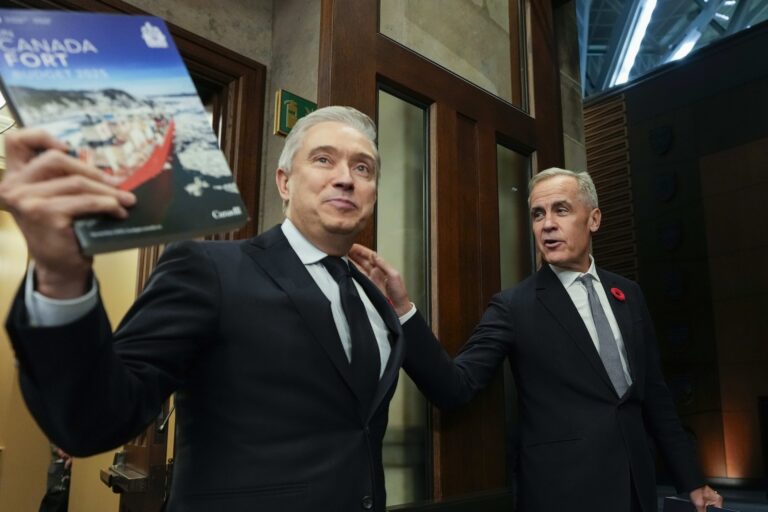
Prime Minister Mark Carney and Finance Minister Francois-Philippe Champagne stand and applaud inside of the House of Commons.
Prime Minister Mark Carney, with Finance Minister François-Philippe Champagne in the House of Commons; Champagne delivered the government's spring economic statement on Tuesday. Photo: The Canadian Press/Adrian Wyld
Apr 28, 2026
A A
A Small A Medium A Large
Share

Gift

Share

Listen Now
0:00

OTTAWA — The Liberals’ new economic update shows a smaller fiscal deficit than expected, but reveals Prime Minister Mark Carney still struggling with how to make Canadians feel better about their lives while they wait for the stronger country he promises to lead them to.

The books aren’t quite closed on the 2025-26 fiscal year, which ended March 31, but even after accounting for everything the federal government has done and promised since the November budget, the update says the deficit for that year will be $66.9 billion instead of the $78.3 billion expected just months ago.

Talking Points

  • Revenue is higher than expected and expenses are lower, so Canada’s national finances are significantly better than the federal Liberals projects in their autumn budget
  • The spring update shows a government trying to buy time for its economic overhaul to take hold in the minds of voters who remain worried about their own finances

Projections for the current year and those to come aren’t as dramatically better, but they’re still improved each year, by $100 million to $400 million.

This is even though the Liberal government has cut personal income taxes and scrapped Justin Trudeau’s increase to capital gains taxes. It’s cut the gas tax. Yet revenue has grown faster than the Finance Department projected last fall.

Personal income taxes are up because incomes are up. Taxes on non-residents’ Canadian income are up because the stock market is strong. Corporate income tax revenue is up, “reflecting steady profits, particularly in the financial sector.” It dips in future years because the government is letting corporations write off more capital investments, then is projected to increase again.

Related Articles
Budget shows what Carney’s big promises will cost but few of the sacrifices he says Canada must make

By David Reevely
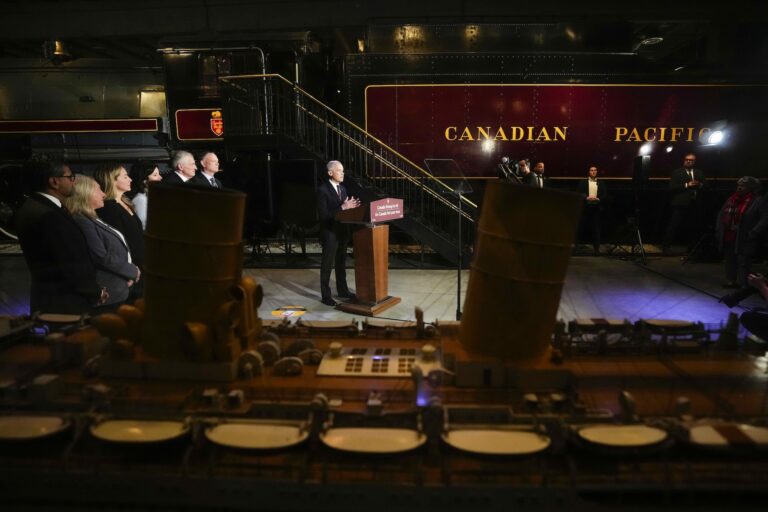
A wide shot of Mark Carney at a lectern, with a vintage Canadian Pacific steam locomotive as his backdrop.

Carney announces Canadian sovereign wealth fund with initial $25B in public money

By David Reevely

Spending on programs is lower than projected, partly because the government hasn’t had to pay out unemployment benefits it expected to. Where costs have gone up, it’s mostly for positive reasons, like bigger transfers to provincial governments that arise from higher-than-expected economic growth.

Carney boasted about the government’s “responsible fiscal management” on Monday as he announced his plans for a new sovereign wealth fund, but the amount of restraint that takes is limited. The Liberals have not just gone and spent all the money they didn’t expect to have.

The fiscal update’s numbers show that Canada’s economic situation is markedly better than the last budget anticipated. Yet polls, like this recent one from Abacus Data, indicate that the cost of living and the economy top Canadians’ collective lists of concerns.

A section of Tuesday’s economic update explicitly grapples with this mismatch. “Why Canadians Still Feel Their Budgets Are Strained—And What the Government Is Doing About It,” it’s titled. Overall inflation isn’t bad now and wages have grown faster than prices for three years, it says. But food and gasoline prices (especially lately) have kept increasing, and even when we’re buying things whose costs have stabilized, 2026 prices give us sticker shock.
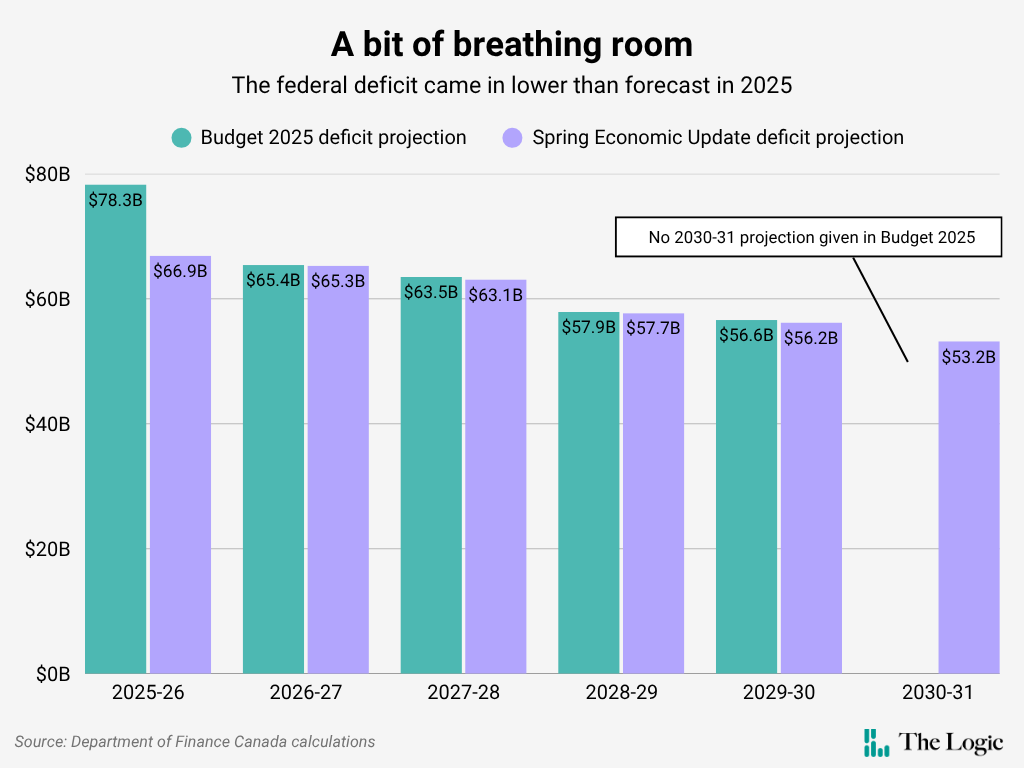
A dual-bar chart headlined "A bit of breathing room" showing the 2025 Budget's projected federal deficit for the next six years alongside the 2026 spring economic statement's projections for the same years. For the 2025-26 year, the 2025 projection was $78.3 billion, but the 2026 projection is down to $66.9 billion. For future years, the 2026 projection is between $100 million and $400 million smaller than the 2025 projection. The deficits projected trend downward over the years, and the 2026 spring economic statement forecast has the 2030-21 deficit down to $53.2 billion. (There is no 2030-31 forecast to compare with from the 2025 budget.)

“All macroeconomic indicators are green,” Finance Minister François-Philippe Champagne said in explaining the budget. But, he added, Canadians are asking, “What about me? …We need to help people where they are now.”

In his instantly famous speech at the World Economic Forum in Davos in January, Carney drew on Thucydides in saying that it feels too often these days that “the strong can do what they can, and the weak must suffer what they must.”

The connection between that lament and Carney’s relentless Canada Strong sloganeering—“Canada Strong For All” is right on the economic update’s cover—isn’t hard to make.

Insisting to voters that things aren’t that bad tends to go badly for politicians. Furthermore, the current state of affairs is fragile. U.S. President Donald Trump has mostly honoured the U.S.-Mexico-Canada trade agreement but he might tear it up tomorrow. We woke up one day at the end of February and he’d bombed Iran and then gas went up 50 cents a litre.

The task before Carney is to make Canadians feel strong, buying time for his agenda of getting big projects built and new trade deals done.

Monday’s Canada Strong Fund announcement is in that vein. Carney called it a sovereign wealth fund, inviting comparisons to similar vehicles created by oil-rich governments that had more money rolling in than they knew what to do with. Despite the better deficit numbers, that’s definitely not a problem the Canadian government has.

But the prime minister’s actual pitch for the fund was different. It’s intended to “create wealth for Canadians today and our kids tomorrow,” he said, by buying stakes in (presumably) profitable major projects, for the federal government and individual Canadians who decide to put their own savings into it.

Everyone, in other words, can be part of the ownership class, not just a helpless watcher of what big international money does.

Tuesday’s update offers yet more pocketbook help. The government proposes to cut Canada Pension Plan contribution rates a bit; a worker making $70,000 a year would get to keep $133 more of it, with an equal savings for his or her employer. Not a fortune, but nothing.

It’s expected to cost about $3 billion a year in foregone revenue for the Canada Pension Plan, but a recent assessment found that the plan will still be taking in slightly more than it needs in order to meet future obligations.

There’s money promised to improve Canada’s dozens of small-craft harbours, which matter a lot in their coastal communities.

There’s funding for sports, to host more international competitions and support national organizations like Tennis Canada and Canada Soccer.

Gift the full article

“Communities love to come together to cheer on their friends and neighbours,” the update says. “Our athletes draw us together. They inspire and exhibit the qualities that set Canadians apart: Determination. Team spirit. Grit.” And so on for several paragraphs.

Does the Brier do measurable economic good in the same way as improving the container throughput at the Port of Vancouver? Not really. But a good curling competition, like seeing your kid play soccer on a nicely spiffed-up field, might be more use in attacking a national deficit in vibes.


#budgets #economy #fiscal policy #Mark Carney #National #spring economic statement 2026

Loading...

Thanks for sharing!

You have shared 5 articles this month and reached the maximum amount of shares available.

Close
This account has reached its share limit.

If you would like to purchase a sharing license please contact The Logic support at [email protected].

Close
Want to share this article?

Upgrade to all-access now

Close
Gift the full article!

You have gifted 0 article(s) this month and have 5 remaining.

Copy link and gift
Copy Link
Email to a friend
Send Email
Gift on Social Media

Recipients will be able to read the full text of the article after submitting their email address. They will not have access to other articles or subscriber benefits.

Prime Minister Mark Carney and Finance Minister Francois-Philippe Champagne stand and applaud inside of the House of Commons.

Photo: The Canadian Press/Adrian Wyld

A dual-bar chart headlined "A bit of breathing room" showing the 2025 Budget's projected federal deficit for the next six years alongside the 2026 spring economic statement's projections for the same years. For the 2025-26 year, the 2025 projection was $78.3 billion, but the 2026 projection is down to $66.9 billion. For future years, the 2026 projection is between $100 million and $400 million smaller than the 2025 projection. The deficits projected trend downward over the years, and the 2026 spring economic statement forecast has the 2030-21 deficit down to $53.2 billion. (There is no 2030-31 forecast to compare with from the 2025 budget.)

Most Popular This Week

Exclusive

PCO clerk Sabia stayed on Mastercard Foundation board for a year with no conflict screen

By Joanna Smith
Nakisa CEO Babak Varjavandi in a screencapture from the floor of a tech show. He's wearing a suit jacket and open-collared shirt.
News

Canadian firms are ready to help with digital sovereignty. Their challenge is getting approved

By Laura Osman
A shot of a small rocket sitting on a launch pad attached to its launch equipment. The backdrop is open sea and a light blue sky.
News

Canada’s submarine decision just paid off for Nova Scotia’s spaceport

By David Reevely
An aerial photo of Kearny mine, a mine surrounded by dense forest, with terraced rock walls that surround a deep blue body of water.
News

Canada bets on graphite as allies scramble for critical minerals

By Anita Balakrishnan

In-depth, agenda-setting reporting

Great journalism delivered straight to your inbox.

A shot of a sign bearing the Pfizer logo, with a lowrise office building in the background.
News

So far, foreign-owned firms have dominated Buy Canadian contracts

By Laura Osman

Briefing

National Defence funds drone skunkworks in Mirabel, Que.

By David Reevely   |   Jul 14, 2026 | 3:52 PM ET

Anthropic commits $10M worth of Claude to Canadian research centres

By Murad Hemmadi   |   Jul 14, 2026 | 3:36 PM ET

Thomson Reuters sells majority stake in book business for US$500M

By Anita Balakrishnan   |   Jul 14, 2026 | 3:13 PM ET

Best business newsletter in Canada

Get up to speed in minutes with insights and analysis on the most important stories of the day, every weekday.

Exclusive events

See the bigger picture with reporters and industry experts in subscriber-exclusive events.

Membership in The Logic Council

Membership provides access to our popular Slack channel, participation in subscriber surveys and invitations to exclusive events with our journalists and special guests.

Recent Popular Stories

Commentary: Quebec Ink

Quebec’s era of endless, cheap electricity is coming to an end

By Martin Patriquin   |   Jul 6, 2026
A cityscape featuring two tall buildings; the right one has a large orange "Q" logo and a Quebec flag atop. The sky is clear and blue.
Exclusive

PCO clerk Sabia stayed on Mastercard Foundation board for a year with no conflict screen

By Joanna Smith   |   Jul 13, 2026
News

Canada’s submarine decision just paid off for Nova Scotia’s spaceport

By David Reevely   |   Jul 8, 2026
A shot of a small rocket sitting on a launch pad attached to its launch equipment. The backdrop is open sea and a light blue sky.
News

Canada bets on graphite as allies scramble for critical minerals

By Anita Balakrishnan   |   Jul 7, 2026
An aerial photo of Kearny mine, a mine surrounded by dense forest, with terraced rock walls that surround a deep blue body of water.
News

Meta to spend $13B on sprawling Alberta data-centre complex

By Meghan Potkins   |   Jul 8, 2026
An aerial-style rendering of a massive data centre on a prairie landscape of farm fields and trees.
News

Alberta wants to be a model for government AI and power Canada-wide adoption

By Murad Hemmadi   |   Jul 10, 2026
A shot of Nate Glubish at a lectern, against a backdrop of exposed brick partly covered by a white film screen.

Canada's most influential executives and policymakers are reading The Logic

  • CPP Investments
  • Sun Life Financial
  • C100
  • Amazon
  • Telus
  • Mastercard
  • bdc
  • Shopify
  • Rogers
  • RBC
  • General Motors
  • MaRS
  • Government of Canada
  • Uber
  • Loblaw Companies Limited
logic-logo

Canada's Business and Tech Newsroom

100% human-crafted journalism

Newsroom

  • News Tips
  • AI Policy
  • Editorial Disclosures
  • Story Pitches

Company

  • About Us
  • Terms of Service
  • Privacy Statement
  • Corporate Information

Contact

  • Contact Us
  • Advertise
  • FAQs
  • Work at The Logic

© 2026 The Logic Inc. All Rights Reserved.

Trusted by leaders

Error

Account creation failed.

Please email us at [email protected].

Create Account

[wppb-register form_name=”cozmo-registration-form-for-modal”]

I do have an account
Login
or

[wppb-login]

I don’t have an account