Skip to content


Analysis
Canada’s EV sales have cratered 32% this year
A mix of economic uncertainty and confusing subsidies has led to a major slump just as the country was gearing up for a sales boom
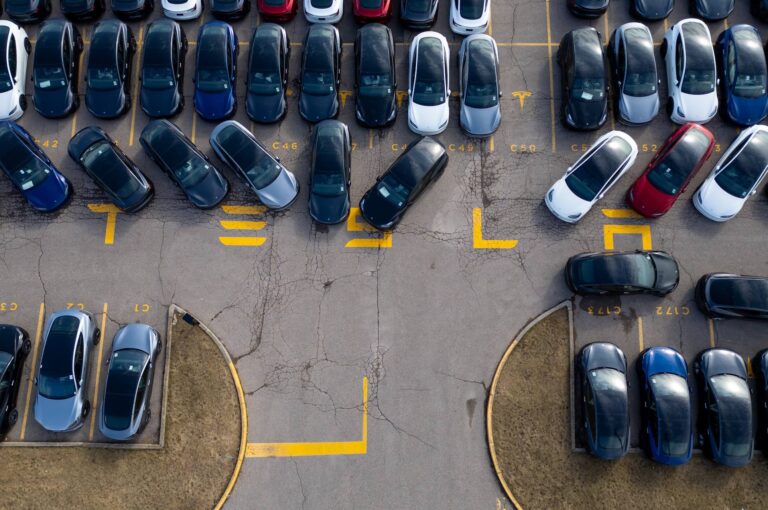
Canadian EV sales fell 32 per cent in the first three quarters of the year. Photo: Justin Greaves/The Logic
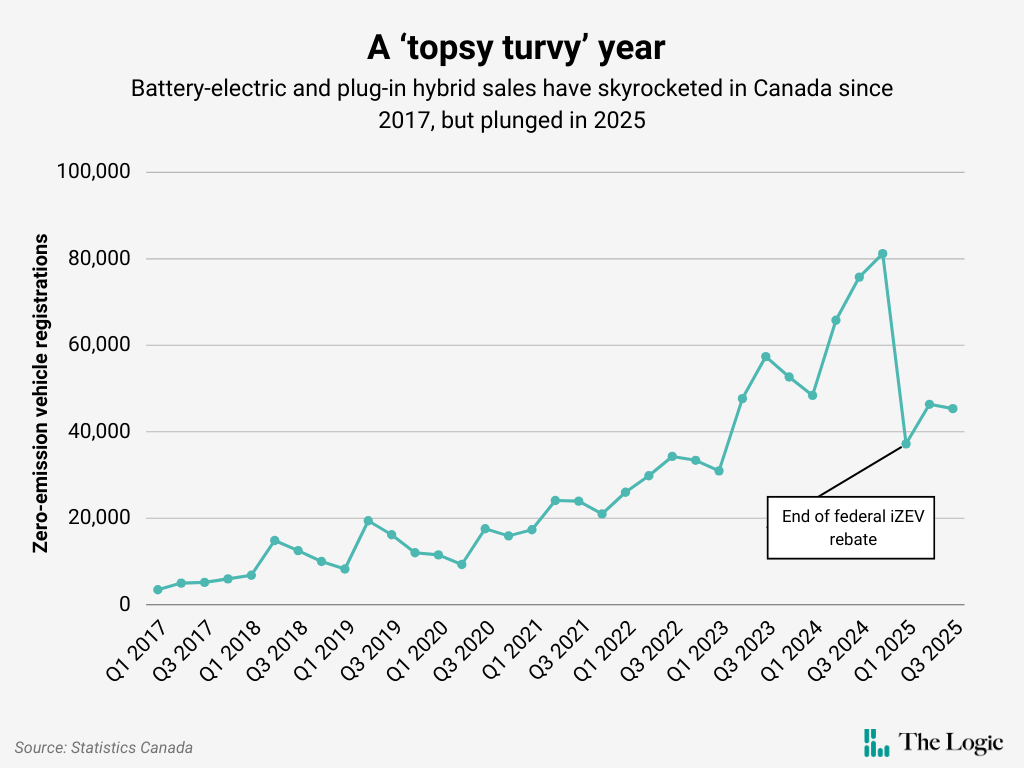
A 32 per cent year-on-year drop in zero-emission vehicle sales in the first three quarters of 2025 has sparked concern that weak EV demand could derail Canada’s emissions-reduction goals.
National zero-emission vehicle registrations, a proxy for sales, have been on a downward trend throughout much of the year, according to Statistics Canada, in stark contrast to the global upswing in every other major region outside of North America. Some Canadians see that as a sign that the country isn’t doing enough to spur adoption, while others believe Canada’s tough economic position requires a new approach to decarbonization.
Talking Points
- Canada’s EV adoption rate has skyrocketed since 2017, but sales slipped in 2025
- Some see that as a sign Canada needs to step up its game, while others think that the nation needs to expand its approach to emissions regulations as the economy weighs on consumers
Daniel Breton, CEO of Electric Mobility Canada, said Canada’s “topsy turvy” year shouldn’t be seen as a message about EV popularity. Rather, he said it has more to do with the U.S.-led global trade war and the abrupt end to federal EV purchase incentives in January, which the government has promised to bring back for months but have yet to materialize. Breton said some consumers are waiting to buy EVs and are confused why the rebates have taken so long to return. The industry association recently estimated that there are now more than 1 million EVs on Canadian roads, up from just 18,000 a decade ago.
“To say that the EV transition is not happening, or that Canadians are not interested. That’s false,” said Breton. “EV sales have slowed down in the short term, but the trend is there.”
Others think 2025’s EV sales dip could deal a bigger blow to the industry, especially with new ZEV registrations down 40 per cent in the third quarter. The Canadian Automobile Dealers Association has argued that it cannot meet EV sales targets set by the federal government, which are currently under review. Charles Bernard, the group’s chief economist, said some dealers are overloaded with extra EVs they couldn’t sell this year after consumers scrambled to take advantage of the disappearing rebates at the end of last year. Online car marketplace AutoTrader found in a survey in February and March that 42 per cent of non-EV owners were considering an EV for their next car, down from 68 per cent in 2022.
“Over the last two years, those consumers that really were looking to get an EV, they bought it when the incentive program was in full force, especially in provinces like Quebec,” said Bernard.
Related Articles
That mirrors patterns in other countries that dropped incentive programs. EV sales in Germany fell 27 per cent when the country killed its incentive program, said Baris Akyurek, vice-president of insights and intelligence at AutoTrader. U.S. sales are expected to drop sharply through the end of the year after EV tax credits ended.
“Now that we are going through what we’re going through macroeconomically,” said Akyurek, “consumers are kind of hitting the brakes.”
The EU has recently eased its EV targets slightly, and Bernard argued that the Canadian government should consider focusing on reducing vehicle emissions with hybrids or more fuel-efficient vehicles from Europe or South Korea, rather than just EV sales.
But Arthur Zhang, who works with the Canadian Climate Institute to measure the country’s progress toward climate goals, said it would be a missed opportunity for Canada to abandon the transition away from gas guzzlers, since many drivers could save money on future fuel costs by switching to these vehicles now. Other countries, like China, which saw EV sales jump 21 per cent from January through November, will reap those benefits.
“There has been this floor in terms of EV sales that has stuck,” said Zhang. “This is really a moment where we can assess: ‘What are currently the barriers for EV adoption? And how can governments reorient their programs to be focused on addressing those key problems?’”



Loading...
Thanks for sharing!
You have shared 5 articles this month and reached the maximum amount of shares available.
CloseThis account has reached its share limit.
If you would like to purchase a sharing license please contact The Logic support at [email protected].
CloseGift the full article!
You have gifted 0 article(s) this month and have 5 remaining.
Recipients will be able to read the full text of the article after submitting their email address. They will not have access to other articles or subscriber benefits.
Photo: Justin Greaves/The Logic
Most Popular This Week




In-depth, agenda-setting reporting
Great journalism delivered straight to your inbox.
News
Panel decries Canada’s chaotic way of funding world-class science
Briefing
AI is pushing insurers to become asset managers, Canadian CEOs say
Trump administration faces lawsuit over 50% tariffs on Canadian goods
Canada-U.S. trade war to reduce real GDP by 1.4% over 2024 levels after five years: PBO
Best business newsletter in Canada
Get up to speed in minutes with insights and analysis on the most important stories of the day, every weekday.
Exclusive events
See the bigger picture with reporters and industry experts in subscriber-exclusive events.
Membership in The Logic Council
Membership provides access to our popular Slack channel, participation in subscriber surveys and invitations to exclusive events with our journalists and special guests.





