Skip to content


News
AI is helping Canadian firms stay on top of the tariff chaos
From customs chatbots to services that help find clients, AI-powered tools are helping companies steer through the messy new world of global trade
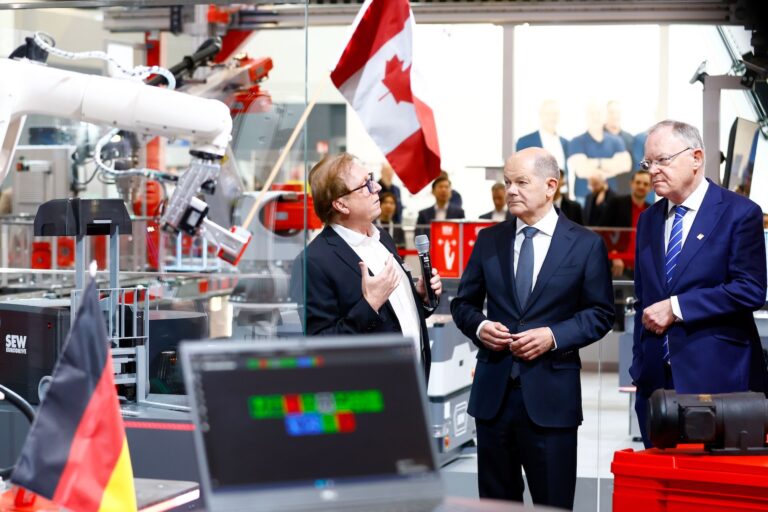
Exporters are turning to a new generation of tools in their search for clarity on U.S. tariffs and trade policy. Photo: AFP via Getty Images/Johannes Eisele
OTTAWA — What is the current U.S. tariff rate on Canadian pork chops, cookies or candlesticks? Do they qualify for duty-free treatment under the North American trade pact? How do you fill out the paperwork to prove it? In their desperate search for clarity on these kinds of questions, exporters are turning to a new generation of tools—many of them incorporating AI—to navigate the ever-changing trade landscape.
The changes to U.S. tariff policy have been fast, furious and confusing since President Donald Trump launched his trade war. As Jim Jarrell, CEO of auto parts manufacturer Linamar, recently told The Logic, it can be difficult to figure out which duties need to be paid. Even customs brokers have struggled to keep up, never mind small businesses trying to prove compliance with the United States-Mexico-Canada Agreement, or dealing with the loss of the de minimis exemption. The push for Canada to diversify exports outside the U.S. adds the challenge of learning unfamiliar rules and market conditions in other countries.
Talking Points
- Several Canadian firms and organizations are developing technological tools to help businesses navigate the shifting sands of tariffs and global trade
- Toronto-based startup Tariff Sense is using artificial intelligence to keep Canadian companies abreast of ever-changing U.S. tariff rates and trade policy
- NGen developed an AI-powered database to link Canadian advanced manufacturers with potential clients at home and abroad
Several businesses and organizations are trying to stay on top of things through innovative tools. The AI-powered platform developed by Toronto-based startup Tariff Sense is connected to official sources of information on trade rules and tariff rates—including bulletins from the U.S. Customs and Border Protection and executive orders from the White House—that ensure its information stays current no matter how many times, or how quickly, Trump changes the rules of the game.
“It will give very detailed responses at the level a customs broker or a trade professional will answer,” Tariff Sense founder Tina Safaei said in an interview with The Logic.
Related Articles

The freely available chatbot is just part of the offering from Tariff Sense. The startup recently went through a Vector Institute program that helps small and medium-sized businesses develop AI for a specific use case. Earlier this year, Safaei and her team developed and shared a free tool that analyzes a bill of materials—a list of the raw materials and other components involved in manufacturing—for companies in the electronics sector. It assesses the duties and how various scenarios would affect a company’s costs. “We just wanted to help out,” she said of the original tool that they shared with their networks. Within a month, there were about 500 active users, she said.
The latest version of Tariff Sense—a paid subscription product in the pilot stage for early clients—goes further by actually completing the paperwork needed for customs clearance. “We also look for any errors, any mismatches,” Safaei said, “and we give them everything ready for final review and submission to their border agency.” Much like tax-filing software suggests ways for users to optimize their returns, Tariff Sense will identify cost-saving opportunities.
One thing the tool does not do: submit the documentation directly to the U.S. Customs and Border Protection. “That final review by a human is actually still a must in the process,” said Safaei. There is a good reason for that. The U.S. Department of Justice, along with the Department of Homeland Security, have been ramping up efforts to crack down on “trade fraud.” Erroneous details could lead to allegations of tariff evasion and cost a company dearly.
Authentica, based in Burlington, Ont., is applying AI to make it easier to buy materials across borders. Clients can use the firm’s network of AI agents to find suppliers, check that they’re not on any government ban lists, generate the import paperwork and cross-reference all the documents to ensure they receive what they ordered.
Authentica has also partnered with underwriters and payment processors to insure customers and handle their money. And it’s building out a system using biotags and physical verification that can help firms prove the path their goods took to their final destination—crucial in a world of constantly shifting tariffs based on where things come from. “In the next six months, we want to do the first fully autonomous international trade using agentic AI,” said CEO Michael Borg.
Next Generation Manufacturing Canada (NGen), the Hamilton-based non-profit that leads the country’s advanced manufacturing cluster, is using AI to help diversify trade—including within Canada. CEO Jayson Myers said NGen created a database of U.S. imports to give Canadian companies a clear sense of where opportunity lies.
The resource was especially useful while Canada was maintaining retaliatory tariffs on $30 billion worth of U.S. imports across a wide range of product categories. Myers said it can also help domestic industries make the most of the Buy Canadian movement. “If you were going to go out and actively hunt for business, you would hunt for areas where you could displace U.S. imports,” he said.
Another tool, NGen Connect, is a database of Canadian advanced manufacturers. NGen created it by using AI to scrape websites for company information and their technologies, processes and use cases. If a defence contractor, for example, wants to know who makes special sealants for naval vessels, it can use the tool to pull up a list of companies, Myers said.
In early April, NGen brought the database to Hannover Messe, a major industrial trade fair in Germany, where, Myers said, Canadian participants often connect with each other, which can lead to both domestic and international business deals. For a Canadian company venturing into a foreign market, fitting into an existing supply chain overseas can make things much easier—especially if the client is another Canadian business already set up there. The NGen tool is trying to speed up those connections. “The biggest problem across this country is that we aren’t aware of who does what,” Myers said.



Loading...
Thanks for sharing!
You have shared 5 articles this month and reached the maximum amount of shares available.
CloseThis account has reached its share limit.
If you would like to purchase a sharing license please contact The Logic support at [email protected].
CloseGift the full article!
You have gifted 0 article(s) this month and have 5 remaining.
Recipients will be able to read the full text of the article after submitting their email address. They will not have access to other articles or subscriber benefits.
Photo: AFP via Getty Images/Johannes Eisele
Most Popular This Week




In-depth, agenda-setting reporting
Great journalism delivered straight to your inbox.
News
Panel decries Canada’s chaotic way of funding world-class science
Briefing
Feds pledge $15M for U.S. satellite navigation company Xona to expand in Montreal
Inovia raises US$200M for new VC fund as it eyes AI’s impact
43% of eligible Albertans voted ahead of Monday’s referendum
Best business newsletter in Canada
Get up to speed in minutes with insights and analysis on the most important stories of the day, every weekday.
Exclusive events
See the bigger picture with reporters and industry experts in subscriber-exclusive events.
Membership in The Logic Council
Membership provides access to our popular Slack channel, participation in subscriber surveys and invitations to exclusive events with our journalists and special guests.







