You want to talk about mental health? In this economy? Well, yes.
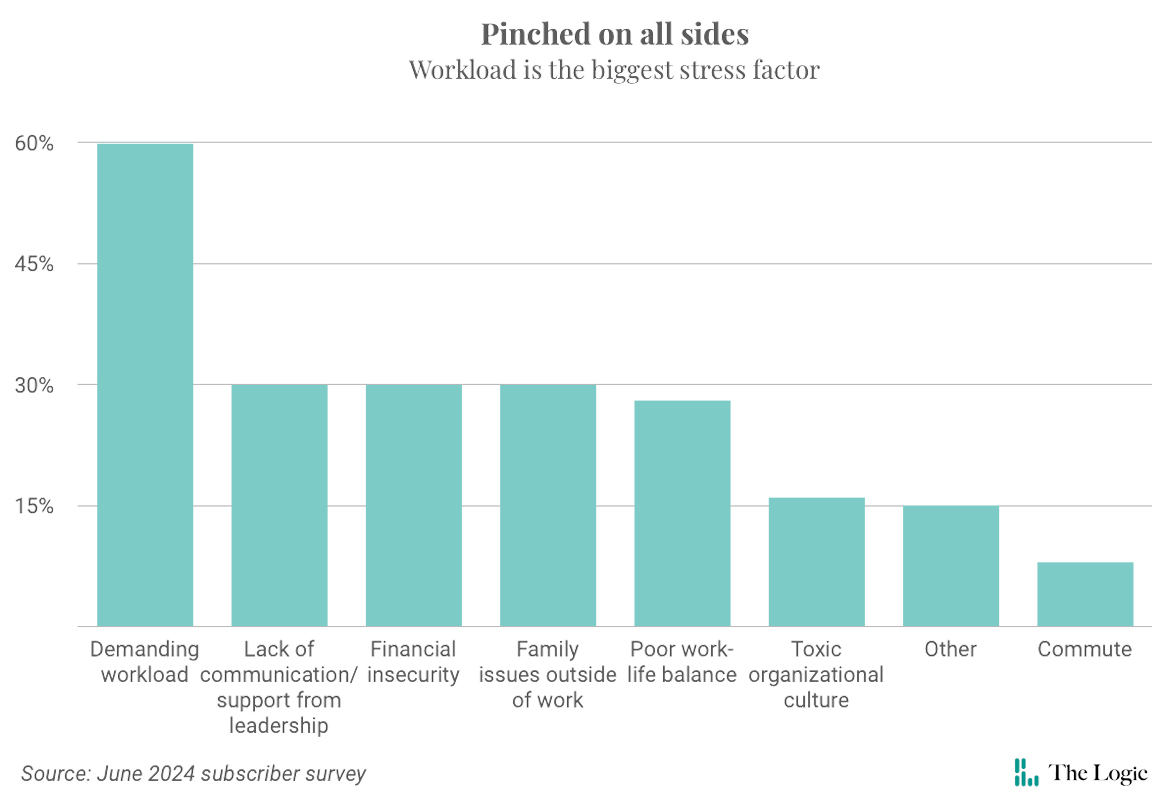
Economic insecurity is playing a big part in what experts regard as a mental-health crisis, which in turn has an economic toll. The pressure is especially acute for entrepreneurs and employees of startups. So The Logic’s June subscriber survey took a reading of mental health—and conversations about it—in the workplace.
To put it mildly, respondents are feeling the heat. Fully four out of five said they were either “hanging in there,” “stressed” or “fully burnt out,” while only 20 per cent reported very low stress levels. Many responded with variants of one respondent’s description: “I’m personally and professionally overwhelmed and running out of bandwidth to cope, let alone address it.” Another bundled a range of stress factors together: “Across relationships, family, politics and uncertainty in the tech market—I’ve chewed off all nails and am neglecting self care.”
The findings square with those of other studies and surveys pointing to a wave of anxiety among businesspeople as inflation took hold in the wake of the pandemic. Worried, the Business Development Bank of Canada started offering free virtual therapy for its clients through GreenShield Health.
In May, the bank’s own annual survey of entrepreneurs found signs of improvement, but the responses of Logic readers suggest the sentiment is far from unanimous. Thirty-one per cent said they’re more stressed at work this year than last. “Still dealing with the effects of high interest rates and inflation,” wrote one reader. “The last four years feel like a giant era of disruption, especially for those of us mid-career.”
Another wrote, “Last year’s stress was more uncertainty-related, and this year it’s more a realization of what that more certain future is looking like.” Meaning: bleak.
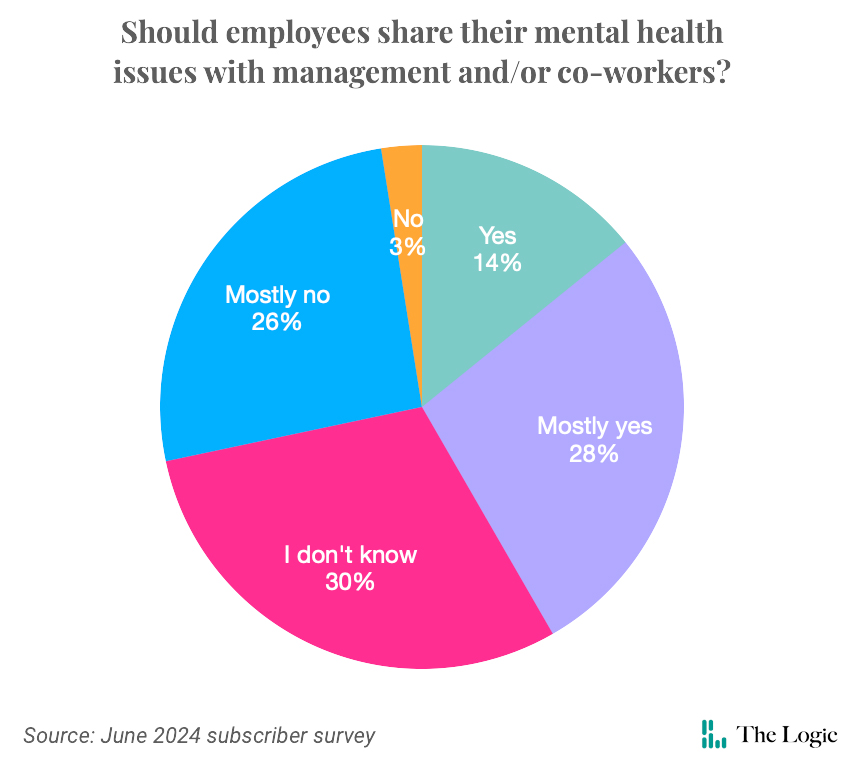
Despite societal attempts at destigmatizing mental health, there was no consensus on whether employees should share their personal struggles with others in the workplace: 30 per cent said “I don’t know” while 28 per cent said “mostly no” or “no.” One reader wrote, “I work in an organization where we are encouraged to speak up about work-life balance and stress levels. However, many colleagues fear professional repercussions from pushing back on work due to mental well-being.”
Another said, “As someone who worked in a corporate setting, disclosing my diagnosis was probably the worst decision.”
“Mental health issues are like broken bones and surgeries,” mused one reader. “Of course, they should form part of the conversation because they happen to humans. However, dwelling on them in the workplace is not healthy.”
At least one reader took a pragmatic view reflecting the inherent stressfulness of market competition. “The best thing for mental health in a business is not to talk about mental health in the business. It’s just to run a business well. Yes, it’s difficult to do, but no amount of therapy can compensate for it.”
Some respondents pointed out that their benefits barely cover the annual cost of three therapy sessions.
Only one-third said they occasionally take time off work to address their mental health. About the same number responded, “No, but probably should have.” Thirteen per cent said they’d never even consider time off an option no matter the circumstance. One admitted they “probably would have benefited from a day or two off when dealing with a marital breakdown and my mother’s Alzheimer’s.”
One reader was clearly not concerned with any workplace fallout from stress leave: “I storm off.”
Stepping away—for a few days or an extended time—is not selfish, readers noted; it can be invaluable. “After two decades spent in multiple startups, I was completely burnt out,” said one. “I hit pause in 2021 and took a sabbatical, completely ignoring all things tech. I eventually recovered mentally, learned new tools to manage stress and burnout, and got back to work a year ago. So far so good.”
Methodology
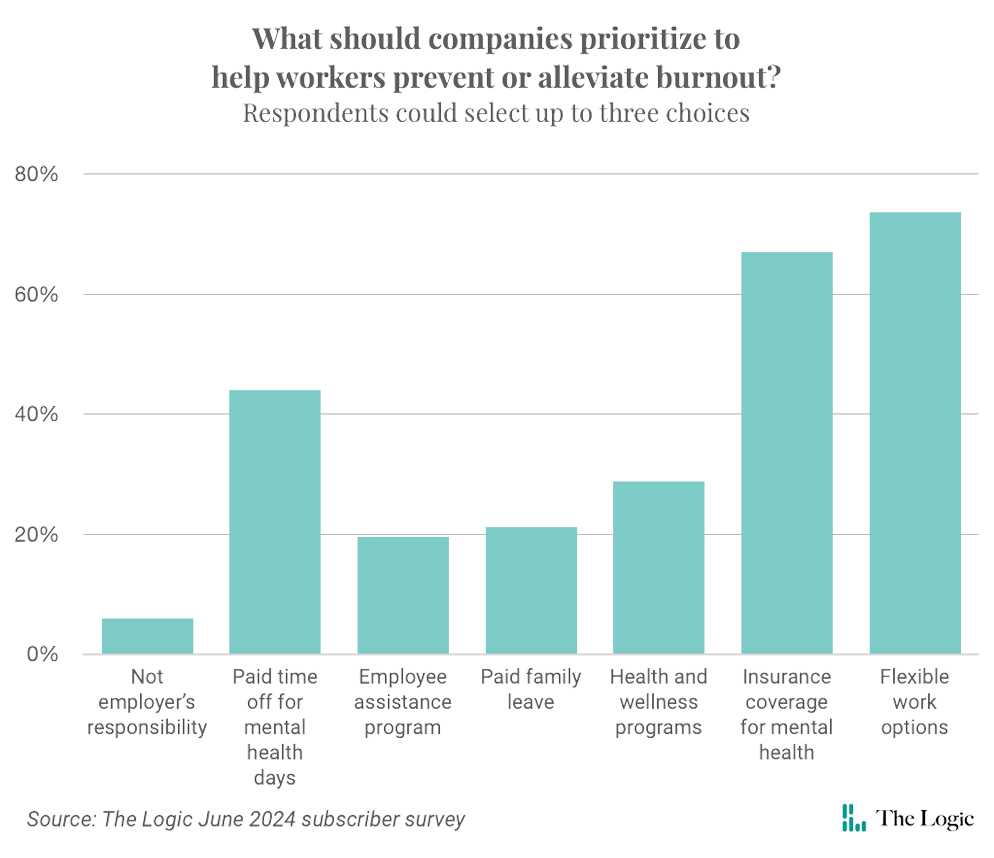
The Logic emailed subscribers a private link to an online survey on June 18 and the survey closed June 21. Respondents’ identities were kept anonymous, and they were encouraged to submit comments. Subscribers were first asked, “How would you describe your current level of stress and/or burnout, both in and out of the office?” They could answer: “Fully burnt out,” “stressed,” “hanging in there, all things considered” or “I have very low stress levels in general.” When asked how that compared to this time last year, they could answer “more,” “same” or “less.” They were also asked: “Does your workplace provide a benefits program that covers mental health expenses adequately, in your view?” Options provided were “yes,” “mostly yes,” “I don’t know,” “mostly no” or “no.” Asked what contributed most to their stress levels at work, respondents were given these options: “Demanding workload,” “lack of communication/support from leadership,” “financial insecurity,” “family issues outside of work,” “poor work-life balance,” “toxic organizational culture,” “commute” or “other.” Next, they were asked: “Should employees share their mental health issues with management and/or co-workers?” Optional responses were: “Yes,” “mostly yes,” “I don’t know,” “mostly no” and “no.” They were then asked whether they’d ever taken time off work to address their own mental health concerns. Optional responses were: “Often,” “occasionally,” “no, but probably should have,” “no, I didn’t need to” and “would never consider this an option.” When asked what companies should prioritize to help prevent or alleviate burnout, respondents could select up to three options: “Flexible work options,” “insurance coverage for mental health expenses,” “health and wellness programs,” “paid time off for mental health days,” “paid family leave,” “employee assistance programs” and “nothing, it’s not an employer’s responsibility.”