Over half of respondents to The Logic’s October survey said they spend at least $200 per month on their health and wellness, while about a fifth of subscribers said they spend more than $500.
Skip to content
 Yoga, pilates and related practices were among the most popular forms of exercise for The Logic’s survey participants. Photo: The Canadian Press/Justin Tang




Subscriber Survey
From IV therapy to yoga: How readers improve their well-being—and work performance
Half of respondents spend more than $200 a month on wellness, and 70% say it’s ‘very important’ for work performance
Yoga, pilates and related practices were among the most popular forms of exercise for The Logic’s survey participants. Photo: The Canadian Press/Justin Tang
Over half of respondents to The Logic’s October survey said they spend at least $200 per month on their health and wellness, while about a fifth of subscribers said they spend more than $500.
The Logic asked readers how they care for their physical and mental health, and how much time and money they spend on it. Almost 40 per cent said they devote five to 10 hours per week on exercise or wellness activities, and the vast majority, at nearly 70 per cent, said health and wellness is “very important” for work performance.
The wellness industry was worth US$1.5 trillion in 2021—encompassing everything from exercise classes, health foods and beauty products, to sleep and mindfulness apps—according to McKinsey & Company. Tech leaders are especially voracious consumers: The Information found that tech leaders among its readership work out twice as much as the average American and spend 10 times as much on equipment and classes.
Related Articles



Bryan Johnson, a software entrepreneur who spends US$2 million a year on treatments in an attempt to stall the aging process, is one high-profile example. But there are others, too, who have sought to improve their health to optimize performance: Jack Dorsey has experimented with fasting to improve focus, and Mark Zuckerberg has trained in Brazilian jiu-jitsu.
In The Logic’s survey, about 32 per cent of respondents spent between $200 and $500 on health and wellness monthly, which could include anything from fitness classes, massages, supplements, sleep aids, therapy, apps and other wellness products. About 18 per cent shelled out $500 to $1,000. Around half of readers spent less than $200, with roughly 16 to 17 per cent falling into each of the spending buckets (see chart below). Only one per cent of respondents spent between $1,000 and $5,000.
Some respondents said they rely on workplace insurance and spend little on wellness out-of-pocket. “I benefit from full coverage on my therapy and on physiotherapy, and I own all my own fitness equipment,” wrote one reader. “My main costs are vitamins and meal replacements/supplements that are not covered by medical insurance.”
Readers participated in a wide range of physical activities. The most common type of exercise was walking, at 85 per cent. Other popular activities included lifting weights (43 per cent), biking or spin classes (32 per cent) and yoga, pilates or a related practice (29 per cent).
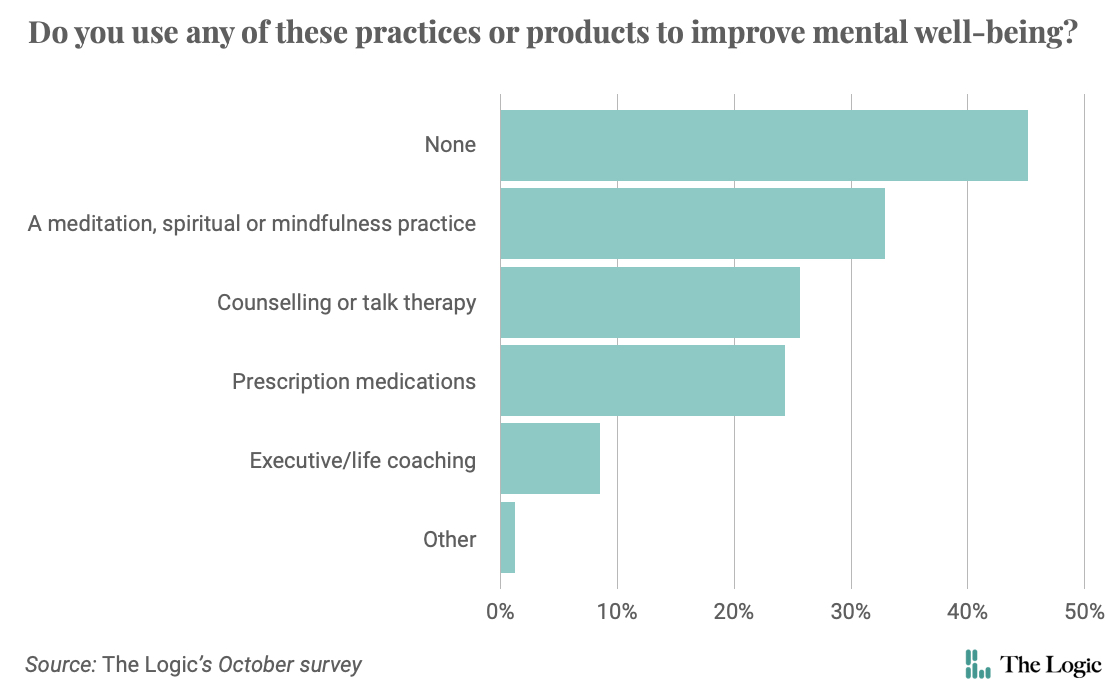
The Logic also asked readers what they do for their mental well-being and sleep. A third of readers spend time on a meditation, spiritual or mindfulness practice, and more than a quarter said they go to counselling or talk therapy. Just under a quarter, at 24 per cent, take prescription medications for their mental health.
Twenty-eight per cent of respondents said they have a structured nightly routine to improve sleep, and 27 per cent use a sleep-tracking app or device. Other commonly used products were sleep supplements like melatonin, white noise and eye masks. Some readers who answered “Other” said they used audiobooks, essential oils, humidifiers and, in one case, “whiskey,” to ensure a good night’s rest.
Other wellness activities were popular, too: 44 per cent of respondents said they take nutritional supplements and 33 per cent said they spend time at spas, saunas or getting treatments like massage, acupuncture, aromatherapy and infrared therapy. Nearly a tenth of respondents each use CBD products as well as fortified food and drinks. “I have to add meal replacement drinks like Boost or Ensure to my daily intake … to meet my body’s energy requirements,” one reader wrote. Another said they do cold plunges.
Most respondents to The Logic’s survey said they devote five to 10 hours per week on their health and wellness (39 per cent), while 32 per cent said three to five hours. Twelve per cent reported spending zero to two hours, about 13 per cent said 10 to 20 hours and only three per cent spend more than 20 hours.
Almost all participants said they devote time to physical activity—only one per cent didn’t—but 45 per cent answered “none” to a list of practices for mental well-being. Forty per cent don’t invest in sleep products or practices, and 37 per cent said they don’t invest in other wellness activities, such as supplements or treatments like massage. It didn’t mean they did nothing: one reader said outdoor exercise was their personal “fix for mental wellness.”
“Probably sufficient sleep is the single most important thing affecting performance,” one reader said. Another said colleagues convinced them to do a marathon about 20 years ago and fitness has been a “key way” to connect with clients.
Several respondents said when their body works well, their minds work better too. “When I’m not feeling physically or mentally well, I cannot function at my best in any other way,” one wrote.
Methodology
The Logic emailed subscribers a private link to an online survey on Oct. 16 and the survey closed Oct. 19. Respondents’ identities were kept anonymous. Subscribers were first asked, “On average, how much money do you spend on health and wellness every month? That can include fitness classes and equipment, treatments like massages, supplements, sleep aids, therapy, mindfulness apps and any other wellness products.” They could answer: “0–$50,” “$51–$100,” “$100–$200,” “$200–$500,” “$500–$1,000,” “$1,000–$5,000” and “Above $5,000.” They were then asked: “On average, how many hours do you spend on your health and wellness per week, such as time exercising or engaging in wellness activities?” The options were: “0-2 hours,” “3-5 hours,” “5-10 hours,” “10-20 hours” and “More than 20 hours.”
Next, respondents were asked: “What forms of exercise, if any, do you devote significant time to each month? Select all that apply. Please provide specifics in the text box below, especially if an option is not listed.” The options were “Walking,” “Running,” “Swimming,” “Biking or spin classes,” “Weightlifting/weight training,” “Cardio-based gym workouts,” “Yoga, pilates or related practice,” “Sports like basketball, hockey, soccer, tennis, etc.,” “Outdoor trips, such as hiking,” “Rock climbing, “Rowing, canoeing, sailing or other boating,” “Dance classes,” “Kickboxing, boxing, jiu-jitsu or martial arts,” “Fitness program such as Crossfit,” “Other (describe below)” and “None.” Then, readers were asked, “Do you regularly use any of these practices or products to improve your mental well-being? Select all that apply.” The options were: “Executive/life coaching,” “Counselling or talk therapy,” “A meditation, spiritual or mindfulness practice, including classes or apps,” “Prescription medications,” “Other” and “None.”
Respondents were asked next: “Do you regularly use any of these practices or products to improve your sleep? Select all that apply.” They could answer, “Sleep-tracking apps or devices,” “Sleep supplements or medication,” “White noise,” “Eye masks,” “Specialized alarms,” “A structured nightly routine,” “Other (describe below)” and “None.” Respondents were also asked: “Are there other wellness activities or products you invest in every month to improve your performance? Select any that apply.” They could answer, “Nutritional supplements,” “Weight-loss drugs,” “Fortified foods and drinks,” “Spas, saunas or treatments like massage, acupuncture, aromatherapy, infrared therapy,” “Cryotherapy,” “CBD wellness products,” “Peptide drugs or therapy,” “IV therapy or vitamin injections,” “Other (describe below)” and “None.” Finally, they were asked: “How important is health and wellness as a factor in your own performance at work?” and could answer: “Very important,” “Somewhat important,” “Not as important as other factors” or “Not at all important.”



Loading...
Thanks for sharing!
You have shared 5 articles this month and reached the maximum amount of shares available.
CloseThis account has reached its share limit.
If you would like to purchase a sharing license please contact The Logic support at [email protected].
CloseGift the full article!
You have gifted 0 article(s) this month and have 5 remaining.
Recipients will be able to read the full text of the article after submitting their email address. They will not have access to other articles or subscriber benefits.
Photo: The Canadian Press/Justin Tang
Most Popular This Week




In-depth, agenda-setting reporting
Great journalism delivered straight to your inbox.
News
Adam Waterous proposes massive crude exports to Asia by rail through northern B.C.
Briefing
Rivals may be ‘horrified’ to realize how exposed their investments are to AI, Aviva CIO warns
Shopify, Sequoia co-lead US$200M investment in online-selling platform Whop
Amid revenue gains, 1Password bets on tools to protect data from AI agents
Best business newsletter in Canada
Get up to speed in minutes with insights and analysis on the most important stories of the day, every weekday.
Exclusive events
See the bigger picture with reporters and industry experts in subscriber-exclusive events.
Membership in The Logic Council
Membership provides access to our popular Slack channel, participation in subscriber surveys and invitations to exclusive events with our journalists and special guests.







