Most respondents to The Logic’s latest subscriber survey are already feeling the effects of U.S. President Donald Trump’s tariffs, but they’re also prepared for the trade fight to drag on.
Skip to content
 Subscribers say U.S. President Donald Trump’s trade war has been a wake-up call for Canada, underscoring the need to move away from the country’s reliance on its largest trading partner. Photo: The Canadian Press/Justin Tang

Subscriber Survey
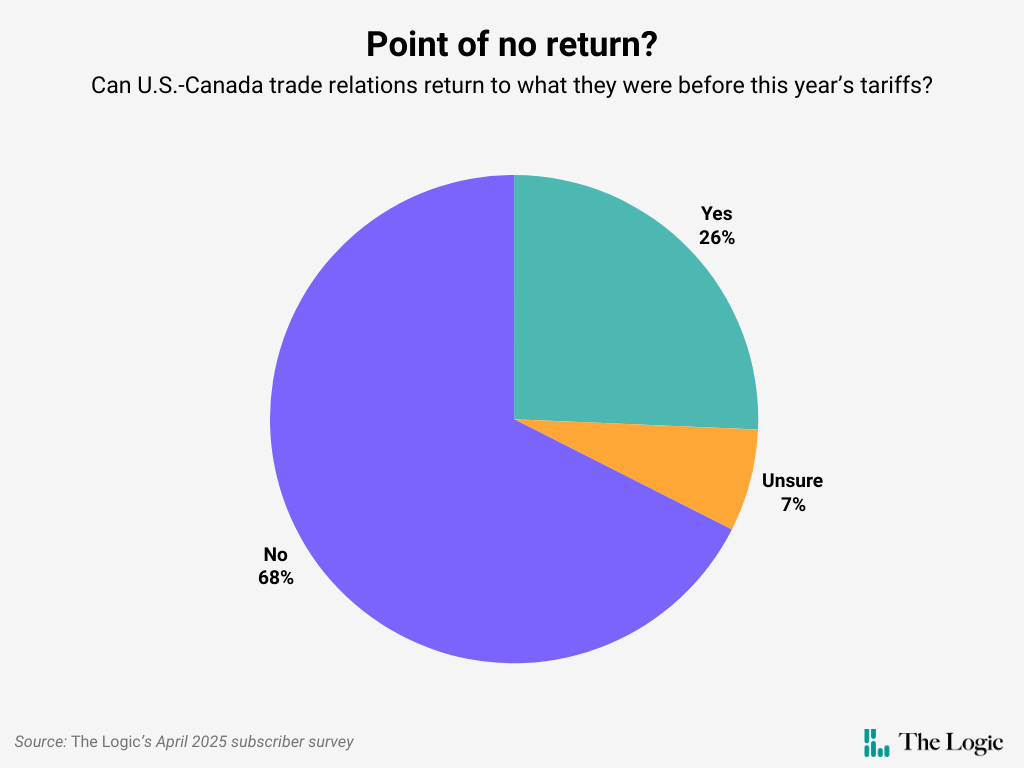
Two-thirds of you say tariffs have changed the U.S.-Canada relationship forever
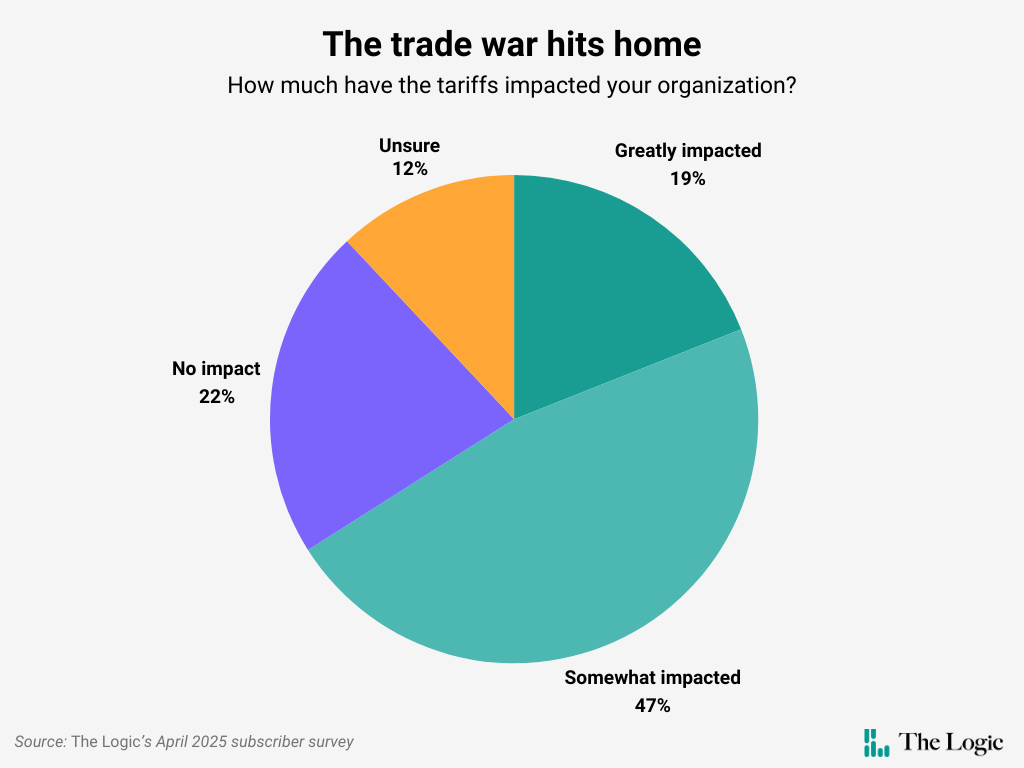
66% of respondents to The Logic’s latest survey also said their workplace is already feeling the impacts of the trade war to some degree
Subscribers say U.S. President Donald Trump’s trade war has been a wake-up call for Canada, underscoring the need to move away from the country’s reliance on its largest trading partner. Photo: The Canadian Press/Justin Tang
Most respondents to The Logic’s latest subscriber survey are already feeling the effects of U.S. President Donald Trump’s tariffs, but they’re also prepared for the trade fight to drag on.
Sixty-six per cent of readers said their organizations are already feeling the impacts of the trade war at least a little. While some had been directly hurt by the new tariffs—one reader noted their investment portfolio had dropped 6.2 per cent since the beginning of the year—many others said the problems so far have surfaced most clearly with their clients, many of whom have been hesitant to make decisions or push forward on projects in light of the uncertainty surrounding the tariffs.
That uncertainty extends to their own organizations’ business decisions, too.
“We feel prepared to act, but lack the information, stability, confidence or trust for any decision to feel responsible at this point,” one reader said, adding that they’d rather have a terrible outcome to act on instead of the “cycle of manufactured chaos, confusion and crisis every 30 to 60 days.”
Over half of respondents said their organizations were at least somewhat prepared for a lengthy fight, while another 28 per cent said they were very prepared. Adjustments include re-evaluating where they source supplies and services, postponing infrastructure investments and building up cash reserves.
Related Articles



Some readers said their organizations are avoiding travel to the U.S. and working to grow their client base within Canada or in Europe and Asia. Another said their workplace was already laying people off, and may have to close entirely.
“Clients are instituting a mix of hiring freezes, laying off employees, delaying tech and equipment purchases, cutting back on expenses,” one said. “It’s not elegant out there.”
The impacts of the tariff fight weren’t exclusively negative, either; one reader in the wine industry said there’s been increased demand to replace U.S. products pulled from the shelves of Ontario’s liquor stores. Another in precision manufacturing said they’ve been “picking up some business that would have gone to China.”
But there was limited optimism that the relationship between the U.S. and Canada could ever return to what it was, regardless of any potential tariff resolution. Twenty-six per cent of respondents said it would be possible to repair the relationship to its former status, but 68 per cent said the damage is permanent.
“Trust takes a long time to get and seconds to lose,” one reader said. “This will be a generational issue and our relationship will be transactional going forward.”
Subscribers said the dispute has been “a wake-up call” for Canada, underscoring the need for the country and economy to be less reliant on any one partner. Many readers said it would take a change in administration in the U.S. at the very least to resume prior trade relations, while others said the American public voting for Trump a second time and the country’s willingness to ignore its previously negotiated treaties mean this could always happen again.
“If we reach another agreement, there’s no guarantee that the U.S. will honour it,” one reader said. “The U.S. attitude is now, ‘The strong do what they can, and the weak suffer what they must.’”
Methodology
The Logic emailed subscribers a private link to an online survey on April 15, with a closing date of April 17. Respondents’ identities were kept anonymous. Subscribers were first asked, “How much have the tariffs impacted your operation?” and could answer “Greatly impacted,” “Somewhat impacted,” “Not at all impacted,” or “Unsure.”
They were then asked, “How prepared is your organization to endure a prolonged trade dispute with the U.S.?” and could answer “Very prepared,” “Somewhat prepared,” “Not at all impacted,” or “Unsure.” The third response was in error and was meant to say “Not at all prepared.”
The third question was “Will the trade dispute harm vendors or partners your organization relies on?” and the fourth was “Do you believe U.S.-Canada relations can return to what they were before this year’s tariffs?” In both cases, respondents could answer “Yes,” “No,” or “Unsure.”
Finally, they were asked the open-ended question: “How is your organization changing in response to the trade dispute?”



Loading...
Thanks for sharing!
You have shared 5 articles this month and reached the maximum amount of shares available.
CloseThis account has reached its share limit.
If you would like to purchase a sharing license please contact The Logic support at [email protected].
CloseGift the full article!
You have gifted 0 article(s) this month and have 5 remaining.
Recipients will be able to read the full text of the article after submitting their email address. They will not have access to other articles or subscriber benefits.
Photo: The Canadian Press/Justin Tang
Most Popular This Week




In-depth, agenda-setting reporting
Great journalism delivered straight to your inbox.
News
Panel decries Canada’s chaotic way of funding world-class science
Briefing
Feds pledge $15M for U.S. satellite navigation company Xona to expand in Montreal
Inovia raises US$200M for new VC fund as it eyes AI’s impact
43% of eligible Albertans voted ahead of Monday’s referendum
Best business newsletter in Canada
Get up to speed in minutes with insights and analysis on the most important stories of the day, every weekday.
Exclusive events
See the bigger picture with reporters and industry experts in subscriber-exclusive events.
Membership in The Logic Council
Membership provides access to our popular Slack channel, participation in subscriber surveys and invitations to exclusive events with our journalists and special guests.





