Over 80 per cent of respondents to The Logic’s latest survey have changed their buying habits due to U.S. tariff threats, a Buy Canadian push they say is unlikely to change even if tariffs never materialize.
Skip to content


Subscriber Survey
Most of you say you’ll keep buying Canadian, tariffs or not
Nine out of 10 respondents to The Logic’s latest survey are prioritizing Canadian goods—and they’re willing to spend more, too
Many of The Logic’s subscribers say they are avoiding American goods, from green onions to wine and whiskey, due to tariff threats. Photo: The Canadian Press/Ethan Cairns
Over 80 per cent of respondents to The Logic’s latest survey have changed their buying habits due to U.S. tariff threats, a Buy Canadian push they say is unlikely to change even if tariffs never materialize.
Trump’s tariff threats have been looming since last November, when the then president-elect pledged a 25 per cent levy on all imports from Canada and Mexico.
U.S. tariffs on Canada are now paused until at least March 4, but Canada’s relationship with its largest trading partner has already taken a beating, with Trump’s “51st state” talk and the trade war’s potential to disrupt everything from North American auto production to the supply of Big Mac ingredients. The American tariffs, combined with retaliatory Canadian measures, would shrink real GDP by 2.6 per cent in Canada and 1.6 per cent in the U.S., according to estimates from the Canadian Chamber of Commerce.
Related Articles



The new front is in shopping baskets: a Buy Canadian consumer movement is encouraging people to buy from Canadian-owned businesses and avoid U.S. products to lessen the blow of tariffs and boost the national economy. Provincial premiers and the prime minister are on-board—Trudeau has urged people to “choose Canada” by ditching Florida orange juice and U.S. vacation plans.
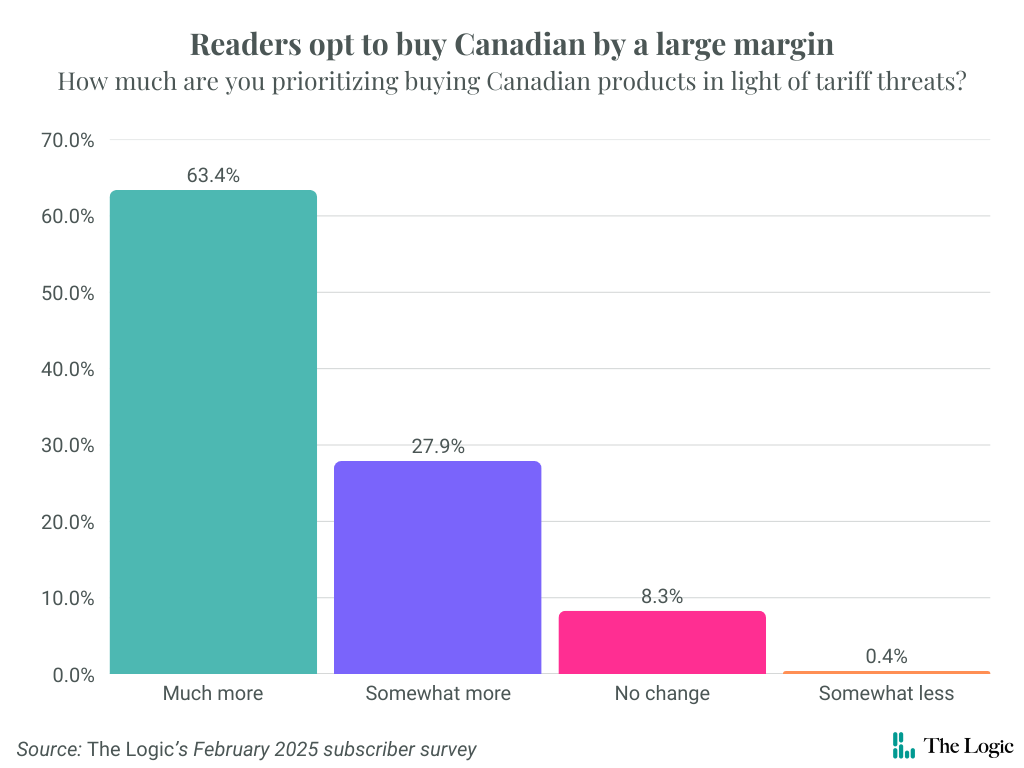
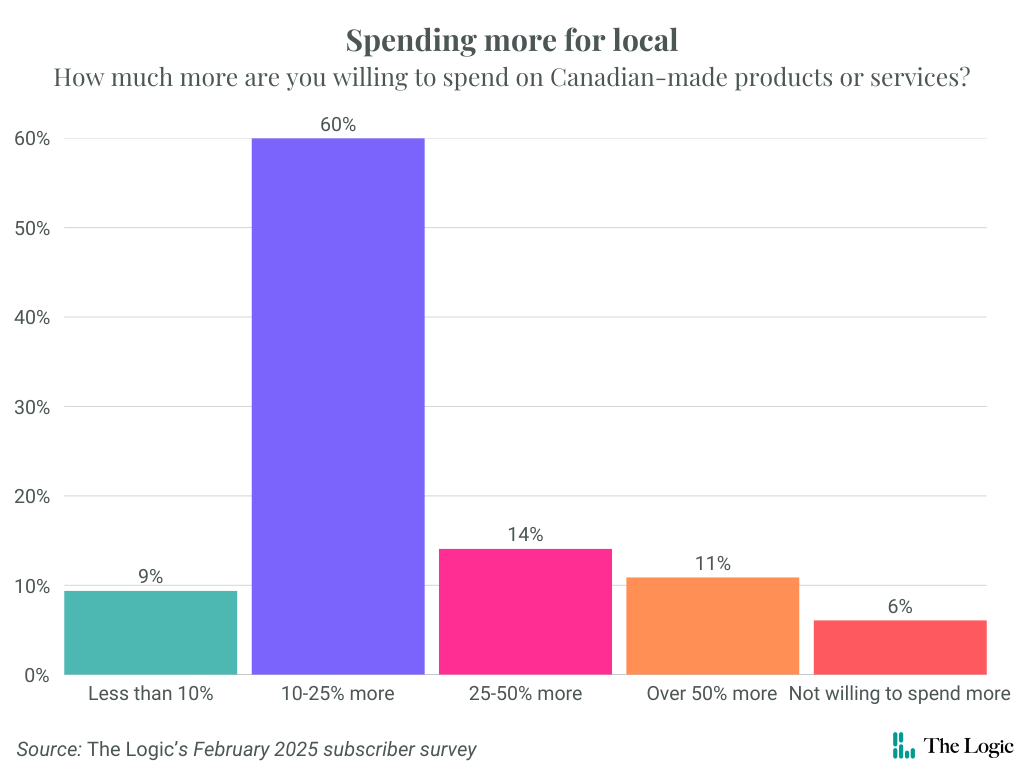
The Logic’s subscribers are joining in, with over 91 per cent of survey respondents prioritizing Canadian products in light of the tariff threats. And the sentiment is strong: 63 per cent say they are prioritizing Canadian products “much more.” The vast majority of respondents—94 per cent—are also willing to increase their spending in their quest for Canadian products.
Many subscribers say they are avoiding American goods, from green onions to wine and beyond. “I look at all the products I buy, and if they’re from the U.S., I’ll put them back on the shelf,” one respondent said.
Determining what is Canadian can be difficult, though, as subscribers pointed out the complications from integrated U.S.-Canada supply chains. One respondent pointed to the difficulty in separating organizations from the products they sell. “You might buy a Canadian product but support a U.S. company.”
Subscribers are split 50-50 on withdrawing from existing U.S. services and travel plans south of the border. Those who have opted out have cancelled services like Netflix and Amazon (one said “I hope Shopify gains on Amazon”), and several readers have dropped U.S. trips and investments. One cancelled the purchase of a home in Palm Springs.
“It’s harder to avoid anything American-made, but doing what we can,” a subscriber said. “Definitely never crossing the border again!”
Overall, subscribers said buying Canadian was a “start” to a broader response from government and corporations, and something to send “a signal to the U.S. that poor policy choices have consequences.” One respondent pointed to “the effect on their tourism industry”—Canadian road trips to the U.S. were down slightly in January—as an example of the strategy’s efficacy. (The U.S. Travel Association warned that a 10 per cent reduction in Canadian travel could lose the country US$2.1 billion in spending and 14,000 jobs.)
Premiers are visiting Washington, D.C., making the case that tariffs would hurt the U.S. economy, too. Reactions from Canadian officials have ranged from announcing tariffs on American goods, making threats to cut off electricity, pulling U.S. liquor from shelves and blacklisting Tesla, owned by Trump ally Elon Musk, from incentive programs. But Trudeau’s promised fentanyl czar doesn’t appear to have persuaded Trump, as the 25 per cent tariffs are expected to move ahead in the coming weeks.
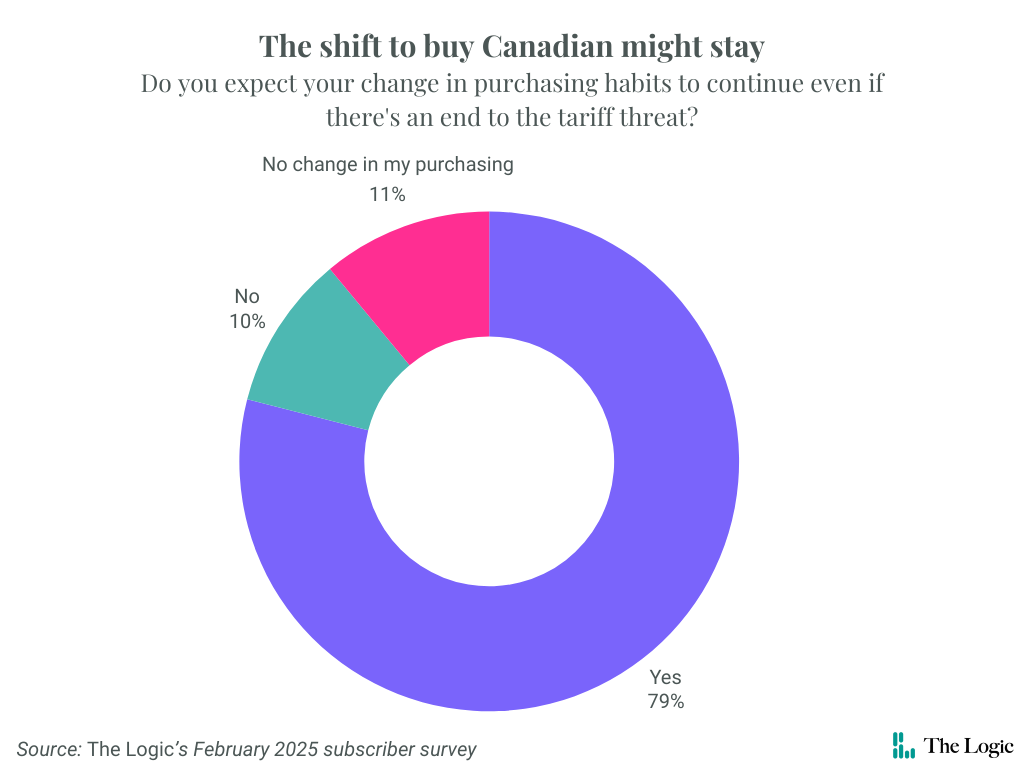
Whether or not the tariffs come into effect, the shift towards Canadian products could be permanent—or at least until the end of Trump’s term. Almost 80 per cent of respondents said their new purchasing habits will continue even if the tariff threats subside.
“I think a focus on [buying] local is important, and I’m glad this gave me the push to do it,” one respondent said. “I may have to make some lifestyle changes to stay on budget but I think it’s worth it.”
Another said they learned their buying habits were too U.S.-centric. “The world is a big place. Choices abound.”
Methodology
The Logic emailed subscribers a private link to an online survey on Feb. 14, and the survey closed at 6 p.m. ET on Feb. 19. Respondents’ identities were kept anonymous. Subscribers were asked “Has the threat of tariffs affected your consumption habits?” with the options “Yes” and “No.” They were then asked, “How much are you prioritizing buying Canadian products in light of tariff threats?” with the options “Much more,” “Somewhat more,” “No change,” “Somewhat less” and “Much less.” Subscribers were asked, “Have you cancelled or withdrawn from U.S. services (trips, subscriptions, etc.) because of the threat of tariffs?” with the options “Yes” and “No.” They were then asked, “How much more are you willing to spend on Canadian-made products or services?” with the following options: “Less than 10 per cent,” “10-25 per cent more,” “25-50 per cent more,” “Over 50 per cent more,” and “Not willing to spend more.” Subscribers were then asked, “Do you expect your change in purchasing habits to continue even if there’s an end to the tariff threat?” with the options “Yes,” “No” and “I haven’t changed my purchasing habits.” Finally, they were asked this open-ended question: “Do you think Buy Canadian is an effective response to the threat of tariffs?”



Loading...
Thanks for sharing!
You have shared 5 articles this month and reached the maximum amount of shares available.
CloseThis account has reached its share limit.
If you would like to purchase a sharing license please contact The Logic support at [email protected].
CloseGift the full article!
You have gifted 0 article(s) this month and have 5 remaining.
Recipients will be able to read the full text of the article after submitting their email address. They will not have access to other articles or subscriber benefits.
Photo: The Canadian Press/Ethan Cairns
Most Popular This Week




In-depth, agenda-setting reporting
Great journalism delivered straight to your inbox.
News
Canada faces a satellite-launch crunch as SpaceX retires its workhorse rocket
Briefing
Zafin buys U.S. fintech Naehas in nine-figure deal
Violations of money laundering and terrorist financing rules hit new high in Canada
Brookfield Asset Management opens Qatar office as it courts Middle East investments
Best business newsletter in Canada
Get up to speed in minutes with insights and analysis on the most important stories of the day, every weekday.
Exclusive events
See the bigger picture with reporters and industry experts in subscriber-exclusive events.
Membership in The Logic Council
Membership provides access to our popular Slack channel, participation in subscriber surveys and invitations to exclusive events with our journalists and special guests.