Carmichael: To survive Trump, Canada needs to rebuild its east-west ties
Michael Wilson, one of the architects of the original free-trade agreement with the U.S., was haunted throughout much of his political life by something he heard on a business trip to Hong Kong in the late 1970s.
Wilson was pitching business for his employer, Dominion Securities, when his host stopped him to ask a question.
Commentary
Carmichael: To survive Trump, Canada needs to rebuild its east-west ties
U.S. trade agreements have made Canada richer, but less reliant on ourselves. That needs to change.
A Canadian flag at the Manitoba legislative building in Winnipeg on March 4, 2025. Trade agreements with the U.S. have made Canada richer, but they’ve also made provinces less reliant on each other. Photo: The Canadian Press/Steve Lambert
Michael Wilson, one of the architects of the original free-trade agreement with the U.S., was haunted throughout much of his political life by something he heard on a business trip to Hong Kong in the late 1970s.
Wilson was pitching business for his employer, Dominion Securities, when his host stopped him to ask a question.
“You live next door to the United States, the greatest country in the world. They are no threat to you,” the man said, according to Wilson’s posthumous memoir. “You have natural resources like oil and natural gas, along with quantities of minerals, food, and water that far exceed your needs, so you are great exporters,” he continued, making some additional points about stable government and high living standards.
Then the compliments stopped. “So why are you not doing better than you are?”
Wilson, who died in 2019, said the question drove him to run for the Progressive Conservative party in 1979. He would become Brian Mulroney’s first finance minister, and later served as trade minister and industry minister. Those positions helped him resolve the Hong Konger’s question by negotiating an historic trade agreement with the U.S. that he assumed would bring not only wealth, but a competitive shock that would transform Canada into a world-beating economy.
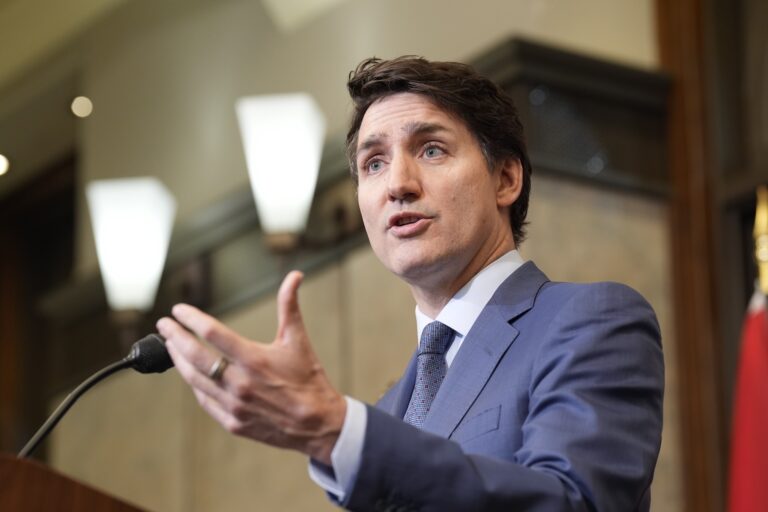
Or so he thought. Almost 40 years after the Canada-U.S. Free Trade Agreement took effect, Prime Minister Justin Trudeau declared on national television that the president of the United States was attempting to orchestrate the collapse of the Canadian economy to make annexation easier.
That wasn’t what Wilson had in mind. But I wonder if the economic war that Donald Trump has initiated is part of the answer to the question that so troubled Wilson during much of his life.
The man in Hong Kong prefaced his query by sharing how much harder it was to live under the crushing weight of China’s shadow, relying on a menacing neighbour for all its staples, while being governed by faraway Britain. “Yet we get by.”
It’s been a long time since Canada has had to exist amid any sort of real threat. Thousands of immigrants and refugees could share stories about what it’s like, but most of us know nothing but peace, comfort and—as Wilson had hoped—prosperity. It’s our turn to learn how to get by. That starts with getting to know ourselves a little better.
An inconvenient truth is that the sudden excitement among politicians about internal trade isn’t shared by the people who will be counted on to do the trading. When Statistics Canada surveyed businesses for its annual snapshot of interprovincial trade between June and October, only 25 per cent said they planned to sell goods or services to clients in other provinces over the next 12 months. Asked why they don’t sell in other provinces or territories, most said they simply had no interest.
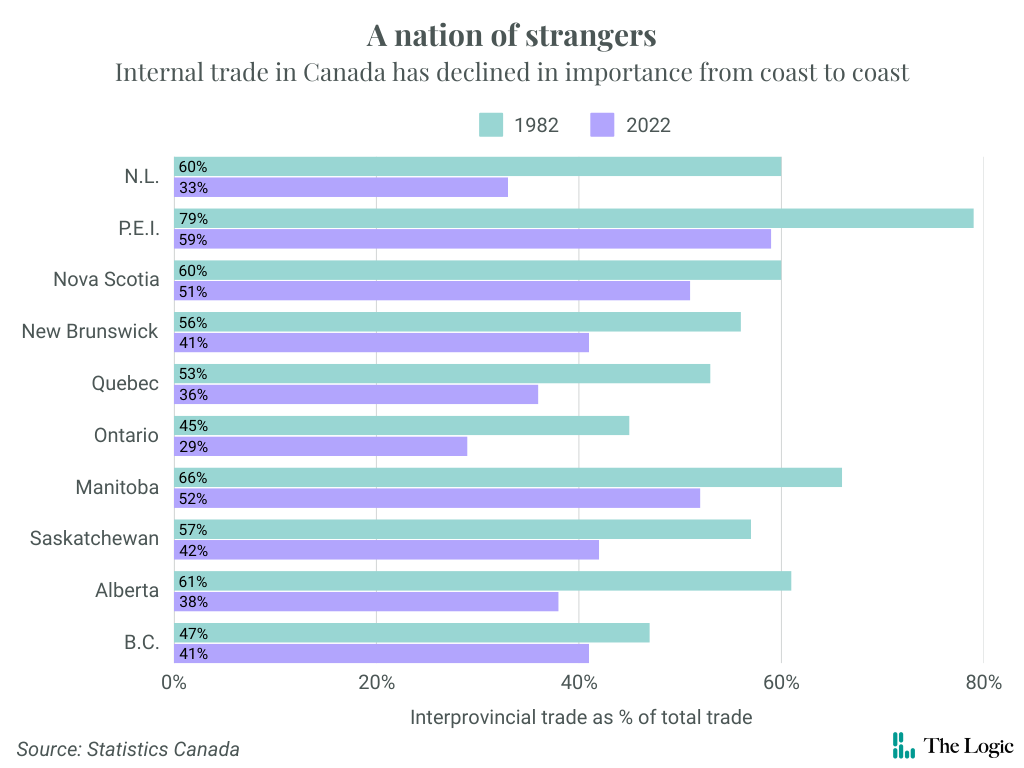
The progression of comprehensive trade agreements with the U.S. since the late 1980s made Canada richer, but it also made the regions less reliant on each other. Interprovincial trade represented only 37.9 per cent of Alberta’s total trade in 2022, compared with 61.3 per cent in 1982, according to Statistics Canada.
It’s similar everywhere. For Quebec, the comparable numbers were 35.7 per cent (2022) and 53.2 per cent (1982), and for Ontario 29.2 per cent and 44.9 per cent. British Columbia and Nova Scotia are the only two provinces where the gap widened by less than 10 percentage points. Those numbers make it easier to understand why Canadian politics has split so starkly along regional lines over the last couple of decades. We don’t need each other the way we used to. That will complicate the response to Trump because our internal economic capacity isn’t what it could be.
Maybe that should have been a greater consideration as the political and business elite embraced north-south trade despite a long colonial history of actively resisting that pull. Freer trade with the U.S. was the right bet, but perhaps it should have been paired with an aggressive effort to reinforce west-east links.
Trade is like water. Flows are governed by gravity and the path of least resistance. A 1998 study by the International Monetary Fund observed that after staying essentially flat between 1984 and 1991, Canadian exports “expanded significantly” thereafter, while internal trade had changed little over the same period. “The increase in the former reflects the implementation of the regional trading arrangements beginning in January 1989 (Canada-U.S. Free Trade Agreement) and January 1994 (North American Free Trade Agreement),” the report said, adding that the stagnation of internal trade flows suggested little had been done to alter existing barriers.
The political energy to make up for lost time seems real. Canada’s internal trade ministers met last week for the second time in as many months, declaring they “remain dedicated to maintaining the positive momentum which they have built over the past months.”
Specifically, they said they made progress on eliminating the many “exceptions” to the Canadian Free Trade Agreement; adding financial services to the agreement; accelerating mutual recognition of rules covering “priority goods or sectors,” including trucking; facilitating labour market mobility and direct-to-consumer sales of alcohol; and exploring a “domestic Team Canada” approach to trade promotion.
All of this is for the good. The value of British Columbia wine shipped to Prince Edward Island in 2021 was zero, according to data at Statistics Canada’s internal trade hub, while the value of B.C. tipple sent to Quebec was roughly the same as that shipped to Manitoba, even though the population of Quebec is six times larger. The Pacific Coast is far from Eastern Canada and the Maritimes, but so is Italy and France, and there is no shortage of bottles from those places. A country ought to be able to trade with itself. Maybe one day we’ll thank Trump for shocking us into doing so.
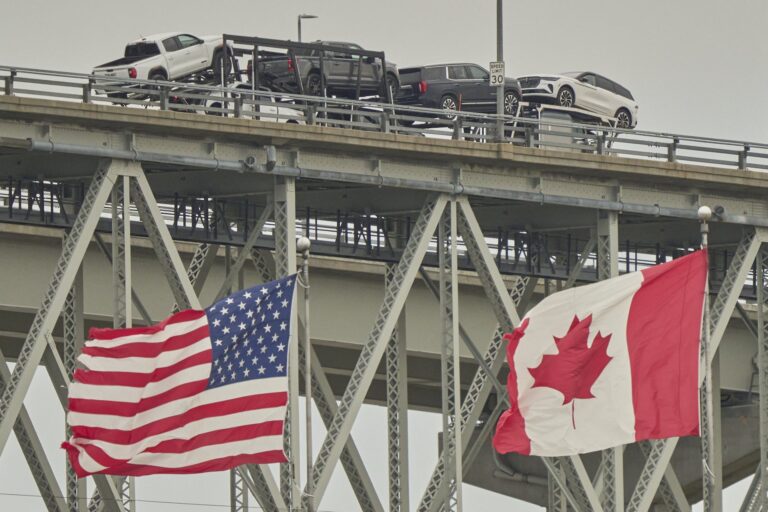
But let’s be careful about characterizing freer trade within Canada as an off-the-shelf replacement for duty-free access to places such as Michigan, California and Texas. Canada’s provinces and territories exchanged goods and services worth about $532 billion in 2023, compared with two-way trade with the U.S. of more than $1 trillion, according to a Royal Bank report.
What’s more, that gap is structural, suggesting it will take time to pivot internally. The value of shipments between provinces have been within the same range as the value of exports to the U.S. only once in recent decades—and that was 2009, when the Wall Street meltdown nearly caused a depression. “Internal trade liberalization should be viewed as a complement to, rather than a substitute for, strong Canada-U.S. trade ties,” wrote Salim Zanzana, an economist at RBC.
“Dismantling the barriers to interprovincial trade isn’t entirely straightforward, nor is it a silver bullet solution to the many challenges that Canada’s growth faces,” Zanzana said in another section of his analysis. “Instead, it is a part of a suite of reforms that the country needs to reinvigorate its economy.”
Trade and water have something else in common. Left undisturbed for long enough, those flows start to reshape geography. The east-west links that early governments created to resist the gravitational pull of the U.S. have been replaced by deep north-south grooves. It will take some time to pull ourselves out of them.
Kevin Carmichael is The Logic’s economics columnist and editor-at-large. He has spent more than two decades covering economics, business and finance for outlets including Bloomberg News, The Globe and Mail and the Financial Post, where he also served as editor-in-chief.
Recipients will be able to read the full text of the article after submitting their email address. They will not have access to other articles or subscriber benefits.
Great journalism delivered straight to your inbox.
News
Panel decries Canada’s chaotic way of funding world-class science
By
David Reevely
Briefing
Feds pledge $15M for U.S. satellite navigation company Xona to expand in Montreal
By David Reevely |
Inovia raises US$200M for new VC fund as it eyes AI’s impact
By Anita Balakrishnan |
43% of eligible Albertans voted ahead of Monday’s referendum
By Meghan Potkins |
Best business newsletter in Canada
Get up to speed in minutes with insights and analysis on the most important stories of the day, every weekday.
Exclusive events
See the bigger picture with reporters and industry experts in subscriber-exclusive events.
Membership in The Logic Council
Membership provides access to our popular Slack channel, participation in subscriber surveys and invitations to exclusive events with our journalists and special guests.