Skip to content

Canada's Business and Tech Newsroom

  • Professional Subscription
  • Partnerships & Advertising
  • Licensing & Syndication
Log In Subscribe
Welcome,
  • My Account
  • Log Out
  • Business
  • Tech
  • National
  • The Big Read
  • Briefings
  • Commentary
Search
Log In Subscribe
Welcome,
  • My Account
  • Log Out
Commentary

Carmichael: Ottawa’s move against payday lenders is a lesson in unintended consequences

Jeremy Kronick spends most of his time these days writing about the Bank of Canada’s battle with inflation. 

But in February, Kronick, director of the Centre on Financial and Monetary Policy at the C.D. Howe Institute, took a break from the only issue anyone cares about to consider something that seemed uncontroversial: the federal government’s crackdown on “predatory lending”—effectively, payday lenders and loan sharks. 

Commentary

Carmichael: Ottawa’s move against payday lenders is a lesson in unintended consequences

New research shows lowering the legal rate of interest could hurt those with limited credit histories

By Kevin Carmichael
A payday loan store in Oshawa, Ont., in May 2017. Photo: The Canadian Press/Doug Ives
Mar 30, 2024
A A
A Small A Medium A Large
Share

Share

Jeremy Kronick spends most of his time these days writing about the Bank of Canada’s battle with inflation. 

But in February, Kronick, director of the Centre on Financial and Monetary Policy at the C.D. Howe Institute, took a break from the only issue anyone cares about to consider something that seemed uncontroversial: the federal government’s crackdown on “predatory lending”—effectively, payday lenders and loan sharks. 

It turns out there was some controversy. That month, the Canadian Lenders Association—a lobby for banks and others in the business of lending money, though not payday lenders—had published research with the Ontario Association of Chiefs of Police that found some 4.7 million non-prime borrowers could be hurt by the federal government’s plan to lower the maximum legal interest rate to an annual percentage rate of 35 per cent from 47 per cent.   

Kronick was astonished by the scale of harm. The CLA and the chiefs of police had tallied the number of non-prime borrowers in Canada and compiled case studies from other jurisdictions to assert that a lower criminal interest rate would cause regulated lenders to exit the non-prime market, forcing borrowers with limited credit histories to turn to the very predatory lenders on whom the government was trying to crack down. 

“I don’t remember who it was that forwarded me the combination of the CLA work that they had done, that had this four-million-person number that was going to potentially be affected by this, which felt crazy to me,” Kronick said in an interview. “Then you look at the government’s cost-benefit analysis, and they come up with 93,000, and you’re like, ‘These aren’t even in the same ballpark.’ Let’s assume the number’s in the middle—it’s still a lot of people.” 

Related Articles

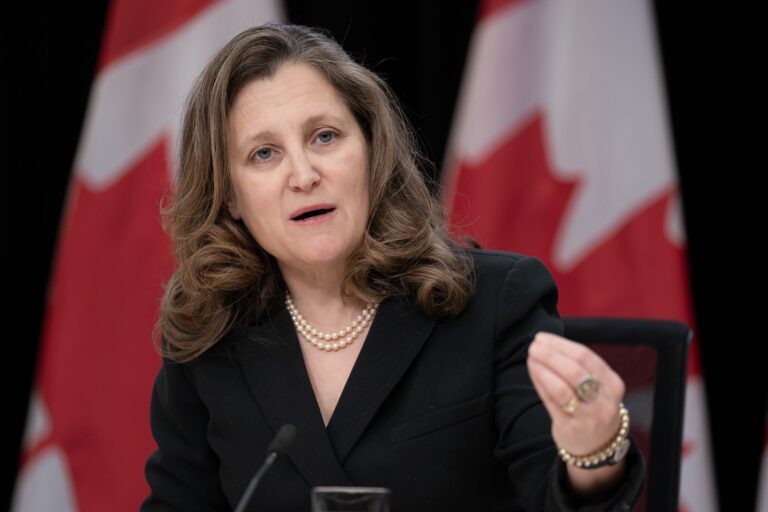
Finance Minister Chrystia Freeland makes a hand gesture in a seated position. She wears a black blazer, two Canadian flags stand behind her.

Carmichael: The case for openness around open banking

By Kevin Carmichael

Carmichael: Channeling Charlie Munger

By Kevin Carmichael

The government had flagged the measures almost a year earlier, in the 2023 budget—yet despite the CLA’s efforts to bring attention to a policy that it insisted would have all kinds of unintended consequences, few outside the fintech community had paid much attention. Kronick’s conclusions suggest this was more than a lobby group fighting a lost cause. In fact, it might be an example of how well-intentioned policymakers end up making things worse instead of better. 

“Will [a lower criminal rate] keep those prey to predatory lending from entering a cycle of debt?” Kronick asked rhetorically in his analysis. “Probably not.” 

It’s hard to mount a defence of high-interest lenders because we’ve been conditioned to see them as manifestations of evil. The literary canon is replete with stories in which the devil appears as a creditor. When Barack Obama was pushing for tighter U.S. restrictions on payday lenders in 2016, his administration invited religious leaders to the White House to highlight that they felt a “moral obligation” to stop payday lenders from “preying on consumers by trapping them in an endless cycle of debt.” 

Prime Minister Justin Trudeau joined the crusade in 2021, instructing Finance Minister Chrystia Freeland in her mandate letter to “crack down on predatory lenders by lowering the criminal rate of interest.” The government held consultations, but it had decided from the outset what was the right thing to do. 

A Money Mart storefront in Vancouver in February 2015. Photo: The Canadian Press Images/Bayne Stanley

The real world is more complicated than a morality tale. The economist Thomas Sowell describes the demonization of payday lenders as an example of how the mushy intentions of do-gooders end up making the lives of actual people worse. “Freakonomics Radio,” the podcast that journalist Stephen Dubner spun out of the bestselling books he wrote with University of Chicago economist Steven Levitt, took on the issue of payday lending in 2016 and failed to draw any definitive conclusions about the merits of rate ceilings.  

The CLA advised the federal government ahead of the 2022 budget that not all lenders that charge elevated rates are payday lenders—some are fintechs and alternative lenders who cater to “underserved Canadians,” including gig workers and influencers, it said. 

When Freeland decided to go ahead in the 2023 budget, Goeasy, one of Canada’s more prominent alternative lenders, said the lower rate would “eliminate access to credit for millions of borrowers, forcing them to turn to more expensive sources of borrowing, such as payday loans or illegal loan sources” and make it harder for such people to rebuild their credit scores. The company also predicted in a press release that the rate limit would force some lenders out of business, reducing competition and options for borrowers. 

Kronick came away from his investigation skeptical that Freeland was doing the right thing. He said the industry probably is exaggerating the potential harm, but the government’s own math raises doubt about whether there’s a problem worth fixing. The cost-benefit analysis said households would accrue about $257 million in savings over 11 years, while lenders would lose about $239 million over the same period—a net benefit of less than $2 million per year. 

That’s not a big number, especially considering the government’s estimate of harm focused only on payday lenders and excluded companies such as Goeasy. Kronick concluded that if the government wanted to help marginal borrowers, it could have forced lenders to be crystal clear in how they communicate the terms of their loans. In markets, the predators have an information advantage. If you want to defang them, you take that advantage away. 

“Obviously, I’m against predatory lending,” Kronick said. “I want to focus on how we can fix these things. But at the end of the day, anytime you’re capping interest rates, it’s a form of price control. As an economist, your back gets up a little bit when you see price controls.” 

It’s too late to make substantive changes because the new rate ceiling is now law. Of course, laws can be changed. Donald Trump watered down Obama’s restrictions on payday lenders. The CLA might be playing a longer game. 

Kevin Carmichael is The Logic’s economics columnist and editor-at-large. He has spent more than two decades covering economics, business and finance for outlets including Bloomberg News, The Globe and Mail and the Financial Post, where he also served as editor-in-chief. 

#C.D. Howe Institute #Canadian Lenders Association #Chrystia Freeland #commentary #economy #payday lenders

Loading...

Thanks for sharing!

You have shared 5 articles this month and reached the maximum amount of shares available.

Close
This account has reached its share limit.

If you would like to purchase a sharing license please contact The Logic support at [email protected].

Close
Want to share this article?

Upgrade to all-access now

Close
Gift the full article!

You have gifted 0 article(s) this month and have 5 remaining.

Copy link and gift
Copy Link
Email to a friend
Send Email
Gift on Social Media

Recipients will be able to read the full text of the article after submitting their email address. They will not have access to other articles or subscriber benefits.

Photo: The Canadian Press/Doug Ives

A Money Mart storefront in Vancouver in February 2015.

Most Popular This Week

Andrew Forde, wearing a beige tweed blazer, black slacks and a white sweater, speaks on a stage at the Elevate conference in Toronto with three large blue screens in the backdrop. One screen displays the session topic, AI, another displays the logos for sponsors KPMG and Google, and a third screen depicts a photo of a stop sign covered in stickers. The stop-sign photo is labelled, “Stickers that beat supercomputers.”
News

KPMG’s AI whisperer says some Bay Street firms are falling into a productivity trap

By Anita Balakrishnan
The Big Read

ApplyBoard faces a reckoning as Canada’s immigration boom turns into a bust

By Claire Brownell and David Reevely
A shot of Anthony Hu in a semi-dark office, with his face illuminated by two computer screens.
The Big Read

Anthropic’s Mythos cracked software open like an egg. It’s just the beginning

By David Reevely
Susan Hawkins, chief executive officer of Payments Canada gestures with her hands as she speaks on stage in front of black screen at the Payments Canada Summit in Toronto.
Exclusive

Not all banks and fintechs will get access to the Real-Time Rail at launch

By Claire Brownell

In-depth, agenda-setting reporting

Great journalism delivered straight to your inbox.

Commentary

Carmichael: If an AI jobs apocalypse is coming, we’re not seeing it in the data

By Kevin Carmichael

Briefing

Anthropic says world needs option to slow AI development, as models learn to self-improve

By Murad Hemmadi   |   Jun 5, 2026 | 3:37 PM ET

Ottawa taps the brakes on efforts to speed up project permitting

By Laura Osman   |   Jun 5, 2026

Kevin O’Leary scales back Wonder Valley Utah plans after objections from a key state legislator

By David Reevely   |   Jun 5, 2026

Best business newsletter in Canada

Get up to speed in minutes with insights and analysis on the most important stories of the day, every weekday.

Exclusive events

See the bigger picture with reporters and industry experts in subscriber-exclusive events.

Membership in The Logic Council

Membership provides access to our popular Slack channel, participation in subscriber surveys and invitations to exclusive events with our journalists and special guests.

Recent Popular Stories

News

Canada’s surprise plan to buy Saab command jets leaves competitors seeking answers

By David Reevely   |   May 29, 2026
A closeup of a scale model of a jet covered in pixellated camouflage, with sensor equipment attached to the top of its fuselage. There are civilians and uniformed military personnel milling in the background.
Exclusive

Canada awards Ford $464M to make F-Series trucks in Ontario

By Murad Hemmadi, Anita Balakrishnan and Joanna Smith   |   May 7, 2026
Blurred red, white and black cars zoom down a street in front of Ford’s Oakville, Ont., assembly plant on Friday April 5, 2024.
News

European and Asian firms want a stake in Canada’s photonics factory, Joly says

By Murad Hemmadi   |   May 7, 2026
The Big Read

ApplyBoard faces a reckoning as Canada’s immigration boom turns into a bust

By Claire Brownell and David Reevely   |   May 27, 2026
Exclusive

RBC Insurance chief to depart in shakeup of key strategic role

By Chaimae Chouiekh and Anita Balakrishnan   |   May 27, 2026
Low-angle view of an RBC logo sign in front of a tall glass-and-concrete office tower, with surrounding skyscrapers visible in the background.
Exclusive

Shopify makes cuts to its operations team in latest round of layoffs

By Aleksandra Sagan   |   May 4, 2026
Tobias Lutke in a black shirt and grey jeans sitting on a couch, gesturing with both hands pinching the air as he speaks

Canada's most influential executives and policymakers are reading The Logic

  • CPP Investments
  • Sun Life Financial
  • C100
  • Amazon
  • Telus
  • Mastercard
  • bdc
  • Shopify
  • Rogers
  • RBC
  • General Motors
  • MaRS
  • Government of Canada
  • Uber
  • Loblaw Companies Limited
logic-logo

Canada's Business and Tech Newsroom

100% human-crafted journalism

Newsroom

  • News Tips
  • AI Policy
  • Editorial Disclosures
  • Story Pitches

Company

  • About Us
  • Terms of Service
  • Privacy Statement
  • Corporate Information

Contact

  • Contact Us
  • Advertise
  • FAQs
  • Work at The Logic

© 2026 The Logic Inc. All Rights Reserved.

Trusted by leaders

Error

Account creation failed.

Please email us at [email protected].

Create Account

[wppb-register form_name=”cozmo-registration-form-for-modal”]

I do have an account
Login
or

[wppb-login]

I don’t have an account