This is a column about how the government should think about regulating the sharing of financial data. Last fall, Finance Minister Chrystia Freeland promised to present legislation alongside next month’s budget. It could be the most important thing she does this year because that bill will determine the extent to which open banking brings competition and innovation in finance at a time when Canada’s economy is in desperate need of both.
Skip to content

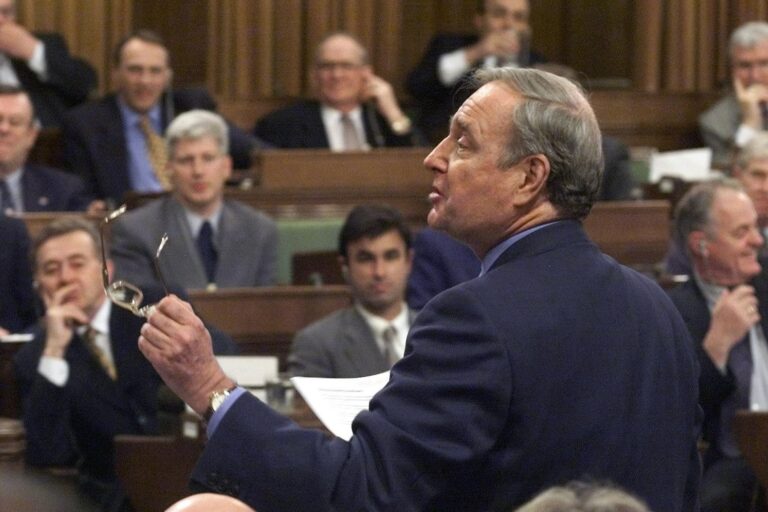
 In February, Conservative MP Adam Chambers asked Bank of Canada governor Tiff Macklem how the well SAC was functioning. Photo: The Canadian Press/Adrian Wyld
Commentary
Carmichael: The case for openness around open banking
Chrystia Freeland is about to decide how to regulate the sharing of our financial data. She should reject the cloistered Canadian status quo
Minister of Finance Chrystia Freeland responds to a question during a weekly news conference, on Tuesday, Feb. 27, 2024 in Ottawa. Photo: The Canadian Press/Adrian Wyld
This is a column about how the government should think about regulating the sharing of financial data. Last fall, Finance Minister Chrystia Freeland promised to present legislation alongside next month’s budget. It could be the most important thing she does this year because that bill will determine the extent to which open banking brings competition and innovation in finance at a time when Canada’s economy is in desperate need of both.
One of the things that Freeland must decide is who will oversee the new regime. That’s a bigger decision than it might seem. To understand why, let’s go back to Bank of Canada governor Tiff Macklem’s last appearance at the House of Commons finance committee in February, and a nondescript exchange he had with Conservative MP Adam Chambers.
Chambers took advantage of having a member of the secretive Senior Advisory Committee at committee to probe what that important group of economic policymakers and financial regulators had been doing.
The SAC is led by the deputy minister of finance and includes the central bank governor, the superintendent of financial institutions, and the heads of the Canada Deposit Insurance Corporation and the Financial Consumer Agency of Canada. They compare notes on the troubles they see brewing on their patches and consider whether those isolated threats could compound into something bigger. If the committee senses danger, it will recommend policy via the deputy minister. This is how Canada approaches what is sometimes called macroprudential regulation.
Related Articles

Chambers didn’t need a Star Chamber to tell him that some micro issues had turned into macro problems. The government’s apparent miscalculation over the economy’s ability to absorb higher levels of immigration had become a source of inflation and political instability, so much so that Immigration Minister Marc Miller recently had slashed student visas. The country’s post-pandemic debt also was becoming a bigger concern.
“I think Canadians are curious whether policymakers are actually thinking about these things,” Chambers said.
If any group of policymakers was thinking about such things, it would have been the SAC. Only insiders would know for sure, however, because one of the most important groups in Ottawa meets in total secrecy. I once requested the agendas of SAC meetings through the Access to Information Act. The government revealed the dates of the meetings and nothing else.
“Is the Senior Advisory Committee actually functioning well?” Chambers asked. “There’s not a lot of transparency. The [central] bank is now out talking about these items out in public. Have you been able to raise these items, closed-door, appropriately to flag the vulnerabilities for the government?”
If you were designing a macroprudential regulator today, you wouldn’t hide it from public view. Democratic capitalism is in trouble because of a lack of confidence in the competence of government. The best way to show you know what you’re doing is to be transparent. The U.S. equivalent of the SAC, the Financial Stability Oversight Council (FSOC), has a website, broadcasts its meetings via webcast and publishes annual reports.
We have the system we have because nothing terrible has happened recently that would force reckoning. The FSOC was a response to the Great Recession, a catastrophe that exposed all kinds of vulnerabilities in the U.S.’s approach to regulation and shattered the public’s confidence in Washington and Wall Street. Canada avoided the worst of the financial crisis, so there was no outcry to fix anything. As the U.S. and others updated their approaches for the times in which we live, Canada stuck with the status quo.
Andrew McAfee, co-director of the Massachusetts Institute of Technology’s Initiative on the Digital Economy, argues that bureaucracies are held together by individuals who fear change would result in a loss of status or some other need that we humans hold dear. Would a more transparent approach to macro oversight have avoided the housing crisis or the inflation scare? Maybe not. Then again, who knows what would have happened if more people would have been aware of the threats that were forming and the responses that policymakers were considering. Maybe better ideas would have surfaced. That’s how democratic capitalism is supposed to work.
“Yes, we have been discussing these issues,” Macklem told Chambers, adding that the SAC sometimes asks the Canada Mortgage and Housing Corporation to attend its meetings. “I’m not going to speak for the government, but you saw last week the cap on the students,” the governor continued. “So I think there is a level of awareness.”
You can decide for yourself whether you are reassured by what Macklem had to say, and whether you think governments that now get elected with about 33 per cent of the popular vote can be trusted to put good policy ahead of their electoral prospects.
The point of all of this is to show that bureaucracies adapt to changing circumstances slowly.
McAfee’s latest book, The Geek Way, argues that Silicon Valley took over the world not only because of its technology, but because the companies formed there consciously chose a new approach to industrial organization. Rather than top-down control and hierarchy, they built cultures based on science, individual ownership, speed and openness.
Regulators should mirror the industries they regulate. That’s something Freeland ought to bear in mind as the budget approaches. Rather than assume industrial-age overseers can learn to keep up with the digital economy, governments should take every opportunity to start from scratch.
Kevin Carmichael is The Logic’s economics columnist and editor-at-large. He has spent more than two decades covering economics, business and finance for outlets including Bloomberg News, The Globe and Mail and the Financial Post, where he also served as editor-in-chief.



Loading...
Thanks for sharing!
You have shared 5 articles this month and reached the maximum amount of shares available.
CloseThis account has reached its share limit.
If you would like to purchase a sharing license please contact The Logic support at [email protected].
CloseGift the full article!
You have gifted 0 article(s) this month and have 5 remaining.
Recipients will be able to read the full text of the article after submitting their email address. They will not have access to other articles or subscriber benefits.
Photo: The Canadian Press/Adrian Wyld
In February, Conservative MP Adam Chambers asked Bank of Canada governor Tiff Macklem how the well SAC was functioning.
Most Popular This Week




In-depth, agenda-setting reporting
Great journalism delivered straight to your inbox.
Commentary
Carmichael: Being boxed in will help Canada focus on what matters
Briefing
Rio Tinto gets nearly $165M in additional federal funds for Quebec aluminum
U.S. to lift tariffs on some Canadian products crucial to Maine: Collins
Carney warns of tech dependence after Starlink disruptions in Ukraine
Best business newsletter in Canada
Get up to speed in minutes with insights and analysis on the most important stories of the day, every weekday.
Exclusive events
See the bigger picture with reporters and industry experts in subscriber-exclusive events.
Membership in The Logic Council
Membership provides access to our popular Slack channel, participation in subscriber surveys and invitations to exclusive events with our journalists and special guests.






