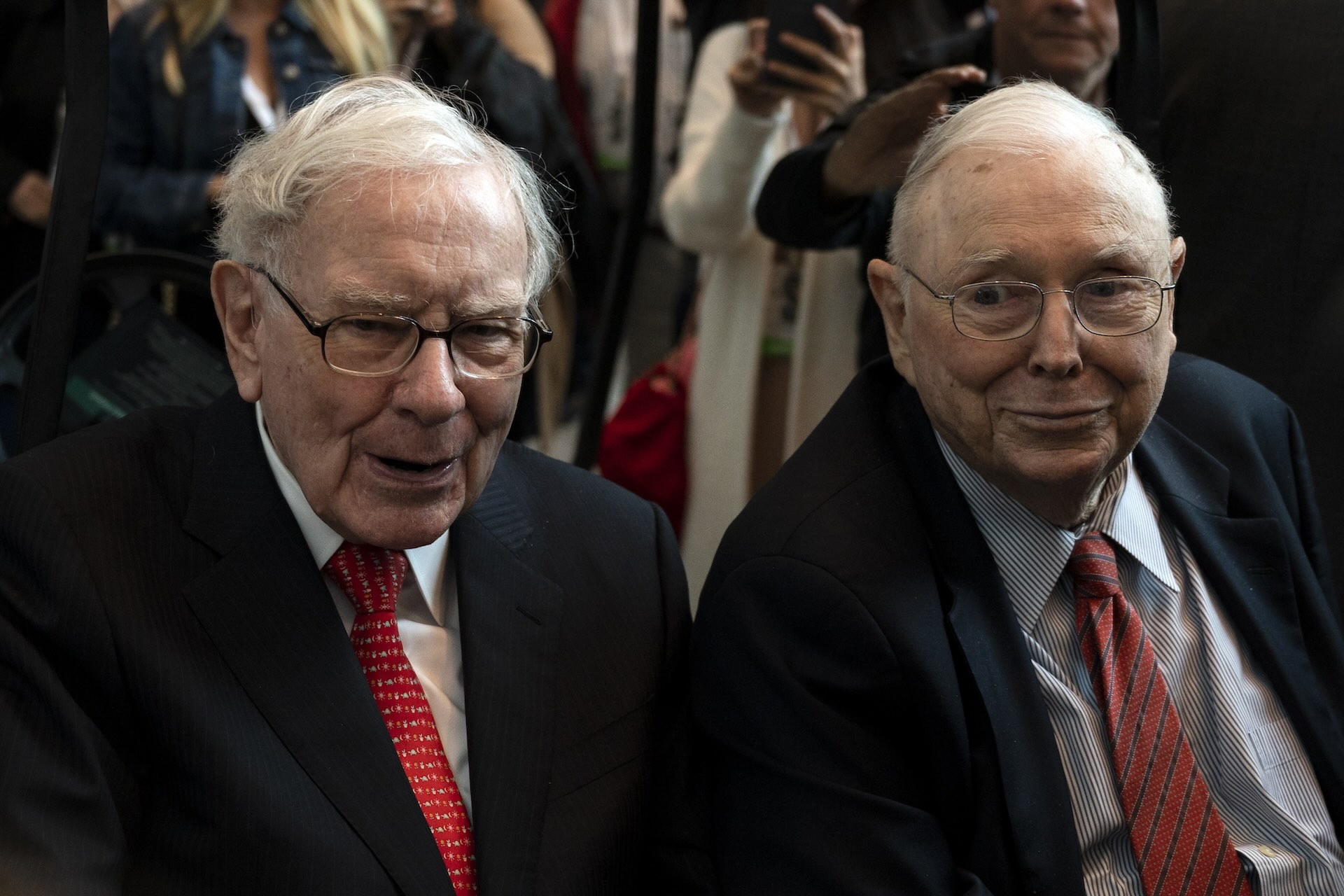
Berkshire Hathaway vice-chair Charlie Munger died at the end of November, but one of history’s great investors won’t soon be forgotten. His ideas about investing and life have influenced popular writers and podcasters such as Tim Ferriss and Shane Parrish, and Stripe Press just published a new edition of Poor Charlie’s Almanack: The Essential Wit and Wisdom of Charles T. Munger earlier this month.
Munger’s most important lesson for investors might surprise you—don’t try to copy what he and Warren Buffett did unless you are certain you have the time and desire to do thorough research on individual companies. When they were younger, they benefitted from relatively little competition. Now, everything is a crowded trade.
“It’s gotten harder, way harder,” Munger told Stripe co-founder John Collison in an interview that was recorded last year to mark the release of Poor Charlie’s Almanack. “It’s gotten so hard that most of the people who are in wealth management have an almost zero chance of outperforming an unmanaged index like the S&P.”
I thought I’d amplify that message as a minor contribution for those who have resolved to make 2024 the year they get their finances in order. It’s probably too late for a lot of us oldsters who took retirement for granted and thought it would be enough to stick a little money in a Registered Retirement Savings Plan every year. But you twentysomethings still have a shot at a comfortable retirement, provided you learn about investing from disinterested voices such as Munger and think hard about the stories told by an industry built on making you believe that the only way to get ahead is by paying a wealth manager thousands of dollars in annual fees.
The Canada Pension Plan was never intended to be more than a basic safety net. When the CPP was created in 1965, the promise was to cover a quarter of a worker’s average lifetime earnings up to a certain maximum. (The target is now 33 per cent.) It was assumed that the fear of living out a spartan existence over our final years would drive us to demand robust pension plans from our employers and set aside money on our own. RRSPs were there as a nudge, promising tax breaks on our annual contributions.
This system hasn’t worked well. Some 37 per cent of Canadians aged 50 and older and still working said they felt they hadn’t saved enough money to retire when they wanted, according to a poll conducted by the National Institute on Ageing and Environics Institute For Survey Research in 2022. What’s more, 25 per cent said it was “unclear” whether they were financially secure enough to retire. That’s significant financial anxiety that might have been avoidable if boomers and gen-Xers had received better financial advice.
Some 6.3 million Canadians contributed to RRSPs in 2000, with a median contribution of $2,700, according to research by Deloitte. In 2019, 5.9 million people made a median contribution of $3,260, or only $2,298 when adjusted for inflation, the study said. If the architects of Canada’s pension system assumed we’d take care of ourselves, they were mistaken.
“Prioritizing spending today over long-term accumulation indicates a lack of healthy savings behaviour,” the Deloitte report says.
Some households will be counting on selling their homes to carry them through retirement. That could work for individuals who were fortunate enough to own real estate at the beginning of Canada’s housing boom a couple of decades ago, but could be of little use to individuals who found themselves chasing runaway prices by piling up debt or to younger Canadians who have been priced out of the market.
Munger’s belief that most investors are best served by putting their savings in low-fee funds that mirror major stock markets could be worth millions to twentysomethings who follow his advice now and stick with it until they retire, said David Feller, co-founder and chief executive of Mogo, a Canadian fintech.
For a flat fee of $4.99 per month, Mogo will facilitate the purchase of ETFs that mirror the S&P 500, Munger and Buffett’s preferred index because its breadth offers built-in diversity and its 66-year history offers a long track record. That’s it. No options trading, no clever funds that exploit the latest investing trends, or anything else that would give Mogo an excuse to charge lots of fees.
Feller’s strategy could expose the finance industry’s dirty secret. It charges billions of dollars every year for advice that amounts to little more than guesswork. S&P Dow Jones data shows that about 86 per cent of actively managed large-cap funds underperformed the S&P 500 over 10 years, while about 95 per cent of active managers underperformed the S&P/TSX composite index of Canadian stocks. “People essentially are investing and being put into solutions that aren’t even close to their best interests,” Feller said in an interview.
Here’s some math on the simple strategy of investing in the S&P 500 and avoiding fees. Feller said one 27-year-old employee at Mogo who recently began investing $250 per week is on track to have $6 million when he’s 67, $14 million when he’s 77 and $42 million by 87. The longer-term fix for Canada’s retirement system might be financial literacy. If we create more savers, compounding and delayed gratification will do a lot of the work.
Kevin Carmichael is The Logic’s economics columnist and editor-at-large. He has spent more than two decades covering economics, business and finance for outlets including Bloomberg News, The Globe and Mail and the Financial Post, where he also served as editor-in-chief.