Skip to content

Commentary
Carmichael: The cost of living crisis is about feelings, not facts
The stories we tell ourselves can harden into actual economic variables
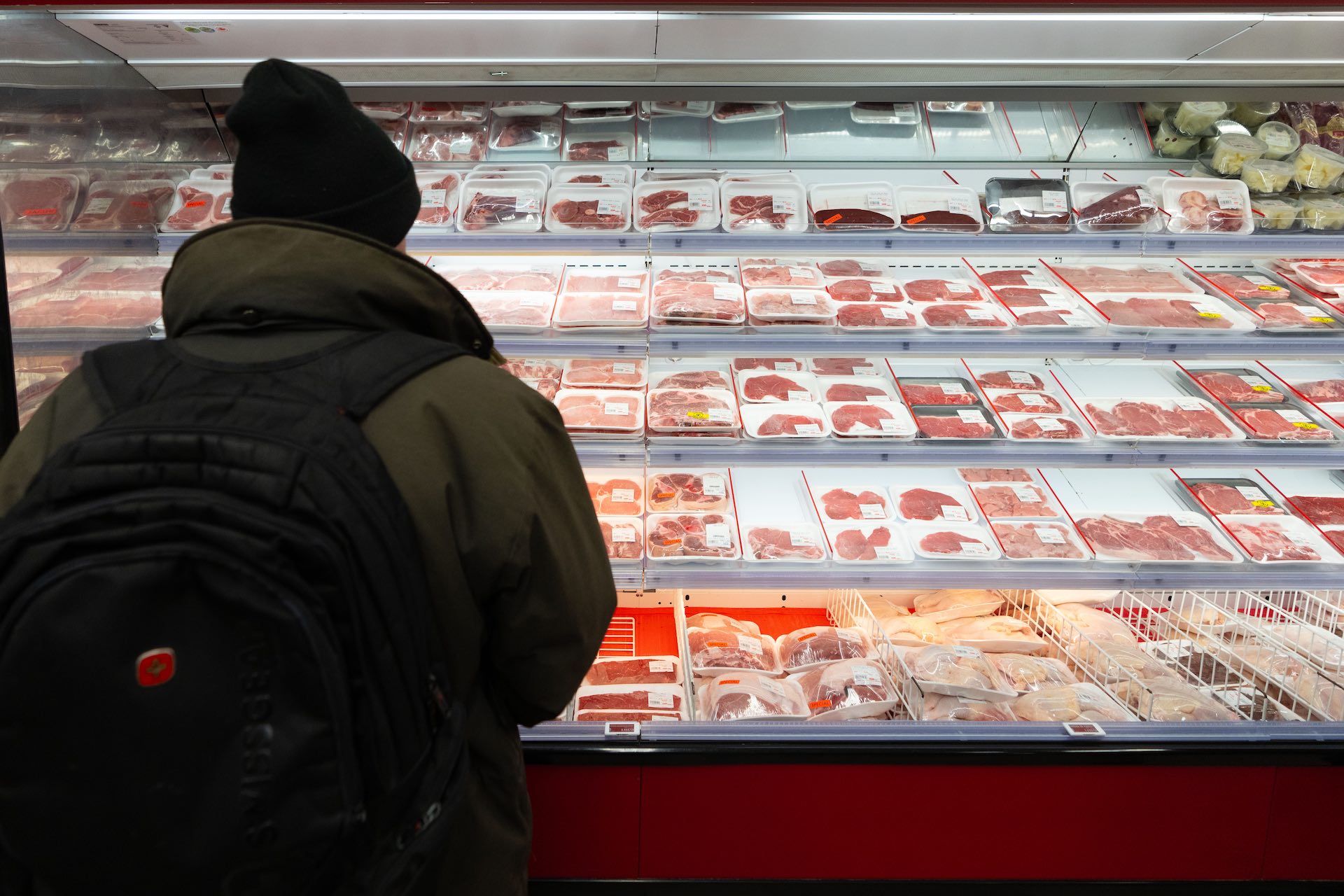
Two-thirds of Canadians say the cost of living is as bad as they’ve ever seen, polling suggests. Photo: The Canadian Press/Christinne Muschi
Late last year, pollster David Coletto felt a jolt of professional envy while reading Politico. “One of the most revealing polling questions I have seen recently did not ask about inflation, wages or interest rates,” Coletto wrote. “It asked something much simpler: does the cost of living today feel worse than ever, merely bad, or not bad at all?”
Politico had surveyed Americans. Coletto, who runs oft-cited Abacus Data from Ottawa, decided to put the same question to Canadians.
Related Articles


Sixty-seven per cent said “the cost of living here is the worst I can ever remember it being,” and 21 per cent said, “The cost of living here is bad, but I can remember times when it was worse.”
The results speak for themselves. Almost all of us feel like the cost of living is either bad or unprecedented. So in this make-or-break year for Canada’s economy, when politics will dictate the extent to which we create a buffer from U.S. belligerence, politicians will instead be distracted by a problem for which there are no short-term solutions, or at least none that they would have the guts to try.
If the political class had the wherewithal to do something about affordability, it surely would have done something by now. Instead, we’ve watched premiers take potshots at the central bank for raising interest rates, members of Parliament haul oligopolistic grocery CEOs to Ottawa for performative committee hearings and governments clip some twigs off the thicket that is the country’s tax code. None of it has made any difference in terms of sentiment.
The affordability question is an example of how stories harden into actual economic variables, something Nobel laureate Robert Shiller describes as narrative economics. That’s because there’s a strong hint of confabulation in the persistence of the affordability story. That is, the stress that people feel is real, but for many it’s a trick of minds that are poorly wired to make sense of numbers. Behavioural economics has shown that for all our intelligence, we remain creatures who would prefer a seven per cent raise amid nine per cent inflation over a four per cent raise amid two per cent inflation. We think in nominal terms, and rarely adjust for context.
Last year, The Economist’s “Free exchange” column offered a cheeky solution to the rich world’s cost-of-living crisis: remove some zeros from their currencies. This is something that has been done on occasion as a palliative for the angst created when our tendency to think in nominal terms clashes with the real world. Apparently, some German shoppers were convinced that prices jumped when their country adopted the euro simply because the numbers changed.
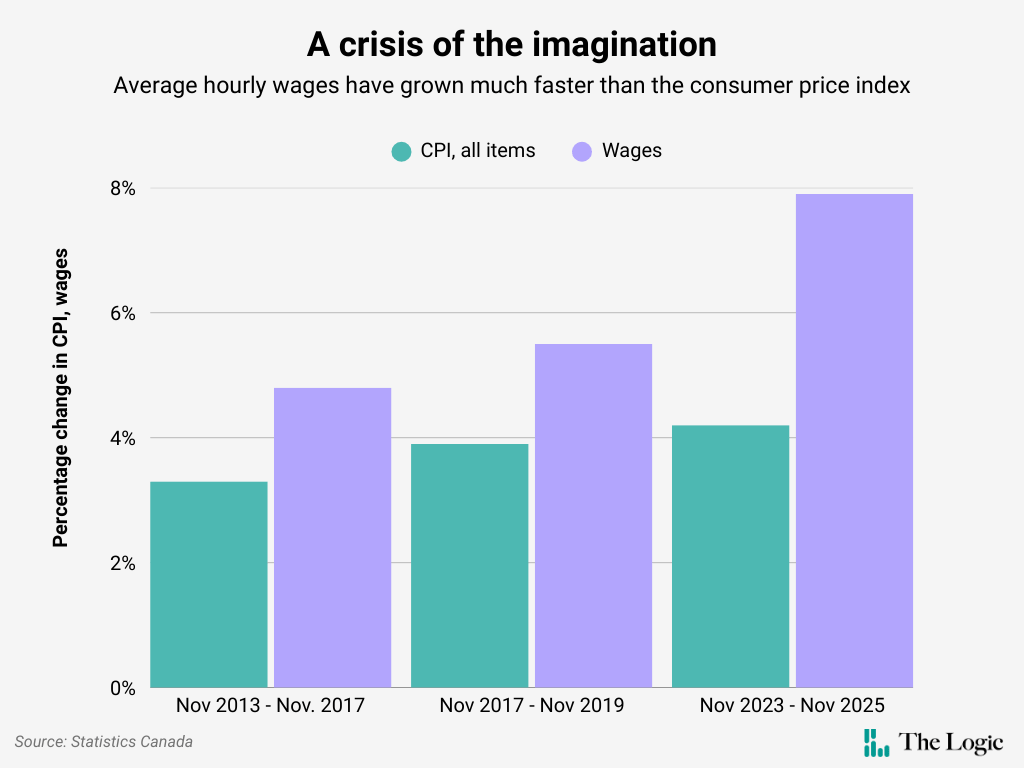
I think something similar is driving Canada’s upset over the cost of living. Affordability is a relative concept. The inflation shock that came in the aftermath of the COVID-19 pandemic was undeniable, but that was more than three years ago. In the meantime, wage increases have more than offset the price spike for most of us.
Aggregate numbers can distort reality, too. The affordability story gets its energy from the thousands of people who form the lower legs of what some now call the K-shaped economy. Most everyone’s wages are up, but some have surged ahead of inflation while others have simply kept pace. The pressure that many renters have felt in recent years wasn’t a trick of the mind. But because there are so few counter-narratives, the pain of those who could use some help becomes a national crisis that takes attention away from threats that truly menace us all.
One of the more steadfast rules of economics is that prices tend not to fall without the help of a recession—or a debilitating bout of deflation that behaves like a recession in slow motion.
A better way to confront affordability is to create the conditions that allow people to get richer at a faster rate than inflation. That’s why the affordability crisis is really a manifestation of the productivity crisis that the Bank of Canada declared in 2024. But besides governor Tiff Macklem and his deputies, you almost never hear anyone talk about affordability in this way.
Coletto’s results were remarkable on their own. But they are even more remarkable when placed next to the Politico survey that inspired his poll. Only 46 per cent of Americans feel the cost of living is the worst they can remember. That implies that there’s a double-digit gap between how Canadians and Americans perceive affordability, even though Macklem got inflation under control far sooner than his counterparts at the Federal Reserve.
Why? Maybe because some Americans are having an easier time with higher costs because they’ve grown considerably richer in recent years, while Canadians are walking around with about as much spending money as they had four years ago.
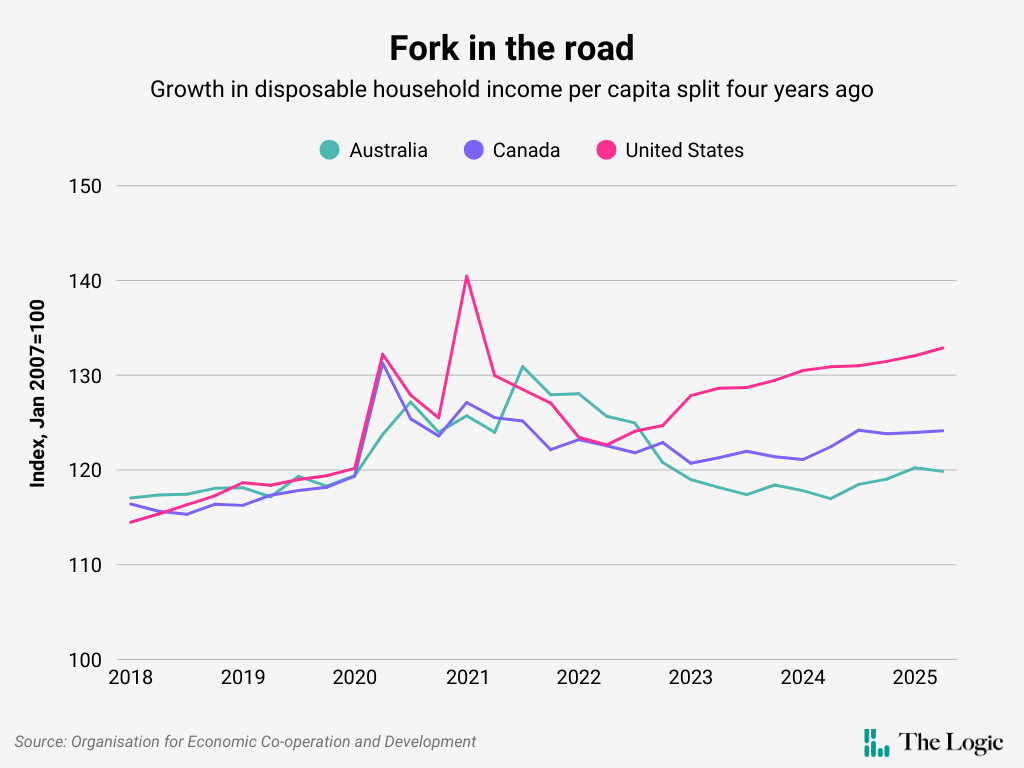
When I saw Coletto’s note, I went to the Organisation for Economic Co-operation and Development’s trove of data on the 38 mostly rich countries that make up its membership. There, I found another big gap between Canada and the U.S. that might explain why anxiety over the cost of living is higher among Canadians than Americans. Household disposable income per capita in the U.S. has increased some 33 per cent since the start of 2007, compared with about 24 per cent in Canada.
More noteworthy is the rate at which that gap has expanded since the pandemic. By 2019, household income in the two countries had grown by essentially the same amount. During the first part of 2022, the two trajectories forked. Disposable income per capita in the U.S. has increased some eight per cent since then, while in Canada it has grown only about 0.8 per cent.
The difference in wealth creation is a function of productivity growth; the U.S. has lots of it in recent years, while Canada has had almost none. It’s a shame. So much energy has been devoted to affordability over the past few years, but so little of it has been directed at the right thing.
Kevin Carmichael is The Logic’s economics columnist and editor-at-large. He has spent more than two decades covering economics, business and finance for outlets including Bloomberg News, The Globe and Mail and the Financial Post, where he also served as editor-in-chief.



Loading...
Thanks for sharing!
You have shared 5 articles this month and reached the maximum amount of shares available.
CloseThis account has reached its share limit.
If you would like to purchase a sharing license please contact The Logic support at [email protected].
CloseGift the full article!
You have gifted 0 article(s) this month and have 5 remaining.
Recipients will be able to read the full text of the article after submitting their email address. They will not have access to other articles or subscriber benefits.
Photo: The Canadian Press/Christinne Muschi
Most Popular This Week




In-depth, agenda-setting reporting
Great journalism delivered straight to your inbox.
News
Panel decries Canada’s chaotic way of funding world-class science
Briefing
AI is pushing insurers to become asset managers, Canadian CEOs say
Trump administration faces lawsuit over 50% tariffs on Canadian goods
Canada-U.S. trade war to reduce real GDP by 1.4% over 2024 levels after five years: PBO
Best business newsletter in Canada
Get up to speed in minutes with insights and analysis on the most important stories of the day, every weekday.
Exclusive events
See the bigger picture with reporters and industry experts in subscriber-exclusive events.
Membership in The Logic Council
Membership provides access to our popular Slack channel, participation in subscriber surveys and invitations to exclusive events with our journalists and special guests.





