Carmichael: Mark Carney’s win shows anti-elitism has its limits
Expertise has been given a second chance.
Mark Carney is nothing if not an expert. Canada’s prime minister has degrees in economics from Harvard and Oxford. His first job was at Goldman Sachs, a fixture in the premier league of global finance. He held senior jobs at the Bank of Canada and the Finance Department, where he impressed his way into the top job at the central bank. He was poached to run the Bank of England, a fixture in the premier league of global policymaking and financial regulation.
Commentary
Carmichael: Mark Carney’s win shows anti-elitism has its limits
With Canada under threat, most of its voters rushed to back the candidate with the flashiest CV
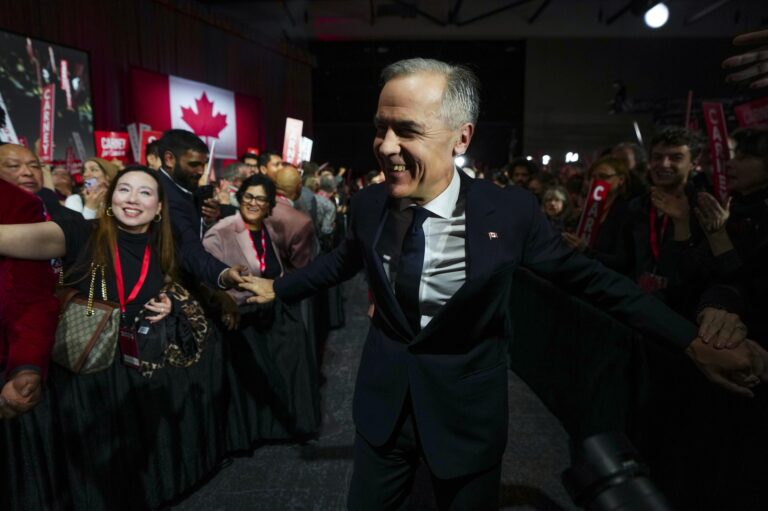
Canadian Prime Minister Mark Carney arrives at the Office of the Prime Minister and Privy Council, the morning after the Liberal Party won the Canadian federal election, in Ottawa on Tuesday, April 29, 2025. Photo: The Canadian Press/Justin Tang
Mark Carney is nothing if not an expert. Canada’s prime minister has degrees in economics from Harvard and Oxford. His first job was at Goldman Sachs, a fixture in the premier league of global finance. He held senior jobs at the Bank of Canada and the Finance Department, where he impressed his way into the top job at the central bank. He was poached to run the Bank of England, a fixture in the premier league of global policymaking and financial regulation.
If you paid attention to the campaign, you know about his roles at Brookfield Asset Management, Bloomberg and Stripe. He also advised the head of the United Nations and wrote a book after he came home from London.
Conservative Leader Pierre Poilievre has done nothing but politics. His experience is in partisan militancy, not decision making; he was a senior cabinet minister for the final nine months of former prime minister Stephen Harper’s nine years in power.
That doesn’t mean Poilievre couldn’t have done the job, but there’s a reason coaches turn to grizzled veterans when the team needs a goal in the dying minutes.
It’s not hyperbole to suggest that the election result was good for democracy. Poilievre wasn’t planning a Trump-style assault on democratic institutions, but the style of politics he favoured was weakening our capacity to do big things. Former prime minister Justin Trudeau started it, his inability to execute on promises and stick to targets giving people reason to doubt whether Parliament could still deliver. Poilievre’s mix of cynicism and ideological blindness might have dealt a final blow, if endorsed in a fit of electoral pique.
In the book that made “creative destruction” a pillar of free-market economics, Joseph Schumpeter also wrote about the conditions he thought were necessary for democracies to prosper. The first was that the “human material of politics”—the cabinet ministers, elected representatives and staffers that guide the machine of government—must be of “sufficiently high quality.” That is, a critical mass of individuals who have “passed many tests in other fields,” thus leaving the elected government suitably prepared for what might come.
Schumpeter formed his thoughts between the First and Second World Wars, a time when democracy was in genuine peril. Fascism and socialism were ascendent. It was a time of scarcity and societies were impatient for a return to abundance. Schumpeter observed that it was false to assume that democratic governments would inevitably reflect the societies they serve; in fact, the quality of representative government is determined by the sorts of people who put up their hands to serve. Schumpeter anticipated the current moment, writing that the “democratic process may easily create the conditions in the political sector that, once established, will repel most of the men [and women] who can make a success at anything else.”
To emphasize the point, he added: “It is not true in democracy that people always have the kind and quality of government they want or merit.”
One of the memes of the campaign was Carney telling the CBC’s Rosemary Barton to “look inside yourself” when she challenged him on whether he’d done enough to shield himself from conflicts of interest, considering the seats he held on various boards, including Brookfield, one of the world’s largest asset managers, where he served as chair. Let’s replay the tape.
Barton: There’s no possible conflict of interest in your assets? That’s very difficult to believe.
Carney: Look inside yourself, Rosemary. You start from a prior of conflict and ill will. I have served in the private sector. I have stood up for Canada. I have left my roles in the private sector at a time of crisis for our country. I’m complying with all the rules. Your line of questioning is trying to invent new rules. I’m complying with the rules that Parliament has laid out, and the responsibilities and ethics commissioner. I will continue to comply with those rules.
A flash of arrogance by the Liberal leader, for sure, and maybe a hint of it from Barton herself. But there’s more than that.
The exchange is also an example of how the democratic process now repels many people from taking part. Our opinions of the people who serve have sunk so low that we force them to defend their motivations before they’ve even made a policy decision. If Carney thinks we’re lucky to have him, he’s right. Too few individuals with long resumes are applying for jobs in Parliament. The country suffers for it.
Trudeau attracted a decent number of such people when he first won in 2015—and then drove most of them away. Poilievre never tried to recruit big names. A moment sticks with me from his early January interview with Jordan Peterson, when Peterson asked the still-ascendent Poilievre who he had in mind to be his lieutenants.
“A remarkable team of people aggregated themselves around Trump,” Peterson said, evidently impressed by how the U.S. president had expanded the MAGA movement to include people such as Elon Musk and Bill Ackman. Peterson asked Poilievre to name some of the people who would play key roles in his government.
First on Poilievre’s list was Andrew Scheer, the leader who lost the 2019 election and, like Poilievre, a career politician. Lawyers-turned-MPs Leslyn Lewis and Jamil Jivani made his list, as did Melissa Lantsman, co-deputy leader of the Conservative party, whose experience before getting elected includes multiple tours of duty as a political staffer. That’s where he stopped. No Musks. No Ackmans.
Poilievre didn’t value expertise. “I’ve been around politics a long time, so I’ve met a lot of these people who are considered part of the elite and I talk to them and I ask them questions, and then I go out to my constituency and I talk to truck drivers and mechanics and farmers,” he told podcaster Shane Parrish during the campaign. “I find the latter group actually smarter. They don’t use all the same fancy language, but if you ask them just sort of nuts-and-bolts type questions, they’re smarter.”
I spent the first half of my life around truck drivers, mechanics and farmers, and the second half chasing after central bankers and other technocrats. I share Poilievre’s admiration for the former group, but that doesn’t mean they are qualified to set monetary policy or allocate scarce resources. Poilievre’s anti-elitism has a downside. “A complex society without elites is inconceivable,” Martin Wolf concludes in his 2023 book The Crisis of Democratic Capitalism.
There’s a tendency to view Trudeau and Poilievre as opposites. I think that’s wrong. They’re really the same type of politician, only different colours. Trudeau started the assault on expertise by emphasizing style over execution. Poilievre—who, like Trudeau, focused on creating a cult of personality—would have diminished the “political sector” that much more.
The opposite of Trudeau is Carney, someone who emphasizes substance over style. Some 44 per cent of the electorate went for that approach. It gives him a mandate to show that expertise still works.
Carney can’t take that opportunity lightly, because some 41 per cent of the electorate preferred the Trudeau-Poilievre approach of governing as a form of performance art. We are reminded daily of where that leads.
Kevin Carmichael is The Logic’s economics columnist and editor-at-large. He has spent more than two decades covering economics, business and finance for outlets including Bloomberg News, The Globe and Mail and the Financial Post, where he also served as editor-in-chief.
Recipients will be able to read the full text of the article after submitting their email address. They will not have access to other articles or subscriber benefits.
Great journalism delivered straight to your inbox.
The Big Read
Alberta’s referendum is just the start of the turmoil
By
Meghan Potkins
Briefing
EverWind plans $10B data centre and wind development in Nova Scotia
By Catherine McIntyre |
Canada ready to force Stelco to sell its Canadian operations, Joly says
By Joanna Smith |
Feds plan a 60 MW defence-oriented data centre for Ottawa
By David Reevely |
Best business newsletter in Canada
Get up to speed in minutes with insights and analysis on the most important stories of the day, every weekday.
Exclusive events
See the bigger picture with reporters and industry experts in subscriber-exclusive events.
Membership in The Logic Council
Membership provides access to our popular Slack channel, participation in subscriber surveys and invitations to exclusive events with our journalists and special guests.