Last summer, Prime Minister Justin Trudeau was asked what advice he’d give himself if he could go back to 2015, when he led the third-place Liberals to a majority government. His answer, I think, captures why most will consider his economic legacy a failure.
Skip to content


Commentary
Carmichael: Goodbye to Trudeaunomics and its failures
The Justin Trudeau era is a cautionary tale for those who believe it’s simple to turn ideas into change
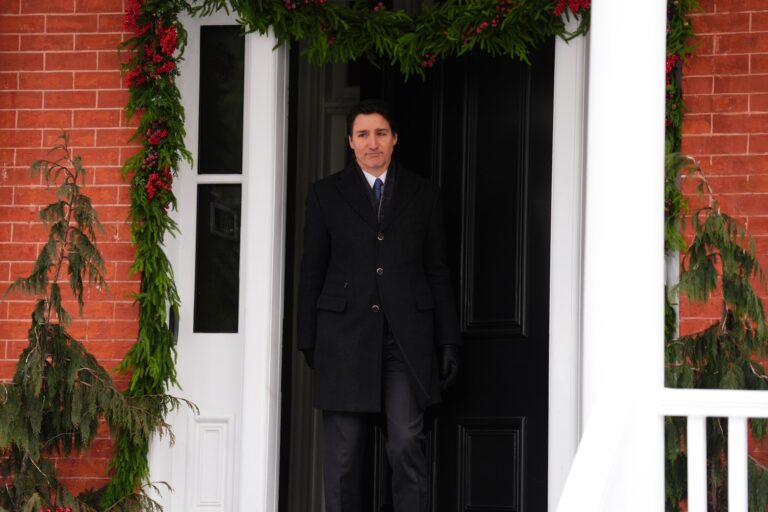
Prime Minister Justin Trudeau announces his resignation outside Rideau Cottage in Ottawa on Monday, Jan. 6, 2025. Photo: The Canadian Press/Adrian Wyld
Last summer, Prime Minister Justin Trudeau was asked what advice he’d give himself if he could go back to 2015, when he led the third-place Liberals to a majority government. His answer, I think, captures why most will consider his economic legacy a failure.
“We have done so much, but at the same time, you can never achieve the level of your greatest ambitions,” Trudeau said at the Global Progress Action Summit in Montreal. “It’s hard work. It’s incremental. It’s making changes that will echo through the coming decades. I don’t know. I’d love to imagine a way where we could have done this and actually been a little more rigorous about pointing out the things that we did, instead of just moving on to the next thing as progressives.”
Nine years into the job of guiding a $2.4-trillion economy and Trudeau still seemed surprised that running a big organization is “hard work” and that change happens incrementally, not the day after the press release goes out.
It was interesting that Trudeau, who announced Monday that he intends to resign as prime minister as soon as the Liberals choose a new leader, thought he could have been more “rigorous.” I wondered if “pointing out the things that we did” was a euphemism. It was obvious to everyone that with the Liberals trailing the Conservatives by a huge margin in the polls, Trudeau’s problem wasn’t that too few people knew about $10-a-day child care or the Canada child benefit. His problem was the housing crisis, which he had allowed to fester. Then, affordability was made even worse by the inflation surge and his government’s lax approach to immigration, which caused a spike in demand for rental units.
Related Articles

When it came to the big stuff, too often Trudeau’s government was either asleep at the switch or paralyzed by indecision. His tenure is a cautionary tale for those of us that believe ideas can lead to change. They can, but only if they are backed by leaders and teams committed to the boring work of strategy and administration. Trudeau learned this too late.
At the Global Progress conference, Trudeau prefaced his answer by noting that one of the “wise old adages in politics was always under-promise and over-deliver.” By “so much,” I took Trudeau to mean he had attempted to do too much for the team he had assembled. He consciously sacrificed experience in order to assemble a cabinet with an equal number of men and women, and weighted heavily in favour of members of Parliament newly recruited to join Team Trudeau at the expense of longer-serving Liberals with established track records.
The gender-neutral cabinet was a great symbol, but it lacked actual diversity. Trudeau was forced to draw from a smaller pool of talent. His cabinets were packed with what Musa al-Gharbi calls “symbolic capitalists,” a class that includes teachers, doctors, lawyers, consultants and journalists. There were precious few operators and labourers. “When a revived Liberal party won a clear parliamentary majority, I was appointed minister of finance, taking my seat in a cabinet populated overwhelmingly with first-time MPs and led by a first-time prime minister,” Bill Morneau, Trudeau’s first finance minister and one of those first-time MPs, wrote in his 2023 memoir.
I dislike assessing economic stewardship by comparing one leader’s tenure against those of others. The macro forces that influence economic growth don’t start and stop with elections. The unemployment rate dropped to record lows during Trudeau’s time in office. He probably deserves a little credit. But low interest rates, a recovery in oil prices, the tech boom and demographics were the main factors.
A better standard is the measures that stick around long enough to make a positive difference. What will the winner of the next election inherit from Trudeau’s tenure? Maybe nothing but targets for Pierre Poilievre’s desire to destroy as many symbols of “wokeism” as he can find. “We’re going to cut bureaucracy, cut the consultants, cut foreign aid, cut back on corporate welfare to large corporations,” the Conservative leader said on Jordan Peterson’s podcast last week. “We’re going to use the savings to bring down the deficit and taxes. Unleash the free-enterprise system.”
It’s notable that Poilievre said he would “bring down” the deficit, not eliminate it. Trudeau broke the political taboo over deficits in 2015 by explicitly promising to run one. That was significant. There was an opportunity cost to placing an arbitrary ceiling on public investment, especially with interest rates near zero. Harper exacerbated the economic slump that followed the collapse of oil prices in 2014 by prioritizing a balanced budget. Trudeau exploited that mistake. Canada had a head start on the wave of industrial policy that is now sweeping the globe in the name of climate change and winning the AI race.
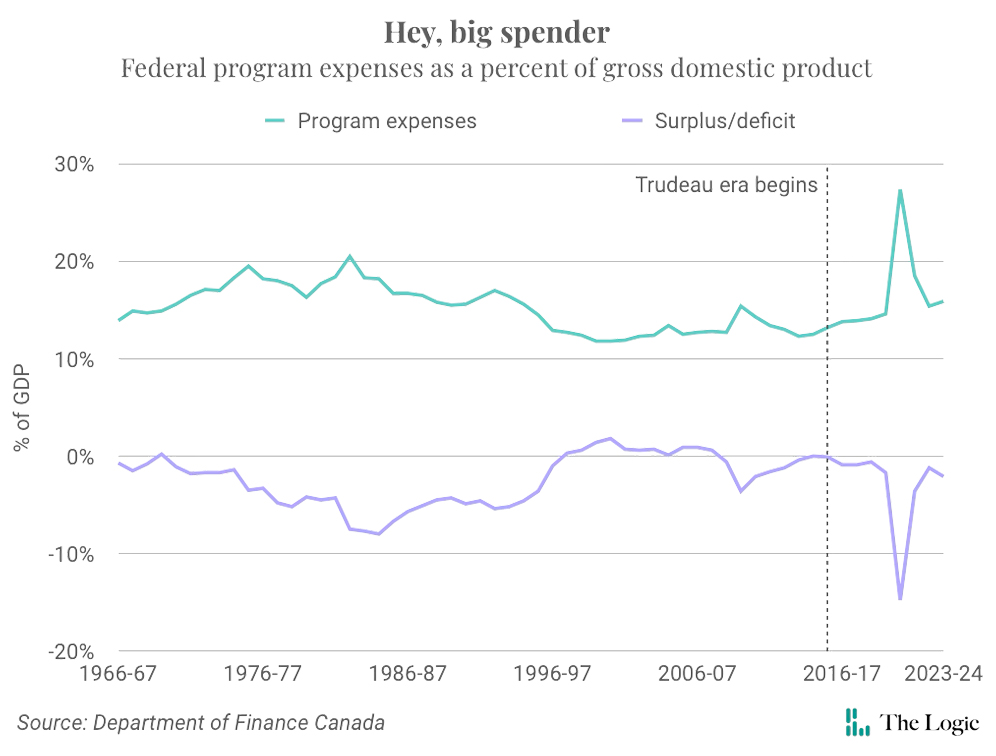
The problem was that Trudeau’s team of first-timers got carried away, and their credibility as economic managers suffered for it. Program spending was 15.9 per cent of gross domestic product in the fiscal year that ended March 31, compared with 15.4 per cent in fiscal 2009-10, when Harper deployed an aggressive stimulus plan to offset the Great Recession. Excluding COVID-19 spending from 2020 to 2022, program expenses as a percentage of GDP are the highest since 1994, when bond investors scared Chrétien and Martin into doing something about the deficit.
Morneau quit the government in 2020 amid a dispute over spending. His book is effectively a critique of Trudeau’s approach to the boring work of governance. Hubris, inexperience, Pollyannaism and political polarization all led to errors, missed targets and hurt feelings, but the “overriding cause,” Morneau wrote, “was the manner in which these and other challenges were managed or, more correctly, not managed on a daily basis at the highest level.”
Trudeau pledged to expand trade with Europe and Asia, but ultimately succumbed to the gravitational pull of the U.S., devoting most of his diplomatic energy on Washington. The carbon tax was an inspired policy for confronting climate change, but it now looks doomed because Trudeau failed to make it stick with the public.
Same for the hundreds of millions devoted to innovation clusters, Canada Infrastructure Bank and the Strategic Innovation Fund. Good ideas, poor execution. All were sold as necessary to jump-start productivity and to take full advantage of historic technological change. What’s happened? Productivity has been in chronic decline for more than three years, and even though economic growth has been OK in aggregate, on an individual level output also has been in decline. GDP per capita declined 1.5 per cent in 2023 and likely did so again in 2024, according to the International Monetary Fund. No other advanced economy has such a dismal record.
“There is a need to repeat and be a little more brash in what we’re doing,” Trudeau told his audience at the Global Progress gathering. “But that doesn’t always work.”
Indeed. Especially when you are focused on the wrong things.
Kevin Carmichael is The Logic’s economics columnist and editor-at-large. He has spent more than two decades covering economics, business and finance for outlets including Bloomberg News, The Globe and Mail and the Financial Post, where he also served as editor-in-chief.



Loading...
Thanks for sharing!
You have shared 5 articles this month and reached the maximum amount of shares available.
CloseThis account has reached its share limit.
If you would like to purchase a sharing license please contact The Logic support at [email protected].
CloseGift the full article!
You have gifted 0 article(s) this month and have 5 remaining.
Recipients will be able to read the full text of the article after submitting their email address. They will not have access to other articles or subscriber benefits.
Photo: The Canadian Press/Adrian Wyld
Most Popular This Week




In-depth, agenda-setting reporting
Great journalism delivered straight to your inbox.
News
Canada faces a satellite-launch crunch as SpaceX retires its workhorse rocket
Briefing
Cohere says it caught an Alibaba model trying to send data to a server in China
Feds and First Nations to work on sharing resource revenue, with a sovereign wealth fund one option
Zafin buys U.S. fintech Naehas in nine-figure deal
Best business newsletter in Canada
Get up to speed in minutes with insights and analysis on the most important stories of the day, every weekday.
Exclusive events
See the bigger picture with reporters and industry experts in subscriber-exclusive events.
Membership in The Logic Council
Membership provides access to our popular Slack channel, participation in subscriber surveys and invitations to exclusive events with our journalists and special guests.