The currents of history are running strong. Economist Nouriel Roubini catalogued ten “megathreats” in his most recent book by the same name. Former Bank of Canada governor Stephen Poloz’s The Next Age of Uncertainty predicts five “tectonic” shifts—population aging, technological disruption, inequality, debt and climate change—will shape the future in unpredictable ways. BlackRock Investment Institute is tracking five “mega” forces: demographic divergence, digital disruption and AI, geopolitical splintering, a wholesale change in finance and the low-carbon transition.
Skip to content

Commentary
Carmichael: Canada faces megathreats. It doesn’t need a mega response
Some of the solutions lie close to home
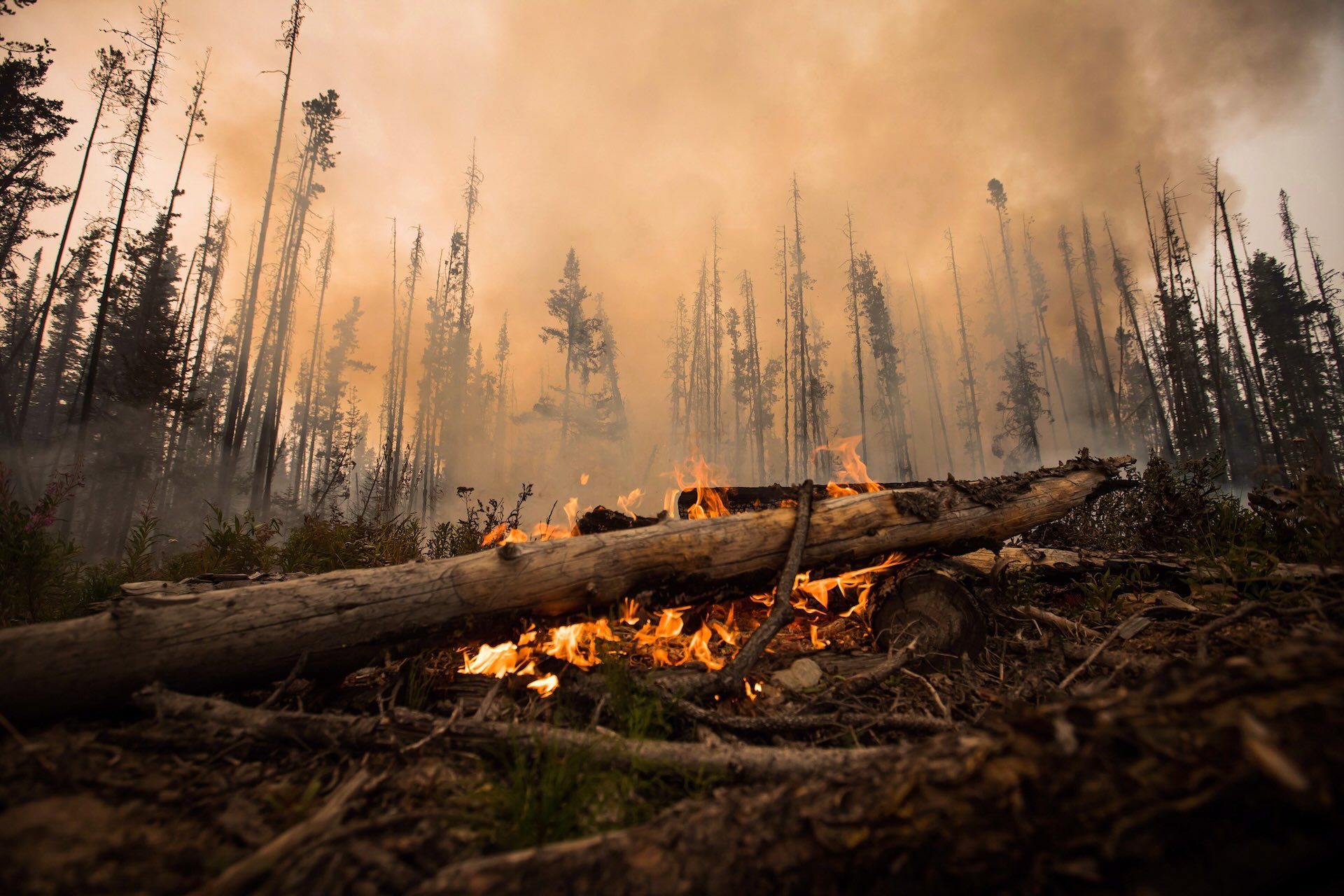
A wildfire burns on a logging road approximately 20 km southwest of Fort St. James, B.C., in, Aug. 2018. Photo: The Canadian Press/Darryl Dyck
The currents of history are running strong. Economist Nouriel Roubini catalogued ten “megathreats” in his most recent book by the same name. Former Bank of Canada governor Stephen Poloz’s The Next Age of Uncertainty predicts five “tectonic” shifts—population aging, technological disruption, inequality, debt and climate change—will shape the future in unpredictable ways. BlackRock Investment Institute is tracking five “mega” forces: demographic divergence, digital disruption and AI, geopolitical splintering, a wholesale change in finance and the low-carbon transition.
It’s enough to make one a fatalist. But even the Stoics, who taught amor fati, believed we should nonetheless attempt to make the world a better place, even if ultimately we have no say in the matter.
Maybe Mark Carney has read some Marcus Aurelius. As prime minister, he has pledged to match megathreats with a mega response. “I’m in politics to do big things, not to be something,” he told reporters on May 2. “Now that Canadians have honoured me with a mandate to bring about big changes quickly, I will work relentlessly to fulfil that trust.”
Related Articles


There will be a temptation to leave the fighting to Carney. When the threats are omnipotent, what’s even a large, profitable corporation to do, besides protect its margins and shareholders? There’s scant evidence of sacrifice. According to Statistics Canada data, corporate profits were 7.3 per cent of revenue in the fourth quarter, greater than the average since the start of 2010. That suggests the corporate class so far has chosen to hunker down rather than lead the charge.
A tendency for reflexive impotence is the reason why hinge moments require an over-the-top response from the government. Profit margins in the oil and gas and real estate industries are double-digit, yet the climate and housing crises persist unabated. Households respond similarly. Per Bank, the chief executive of Loblaw, is skeptical that “Buy Canada” will make the jump from anti-Trump meme to sustained demand and cause a market-led shift to local food production. “Maybe a third of it will stick,” he told analysts after the company’s latest quarterly report. Price and quality are what ultimately drive demand, not a desire for economic resiliency, he said.
Any drive to make Canada more resilient will need to inspire individuals to think bigger than themselves. There’s only so much one prime minister and a set of premiers can do on their own. “A wartime economic adviser is a nice idea,” said Romel Mostafa, director of Ivey Business School’s Lawrence National Centre for Policy and Management, but “agility becomes an issue.”
Carney’s thesis is that if the federal government leads the charge, private investment will follow, thus multiplying the impact of the initial investment.
It’s a good bet given the circumstances. Markets are amplifiers, not catalyzers. Oligopolistic companies run by executives raised on maximizing shareholder value aren’t going to take big risks in the face of extreme uncertainty. It’s fair to wonder whether the state is fit for the challenge, but if you believe this historic moment requires an equally historic response, the state is the only option.
Mostafa’s observation about the limits of generalship is well placed. If battles are won and lost on the field, then any attempt Canada makes to create a more resilient economy ultimately will be determined by what takes place in communities, what economist Raghuram Rajan calls the “third pillar” that supports any society, along with the state and markets.
It’s no small thing that someone like Rajan would turn to localism as a way to counter megathreats. He’s the former head of India’s central bank, and as chief economist at the International Monetary Fund, he famously foreshadowed the events that triggered the Great Recession. His outlook is macro, not micro. In The Third Pillar, he argues that the concentration of government and market power has caused communities to erode, creating an imbalance. He thinks that imbalance explains much of what has gone wrong in recent decades, especially the extreme polarization that has endangered many democracies.
If Rajan is right, then communities can do a lot to meet the moment, especially if they recognize the value of investing in themselves. Carney’s theory of using markets as amplifiers works at the local level, too.
Here’s an example from London, Ont. What Andrew Fleet is building deserves more words than it’s going to get here. He’s the co-founder and executive director of Growing Chefs!, a charity whose primary mission is to get children excited about making and eating real food. Fleet’s ambitions exceed donations, so he operates Growing Chefs! as a social enterprise that delivers boxed meals and caters events. He employs 20 people and generated some $1.7 million in revenue in the most recent fiscal year, 54 per cent of which came from money-making ventures.
Growing Chefs! could be bigger. Fleet would happily add to his gardens, expand his kitchen and boost orders to local farmers if big buyers of prepared meals, such as hospitals, would sign a contract with him instead of the traditional meal providers they use. “If there was funding available to scale it, there’s nothing in the world I would like more,” Fleet said. “I have not found that anywhere to date, and I’m 18 years into that search.”
Think about how many of those megathreats that Growing Chefs! And others like it could help the country confront. As Fleet has grown, so has his demand for local produce, creating demand for farmers and doing his bit to curb agriculture’s carbon footprint. He’s applied what he learned working at high-end restaurants to develop a system that can mass produce healthy food boxes—an answer to concerns related to keeping an aging society healthy and arresting a troubling increase in food insecurity. The value of giving children something to do that would force them to put down their smartphones should be obvious to all of us by now.
Fleet’s sense of things is that too many of us think as individuals rather than holistically. “We’re not incentivized,” he said. That will have to change. Megathreats are becoming a reality.
Kevin Carmichael is The Logic’s economics columnist and editor-at-large. He has spent more than two decades covering economics, business and finance for outlets including Bloomberg News, The Globe and Mail and the Financial Post, where he also served as editor-in-chief.



Loading...
Thanks for sharing!
You have shared 5 articles this month and reached the maximum amount of shares available.
CloseThis account has reached its share limit.
If you would like to purchase a sharing license please contact The Logic support at [email protected].
CloseGift the full article!
You have gifted 0 article(s) this month and have 5 remaining.
Recipients will be able to read the full text of the article after submitting their email address. They will not have access to other articles or subscriber benefits.
Photo: The Canadian Press/Darryl Dyck
Most Popular This Week




In-depth, agenda-setting reporting
Great journalism delivered straight to your inbox.
News
Tech firms want AI models to create better versions of themselves
Briefing
Lightspeed cuts 250 jobs through layoffs and attrition
Oil tycoon Adam Waterous aims to build new Canadian energy player with US$1B fund
Data centre infrastructure firms 3C and Datalec merge, plan Calgary expansion
Best business newsletter in Canada
Get up to speed in minutes with insights and analysis on the most important stories of the day, every weekday.
Exclusive events
See the bigger picture with reporters and industry experts in subscriber-exclusive events.
Membership in The Logic Council
Membership provides access to our popular Slack channel, participation in subscriber surveys and invitations to exclusive events with our journalists and special guests.