In early January, when Donald Trump was building his chaos machine like a child with a Meccano set, Canadian venture investor Chris Neumann noticed the then president-elect was choosing some unusual pieces to construct his new administration.
Skip to content
Commentary
Carmichael: Trump defies the laws of economics because he doesn’t believe in them
Take it from one of the guys who helped him ‘normalize the crazy’
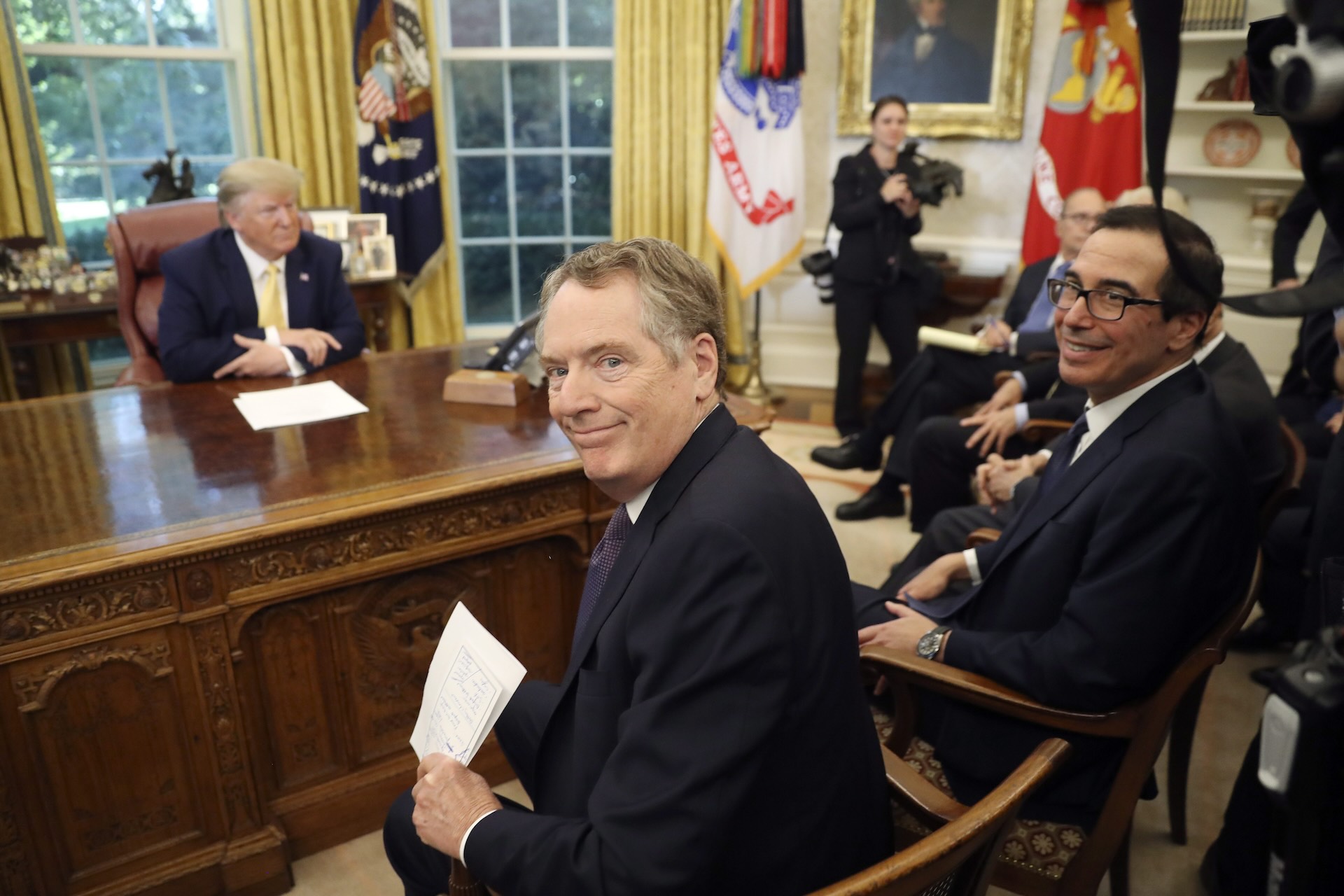
Robert Lighthizer was U.S. trade representative during Donald Trump’s first term. He won’t reprise that role in the new administration, but his economic philosophy still looms large. Photo: AP Photo/Andrew Harnik
In early January, when Donald Trump was building his chaos machine like a child with a Meccano set, Canadian venture investor Chris Neumann noticed the then president-elect was choosing some unusual pieces to construct his new administration.
“I’m not sure that folks outside Silicon Valley understand the degree to which [venture capitalists] and former VCs are slotting into roles within the new administration,” Neumann wrote in his newsletter. Neumann flagged seven by name, starting with vice-president-elect J.D. Vance. “This is an astonishing degree of representation for what is objectively a cottage industry,” Neumann wrote.
If Trump was over-indexing on one profession, that meant another was being crowded out. Among the losers in Trumpworld are economists and Wall Street bankers, fixtures of previous U.S. administrations who are much less prominent now.
That might explain why those of us conditioned to think like economists—nevermind economists themselves—are struggling to accept the reality of Trump’s agenda. “The iron laws of economics and U.S. politics will eventually defeat Trump’s use of tariffs against Canada, Mexico and China,” Tim Sargent, a former Canadian deputy minister of trade, and Fen Osler Hampson, a professor at Carleton University, insisted in a commentary for Policy magazine.
Related Articles

However, the authors lack conviction on when those laws will reassert themselves, so they advise Canada to get its house in order. No argument here.
Doing so might require learning to live with the cognitive dissonance that Trump’s return to the White House has introduced. His administration will continue to defy laws of economics and politics because they don’t believe in them. “We made what seemed crazy, normal,” Robert Lighthizer, the U.S. trade representative during the first Trump presidency, told The New Yorker in December. “We normalized the crazy.”
I spotted an observation that resonated from a partner at law firm McCarthy Tétrault. “To seek coherence in the erratic is to misunderstand the frame,” Awanish Sinha wrote on LinkedIn. “We in Canada are not partners in a negotiation; we are props in a domestic American drama of strength.”
Dramas often are episodic. Within a day of pausing his feud with Canada and Mexico, the president had taken his show to the Middle East. The road to Trump’s geopolitical Wrestlemania could yet swing back to North America, but for now Canada has won some peace and quiet by “doing the job”—professional wrestling lingo for losing a match.
It would be unwise to assume that becoming a jobber will be enough to survive. Backstage, men and women with ideas about the way the world should work will be using the path that Trump clears to set policy. They might be the most dangerous.
Lots of Canadian decision-makers are apparently reading No Trade is Free, Lighthizer’s 2023 memoir. Former finance minister Chrystia Freeland put it on her reading list for International Reading Day. During an appearance on journalist Paul Wells’s podcast, Alberta Premier Danielle Smith referenced Lighthizer’s characterization of value-added taxes like the GST as a form of cheating at international trade.
“He’s really irritated by national value-added taxes,” Smith said. “He thinks that’s unfair. American products sold into another market get taxed at that level, whereas foreign governments selling into their market don’t because they don’t have that tax.”
Lighthizer didn’t make the cut for Trump’s new cabinet. But if he remains a sage, then anyone who insists that trade deals should be “win-win” in order to facilitate efficiency and maximize welfare will struggle to get a hearing in Trumpworld. “It is no longer possible for Americans to continue to think of ourselves just as consumers and not producers,” he wrote.
Lighthizer has no time for “theological free-traders” and a “foreign policy blob” that believes in a link between international trade and foreign policy. Point out that the trade deficit is a function of voracious U.S. demand and he’d tell you the dollar is too strong. Suggest the dollar is strong because the world wants to invest in the U.S., and he would say that’s because America has made it too easy for the rest of the world to claim America’s deep stash of treasure.
“Huge persistent trade deficits are making the United States poorer,” he wrote. “My solution is that we should put in place tariffs to offset what would be the over-valuation of the currency.”
Economists have a lot to answer for, but I don’t think a lifelong trade lawyer with a chip on his shoulder should lead the inquisition. Like Smith, I was struck by Lighthizer’s fixation on value-added taxes. It caused me to see the book as something akin to Plato’s allegory of the cave, where prisoners trapped below ground confuse shadows for reality.
Earlier this week, an ideologically diverse group of American scholars released a set of facts to make an assessment of the state of their nation. Few countries are richer, yet many have healthier and safer societies. The group judged that no country was more polarized or suffered a higher rate of fatal overdoses. The U.S. outperforms only one per cent of its peers when it comes to youth depression and curbing greenhouse gas emissions. Three quarters of the world does a better job of creating employment, according to this assessment.
Lighthizer has a point when he says economists get too hung up on efficiency. But America’s problems are rooted in its failure to widely distribute its fabulous wealth. Much of the rest of the world does that through a safety net that it pays for with value-added taxes, an efficient and fair means of taxation.
If the Trump administration is convinced that trade is the cause of all that misery, then Canada has little choice but to prepare for tariffs. There might be no reasoning with them. Sometimes crazy is just that: crazy.
Kevin Carmichael is The Logic’s economics columnist and editor-at-large. He has spent more than two decades covering economics, business and finance for outlets including Bloomberg News, The Globe and Mail and the Financial Post, where he also served as editor-in-chief.



Loading...
Thanks for sharing!
You have shared 5 articles this month and reached the maximum amount of shares available.
CloseThis account has reached its share limit.
If you would like to purchase a sharing license please contact The Logic support at [email protected].
CloseGift the full article!
You have gifted 0 article(s) this month and have 5 remaining.
Recipients will be able to read the full text of the article after submitting their email address. They will not have access to other articles or subscriber benefits.
Photo: AP Photo/Andrew Harnik
Most Popular This Week


In-depth, agenda-setting reporting
Great journalism delivered straight to your inbox.
News
People hired to promote Canadian rocket firm didn’t actually help, company alleges in lawsuit defence
Briefing
New 100% U.S. tariffs on drones take effect, hitting Canadian industry
Solomon says Canada will stick with its own AI rules after U.S., tech giants push G20 not to regulate
Ottawa defence supplier Allen-Vanguard put into receivership
Best business newsletter in Canada
Get up to speed in minutes with insights and analysis on the most important stories of the day, every weekday.
Exclusive events
See the bigger picture with reporters and industry experts in subscriber-exclusive events.
Membership in The Logic Council
Membership provides access to our popular Slack channel, participation in subscriber surveys and invitations to exclusive events with our journalists and special guests.