Normal is redefined on the regular these days, but what goes up still comes down. Those charts of geopolitical risk indices that had looked like rocket trails to infinity as Donald Trump resettled in the White House now resemble sketches of the Himalayan mountain chain. We’ve come off peak chaos.
Skip to content

Commentary
Carmichael: Canada’s governments are making big bets. Now it’s the private sector’s turn
Embracing economic risk isn’t easy, but Ottawa and the provinces are lighting the way
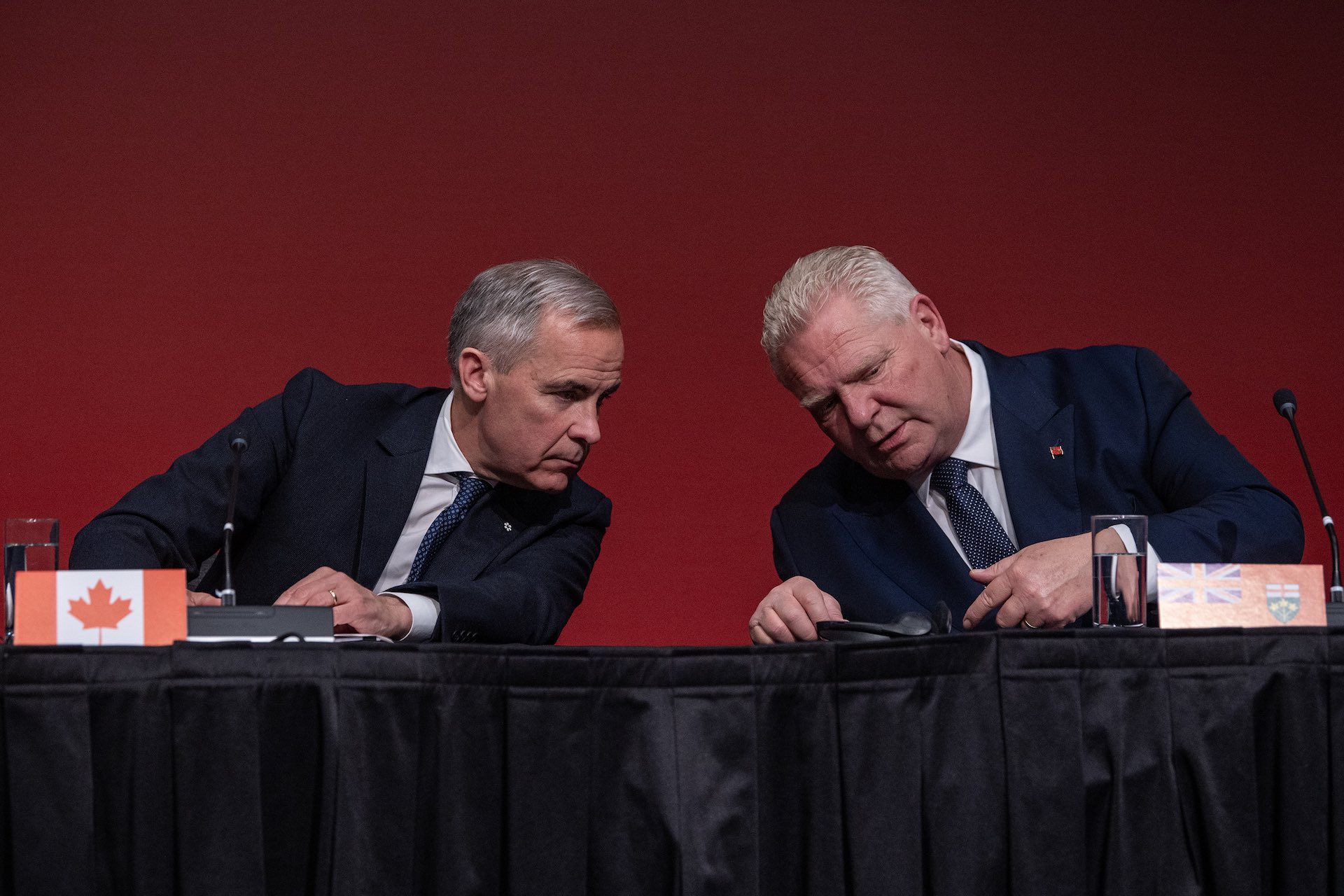
Prime Minister Mark Carney confers with Ontario Premier Doug Ford during a first ministers meeting this spring in Saskatoon. Photo: The Canadian Press/Liam Richards
Normal is redefined on the regular these days, but what goes up still comes down. Those charts of geopolitical risk indices that had looked like rocket trails to infinity as Donald Trump resettled in the White House now resemble sketches of the Himalayan mountain chain. We’ve come off peak chaos.
Of course, everything’s relative when the U.S. president treats the rudder of world affairs like it’s an on/off switch. It’s worth noting that even the Lesser Himalayas climb some 4,000 metres into the sky. Similarly, what passes for calm these days still means a risk premium that could severely hobble global commerce. Export Development Canada is among the latest to predict that all the uncertainty will cause a Canadian recession this year.
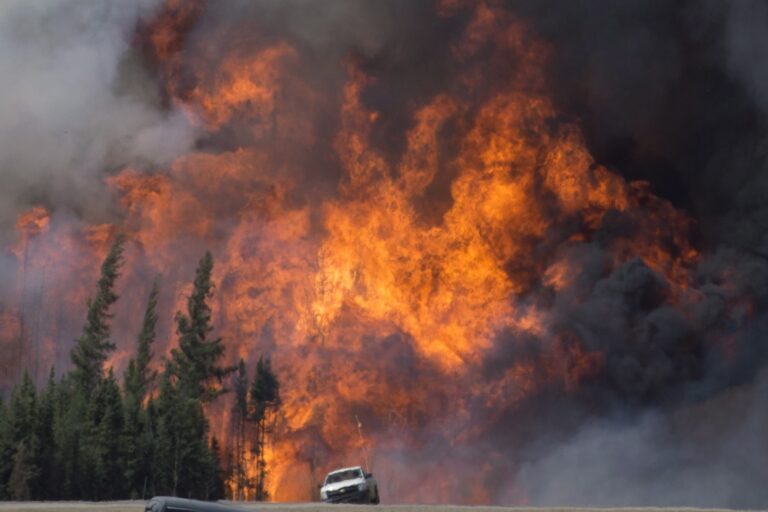
The BlackRock Institute tracks 10 major geopolitical risks and it ranks only one of those threats—a breakup of the European Union—as “low.” Three are “medium,” and six are marked as “high.” And that’s only the political stuff. It was harder to breathe in Toronto and Montreal than New Delhi and Beijing again this week because of drifting forest-fire smoke, a reminder that our real war is with climate change, not the Trump administration.
University of Toronto philosopher Mark Kingwell wrote in 2020 that if humans understood that life was a series of bets, we’d choose not to play. That’s why narratives are so important. Stories guide us forward, like flashlights in the dark. What happens when all those torches flicker at once? It’s worth considering because the extreme uncertainty probably isn’t going away.
Related Articles

Former Bank of Canada governor Stephen Poloz thinks we’ve entered a new industrial revolution marked by automation, digitization and artificial intelligence. Previous industrial revolutions brought the steam engine, electricity and the internet. Poloz observed in a recent essay that those periods also brought the kind of geopolitical chaos that we’re experiencing now.
Before society benefited broadly from each of those shifts, the lives of many individual workers were disrupted, while the inventors of those technologies reaped outsized rewards. The unfairness fed populism, which led to reactionary policies and power vacuums that created opportunities for “geopolitical opportunism.”
Poloz’s thumbnail description of the mid-1800s, the early 1900s and the mid-1980s echoes loudly today. It’s natural to assume that things will settle down, because settled is what we know. It’s the backdrop for the narrative we’ve constructed of how the world works. You see it in the assumptions that the central banks will eventually dull the pain of this crisis by cutting interest rates, like they have during every other crisis over the past few decades. Yet the inflation numbers refuse to co-operate.
If Poloz is right, our individual reference points are useless because we’re no longer in Happy Valley, that utopian moment where the peace dividend, globalization and rapid productivity growth combined to create a period of abundance. That could make coping with what’s to come extremely hard.
“Fundamental structural changes in economies are rarely done in wisdom and foresight,” Poloz wrote. “They are usually forced upon us. And the forcing mechanism is likely to be rising economic, financial and geopolitical stress, not a return to calm.”
I’ve started to think that our ability to cope with the unknown will determine how we come out of this moment in history. Canada will need to rely on its wits, which means getting comfortable with making bets on an uncertain future. This is where everything that Prime Minister Mark Carney and the provinces are trying to do could break down. We’ve spent decades trying to erase risk from economic life to the point that few of us are willing to do anything without a guarantee.
“Canada has become less and less risk tolerant,” said Nancy Southern, chief executive of Calgary-based Atco, the electricity utility that has sidelines in renewable energy, modular building construction and defence. “Everybody wants everything buttoned up. That’s the tone from the regulator. That’s the tone from the government, all levels of government. That’s actually the tone from boards of companies today. You can’t make a mistake.”
It’s tempting to assume the profit motive will propel Canada’s capitalistic economy into the future, no matter the size of the abyss. That hope might be what Kingwell, citing Slavoj Žižek, called an “unknown known”—a risk that goes unexamined because it’s so tightly threaded into our idea of how things work. Profit margins have been strong and periods of disruption present all kinds of opportunity. But while fortune might still favour the bold, the finance industry has worked hard to make sure that doing almost nothing with one’s profits is also highly lucrative.
In May, I asked Cenovus chief executive Jon McKenzie why business investment in the oil industry had become so weak. One of the reasons he cited was onerous regulation and lower oil prices had made it too hard to expand production. But another reason is that companies such as Cenovus can keep their shareholders happy by repurchasing stock. “It’s made capital allocation a much simpler game if you understand your worst-case scenario is where you’re just buying back your stock,” McKenzie said. “You understand the returns on that. Any investment you make in the business needs to supersede those kinds of returns.”
The point isn’t to further demonize share buybacks. I surfaced that comment to show that an unintended consequence of our efforts to remove risk from the economy has dulled the impulse to move things forward. There are other examples. Nova Scotia billionaire John Bragg, who founded Oxford Wild Blueberries and Bragg Communications, told podcaster Shane Parrish last year that his family’s investment portfolio includes “a lot of Buffett,” and that they had been considering an investment in a riskier company, but decided they’d rather buy more shares in Berkshire Hathaway, Warren Buffet’s publicly traded holding company. Why roll the dice when you can ride with one of history’s greatest investors?
It’s going to take a lot of coaxing to get private money to take the leap into the unknown. It’s all the more reason for governments to keep doing what they’re doing. They are going to have to light the way.
Kevin Carmichael is The Logic’s economics columnist and editor-at-large. He has spent more than two decades covering economics, business and finance for outlets including Bloomberg News, The Globe and Mail and the Financial Post, where he also served as editor-in-chief.



Loading...
Thanks for sharing!
You have shared 5 articles this month and reached the maximum amount of shares available.
CloseThis account has reached its share limit.
If you would like to purchase a sharing license please contact The Logic support at [email protected].
CloseGift the full article!
You have gifted 0 article(s) this month and have 5 remaining.
Recipients will be able to read the full text of the article after submitting their email address. They will not have access to other articles or subscriber benefits.
Photo: The Canadian Press/Liam Richards
Most Popular This Week


In-depth, agenda-setting reporting
Great journalism delivered straight to your inbox.
News
ApplyBoard was the worst-performing Canadian startup in Fidelity’s portfolio in 2026
Briefing
Defence Investment Agency to be a Crown corporation so it can get deeper into Canada’s military industry
Mark Carney says he’ll work with Quebec separatist premier-to-be on housing, infrastructure, big projects
Mistral claims its new AI model closes the gap with leading Chinese developers
Best business newsletter in Canada
Get up to speed in minutes with insights and analysis on the most important stories of the day, every weekday.
Exclusive events
See the bigger picture with reporters and industry experts in subscriber-exclusive events.
Membership in The Logic Council
Membership provides access to our popular Slack channel, participation in subscriber surveys and invitations to exclusive events with our journalists and special guests.