OTTAWA — Justin Trudeau headed into his first conversation with Donald Trump after the Nov. 5 election ready to talk about cross-border pipelines and with a warning from Canadian officials the incoming U.S. president wanted an early review of the North American trade pact.
Skip to content
News
Memo for Trudeau on key Trump call had few hints of chaos to come
Before the conversation on Nov. 6, officials told Trudeau to congratulate Trump on an ‘amazing campaign’ but to be prepared for some friction on trade
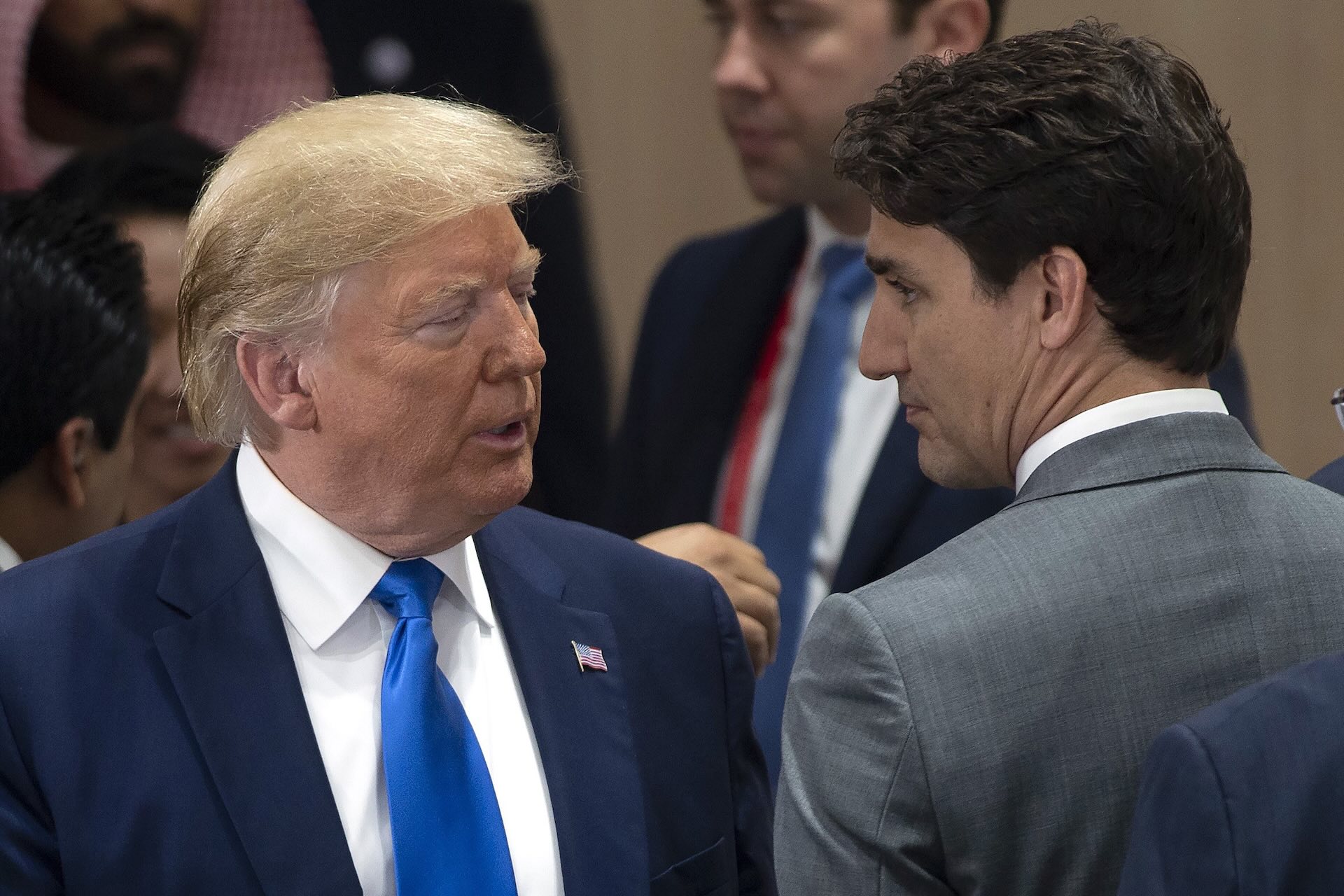
A preparatory memo suggests Justin Trudeau made his congratulatory call to Donald Trump on Nov. 6 with little hint of the rupture to come between the two countries. Photo: The Canadian Press/Adrian Wyld
OTTAWA — Justin Trudeau headed into his first conversation with Donald Trump after the Nov. 5 election ready to talk about cross-border pipelines and with a warning from Canadian officials the incoming U.S. president wanted an early review of the North American trade pact.
A draft memo the Privy Council Office provided to then-prime minister Trudeau touched on areas where there may be increased bilateral tensions—such as the coming review of the free trade deal—but it carried no hint of the unprecedented rupture in the relationship that would come after Trump threatened to annex Canada through “economic force,” including several layers of steep tariffs on Canadian goods.
Talking Points
- A draft memo prepared for then-prime minister Justin Trudeau’s congratulatory call to Donald Trump suggested he talk about cross-border pipelines
- The memo released to The Logic through the Access to Information Act also warned that Trump would likely press for an earlier review of the North American trade pact
“You led an amazing campaign,” says a suggested talking point in the Nov. 5 memo released to The Logic through the Access to Information Act. The telephone call took place Nov. 6.
The suggested talking points, which were partially redacted prior to being released, encouraged Trudeau to discuss “continuing to protect our economies,” as well as “working together on strengthening and protecting the 100+ cross-border pipelines and transmission lines that are key to our joint energy security.” It also suggested Trudeau, who was at the time still vowing to lead the Liberals through the next federal election, talk about “strengthening our supply chains to reduce dependence on hostile states and increase our resiliency and security.” There was a plan to discuss peace in the Middle East. There was no mention of fentanyl.
The Privy Council Office, which is the part of the federal bureaucracy that supports the prime minister and cabinet, also provided Trudeau with contextual notes for the call. “Economic security will be a front-burner issue for a Republican administration. It is an issue that transcends economic policy and includes national security,” it said.
Reviewing the North American trade deal
Related Articles



The United States-Mexico-Canada Agreement (USMCA) negotiated during the first Trump administration is up for review in July 2026. The memo noted the new president was unlikely to wait until then “before pressing for action.” It pointed to his Oct. 10 speech to the Detroit Economic Club, when Trump announced he would notify Canada and Mexico as soon as he took office that he wanted to review the deal that had replaced the North American Free Trade Agreement. (Trump also said of USMCA that day: “the best trade deal, they say, ever made.”)
“Canada’s preference would be to keep the joint review as narrow and as targeted as possible to provide greater clarity for business and investment in the region,” the memo continued. “However, Canadian officials are preparing for a range of potential scenarios in anticipation of a party seeking to revisit some [USMCA] outcomes, or even the entire agreement.”
Using tariffs to boost domestic manufacturing
The memo noted Trump would bring in an “America First Trade Policy” that would “focus on U.S. domestic manufacturing from other countries and strategic independence from China, including by imposing tariffs on U.S. imports.” It said his campaign platform had pledged to slap 60 per cent tariffs on Chinese goods, on top of any already there. Although this section of the memo focused on China, it also hinted at bad news for Canada in Trump’s plans—while still underestimating the magnitude of the threat. “In addition, it plans to introduce a baseline tariff of 10 to 20 per cent on imports from all other countries,” it said. The rest of that paragraph was censored.
Energy
The memo calls the Canada-U.S. relationship “a major contributor to energy security and supply for both countries,” noting energy is Canada’s top export commodity below the border. “Most cross-border energy trade works seamlessly; however, flashpoints arise affecting Canada’s interests,” the memo said. It pointed to the Line 5 pipeline, which transports propane and crude oil along the bottom of the Straits of Mackinac in northern Michigan, as one example. The project has been subject to court battles between Enbridge and Michigan’s state government.
Keystone XL was another. The pipeline project originally proposed by TC Energy in 2008 would have transported oil from Alberta to refineries along the Gulf Coast, but was rejected by the Biden administration in 2021. “When [TC Energy] closed KXL in June 2021, they indicated they would not consider reviving it without guarantees of completion from the U.S. government,” the memo said. South Bow, the Calgary-based oil pipeline company that spun off from TC Energy, told The Logic last month it has “moved on” from the project.



Loading...
Thanks for sharing!
You have shared 5 articles this month and reached the maximum amount of shares available.
CloseThis account has reached its share limit.
If you would like to purchase a sharing license please contact The Logic support at [email protected].
CloseGift the full article!
You have gifted 0 article(s) this month and have 5 remaining.
Recipients will be able to read the full text of the article after submitting their email address. They will not have access to other articles or subscriber benefits.
Photo: The Canadian Press/Adrian Wyld
Most Popular This Week




In-depth, agenda-setting reporting
Great journalism delivered straight to your inbox.
News
Canada faces a satellite-launch crunch as SpaceX retires its workhorse rocket
Briefing
Rio Tinto gets nearly $165M in additional federal funds for Quebec aluminum
U.S. to lift tariffs on some Canadian products crucial to Maine: Collins
Carney warns of tech dependence after Starlink disruptions in Ukraine
Best business newsletter in Canada
Get up to speed in minutes with insights and analysis on the most important stories of the day, every weekday.
Exclusive events
See the bigger picture with reporters and industry experts in subscriber-exclusive events.
Membership in The Logic Council
Membership provides access to our popular Slack channel, participation in subscriber surveys and invitations to exclusive events with our journalists and special guests.






