Listen Now
0:00
TORONTO — Canada’s World Cup host cities are trailing those in the U.S. and Mexico on accommodation demand and occupancy just days before kickoff, raising questions about whether the tournament will deliver the tourism boom promised by organizers and government officials.
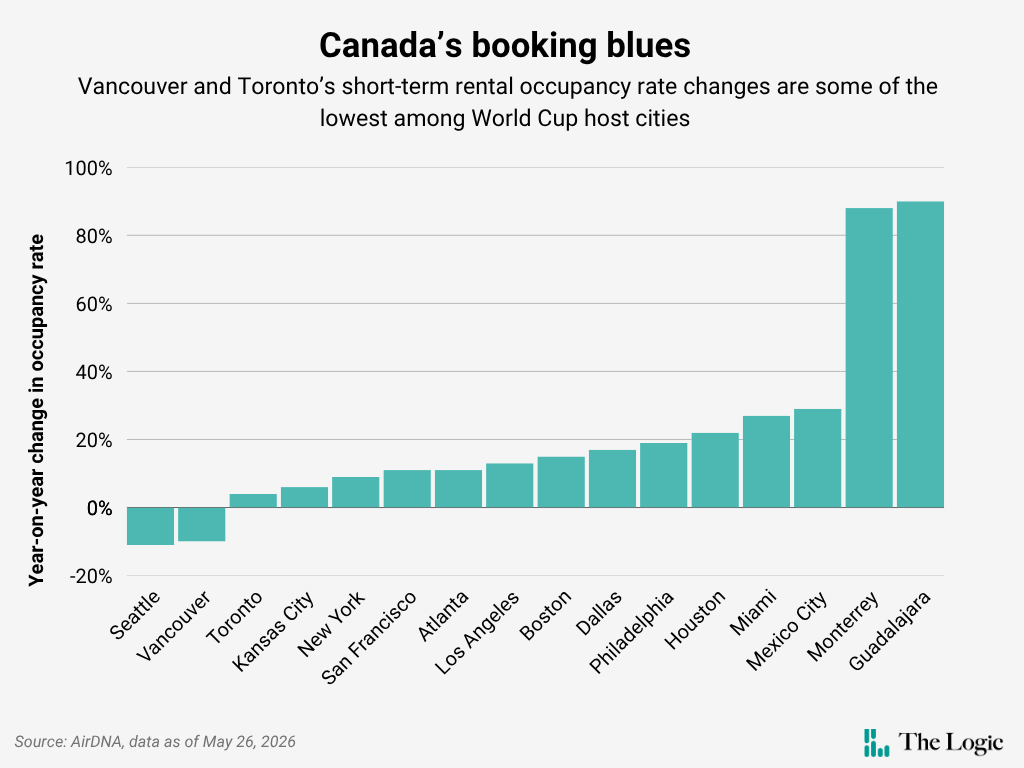
As of May 26, the occupancy rate of short-terms rentals in Toronto on and around match days is projected to be just 4 per cent higher than during the same period last year—placing it third-last among the 16 host cities analyzed—according to data from AirDNA, an analytics firm that tracks listings on Airbnb, Booking.com, Expedia and other platforms.
Talking Points
- Toronto’s short-term rental occupancy on and around match days is projected to rise only four per cent compared to last year. In Vancouver, occupancy rates are down 10 per cent year-on-year, according to analytics firm AirDNA.
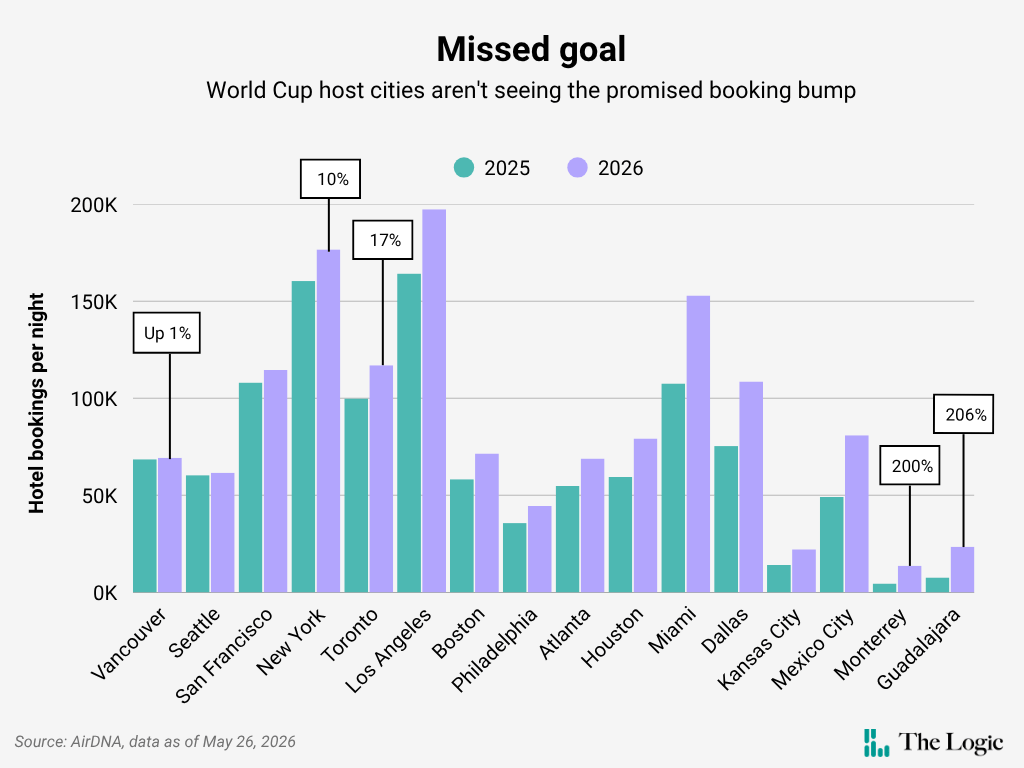
- Demand for hotel rooms in Vancouver is up just one per cent year-over-year, the lowest of all World Cup host cities. In Toronto, which was expecting a surge in bookings, the increase is 17 per cent.
In Vancouver, occupancy rates are expected to be 10 per cent lower over the same period, making it one of only two host cities projected to post a year-over-year decline during the World Cup, alongside Seattle. On the other side of the spectrum, occupancy is expected to be up 27 per cent in Miami, 29 per cent in Mexico City, and around 90 per cent in Guadalajara and Monterrey.
Booking demand, a measure of the total number of nights booked, has also been low in Canada’s two World Cup host cities. In Vancouver, demand for short-term rentals is projected to rise just one per cent year-over-year during match periods—the lowest growth among all host cities—while Toronto is expected to post a 17 per cent increase. The cities with the largest relative growth are in Mexico, where demand is tracking up 200 per cent in Monterrey and 206 per cent in Guadalajara.
Related Articles


According to a Deloitte Finance study prepared last year, Airbnb guests attending the FIFA World Cup were projected to contribute roughly US$94 million to GDP and support 1,410 full-time jobs in Toronto, while visitors staying in Vancouver and surrounding areas were expected to contribute about US$119 million to GDP and support 1,590 full-time positions.
Hopes of a World Cup tourism boom had been high in the years after Canada was chosen as a co-host of the tournament. Vancouver Mayor Ken Sim claimed that the city’s seven World Cup matches would be “the equivalent of 30 to 40 Super Bowls.” According to Royce Chwin, CEO of tourism agency Destination Vancouver, hotel bookings in the city for June are about 20 per cent below last year’s levels.
Tony Elenis, CEO of the Ontario Restaurant Hotel & Motel Association, which represents roughly 11,000 establishments across the province, told The Logic that the World Cup has so far not been “the success that was anticipated.” He added that if hotels ultimately fill their rooms, it may be due to other events taking place in the city, including a busy concert schedule.
Elenis attributed low demand to several factors. Unlike previous tournaments hosted by a single country, he said, the 2026 World Cup’s three-country format has spread visitors across a much larger geographic area. He also pointed to geopolitical uncertainty, immigration policies and rising travel costs, including higher jet fuel prices, as factors that may be dampening travel demand.
“All I’m hearing [from] hotels is there are a lot of cancellations, and they’re hoping for these last-minute reservations that are happening in a week or two weeks,” Elenis said.
When Mexico, Canada and the U.S. were selected as hosts in 2018, they estimated selling tens of thousands of seats for less than $30. Instead, ticket prices have skyrocketed under FIFA’s dynamic pricing model. At the same time, large blocks of tickets appeared on secondary marketplaces at prices well below face value, fueling concerns about demand for less popular matches and the prospect of empty seats. As of this week, all but one of the World Cup matches scheduled to be played in Canada still had tickets available on FIFA’s ticketing platform.
Before the tournament, hotel room rates were expected to climb by more than 200 per cent according to another Deloitte report. Instead, Elenis said some Ontario hotels are now lowering their prices in response to a lack of bookings, despite June typically being one of the sector’s busiest months of the year.
Meanwhile, FIFA reportedly cancelled between 70 and 80 per cent of the hotel room inventory it had initially reserved in Vancouver, and made significant reductions to its reservations in other host cities. Although room-block adjustments are common for events of this size, the American Hotel & Lodging Association told the BBC that the move created the impression of stronger demand than ultimately materialized.
The cost of hosting the World Cup has ballooned since Canada secured the tournament. Toronto is now expected to spend $380 million to host six matches, up from initial estimates of $30 million to $45 million when the city entered the bidding process. In Vancouver, British Columbia’s contribution has risen to $578 million for seven matches. The Parliamentary Budget Officer estimated last month that total public spending across all levels of government will exceed $1 billion, or roughly $82 million per game, including $145 million in federal funding for security alone.
Elenis argued that with billions of viewers expected to tune in, the tournament serves as a powerful marketing opportunity that could help attract future investment to Toronto and Vancouver long after the World Cup’s final whistle.
However, academic research suggests the economic benefits of events such as the World Cup are often modest and short-lived. Meanwhile, any boost from World Cup visitors may also be partially offset by regular tourists who avoid cities during the tournament, reducing net increases in tourism spending.
Exact numbers are hard to pin down. In 2024, FIFA projected that the 2026 World Cup would generate $3.8 billion in economic output for Canada, including $2 billion in direct GDP gains. BMO senior economist Erik Johnson believes the impact will be more modest. In a report published earlier this month, he estimated that tourism-related spending could contribute between $1 billion and $5 billion, with spending by Canadian residents adding another $0.5 billion to $1.5 billion, for a total GDP lift of roughly 0.1 percentage points on an annualized basis.
François Brouard, a professor at Carleton University in Ottawa, said that attributing future tourism gains to the World Cup may be a “different ball game,” arguing that it will be difficult to determine whether visitors choose Canada because of the tournament or for other reasons. He also cautioned that some costs associated with hosting the event may not yet be fully reflected in official projections.