The lobbyists and corporate bosses wondering what it will take to get Pierre Poilievre to respect them might want to listen to a recent episode of the “All-In” podcast, the platform on which Ottawa native Chamath Palihapitiya and three other celebrity Silicon Valley investors gather to riff on tech, politics and the world as they see it.
Skip to content

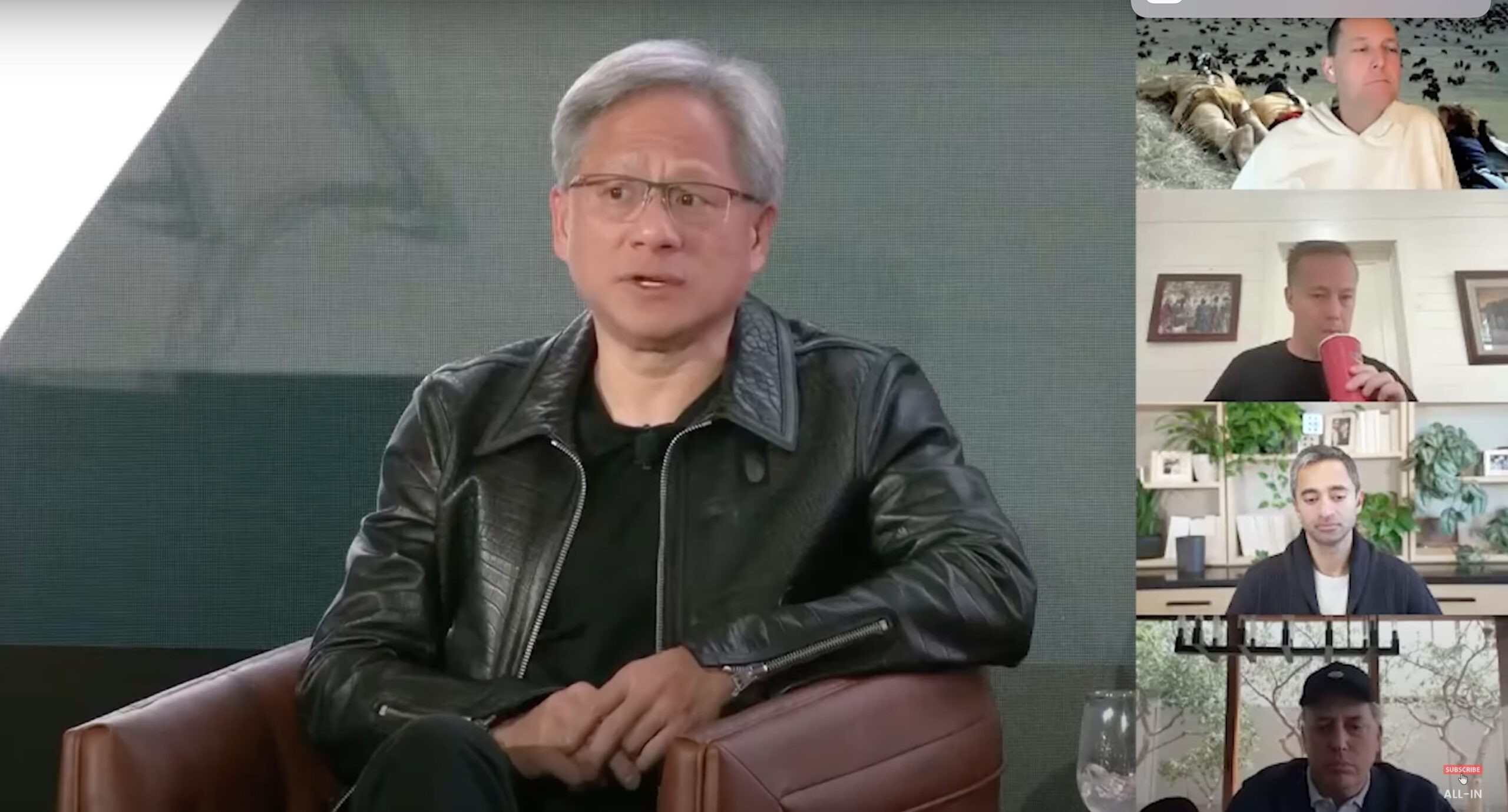 All-In podcast hosts talk about Nvidia chief executive Jensen Huang’s radically candid speech at Stanford University. Photo: YouTube | Screenshot

Commentary
Carmichael: Poilievre demands radical candor from corporate Canada
Want to understand the Conservative leader’s attacks on big business? Tune in to an influential Silicon Valley podcast
Conservative leader Pierre Poilievre in Ottawa in January 2024. Photo: The Canadian Press/Sean Kilpatrick
The lobbyists and corporate bosses wondering what it will take to get Pierre Poilievre to respect them might want to listen to a recent episode of the “All-In” podcast, the platform on which Ottawa native Chamath Palihapitiya and three other celebrity Silicon Valley investors gather to riff on tech, politics and the world as they see it.
Co-host and moderator Jason Calacanis posited that there’s been a “vibe shift” in how chief executives are confronting the culture wars. “Something has clearly changed,” he said. “Tech CEOs have gotten radically candid and fired their comms group.”
Exhibit A: Nvidia chief executive Jensen Huang telling Stanford University students that he hopes they experience “pain and suffering” because difficulty builds resilience, and it’s resilience that determines greatness, not intelligence.
Exhibit B: Palantir CEO Alex Karp saying on CNBC that he “loves burning the short sellers,” who enjoy “pulling down great American companies so they can pay for their coke.” The “All-In” guys loved that line. There was no consensus on Calacanis’ contention that there had been an actual change in the weather, but they all appeared to hope Silicon Valley’s leaders were getting over their fear of offending social media’s various mobs.
“People are speaking their mind more,” said David Friedberg, a former Google employee who sold a startup to Monsanto for US$1 billion in 2013. “Obviously positive and refreshing.”
There’s not much radical candor in Canada, where the country’s most important business leaders appear to think they have a fiduciary duty to avoid offense. They almost never speak outside controlled environments, instead employing armies of lobbyists and professional communicators.
Related Articles


David Herle, the host of must-listen political podcasts “Curse of Politics” and “The Herle Burly,” reads lobbying messages each week from sponsors Telus and Canadian National. But when was the last time you heard Telus CEO Darren Entwistle or CN CEO Tracy Robinson use their own voices to express what they want from our elected representatives?
Poilievre has certainly noticed. “The corporate lobbyists in Ottawa are focused on getting lunches with ministers at the Rideau Club, or showing off their latest ESG brochure, or expecting that politicians are going to do things for them without actually convincing the people on the ground of the benefit to them,” he said in a speech hosted by the Greater Vancouver Board of Trade on March 8.
He knew what he was doing. The attack on lobbyists and their corporate paymasters was the first thing out of Poilievre’s mouth. He raised his voice to deliver the words “utterly useless,” making his message easily digestible for observers and for partisan social media managers, then returned to his usual cadence. He gave a similar speech on Bay Street in December, but with much less fanfare. The Vancouver event had a purpose.
There’s been a fair amount of speculation about what that purpose was. Theo Argitis, managing director at public affairs firm Compass Rose—who, as Ottawa bureau chief for Bloomberg News, knew well the Conservative government in which Poilievre served under Stephen Harper—called the speech a “power move.” It was meant to dilute any praise the Liberals might get from business for an improving economy, Argitis wrote in his newsletter, and to give a future Prime Minister Poilievre leverage to kill Liberal economic policies, no matter how popular or effective they are with corporate leaders.
All that’s possible. The speech also continued a systematic pattern of messages that will have the effect of polarizing the electorate, one that dates back at least as far as the Conservative leadership campaign, when Poilievre threatened to fire Bank of Canada governor Tiff Macklem.
Creating “in” groups and “out” groups is “pathetically easy,” according to Robert Trivers, the American evolutionary biologist. “You need not stoke Sunni or Catholic fundamentalism to get people to feel the right way,” he wrote in his 2014 book The Folly of Fools. “Just make some wear blue shirts and others red and within a half-hour you will induce in-group and out-group feeling based on shirt colour.”
Poilievre defined his “in group” and “out group” right off the hop in Vancouver, pitting the regular people versus the elites. “This is the first time I have spoken to either a chamber of commerce or a board of trade since I became leader of the common sense Conservatives two years ago,” he said. “During that time, I have spoken at 110 shop floors and five union local facilities.”
He described those who had access to power over these past several years as self-serving villains. At a press conference in Vancouver in January, he accused Mark Carney, the former Bank of Canada and Bank of England governor turned Liberal partisan, of “celebrating” the central banks that “caused the inflation by printing trillions of dollars” so “multi-millionaires like him could have their asset values inflated while the purchasing power of working-class people and seniors was wasted away by inflation.”
Now the country’s CEOs are enemies, too.
This is an important moment for big business. Not so long ago, corporate CEOs were used to being described as job creators and the leaders of national champions. But as sentiment has turned against them, their instinct has been to retreat. That lack of courage has cost them, because their silence has created a void that their antagonists across the political spectrum have been happy to fill.
Maybe the vibe shift “All-In” discussed is real. Maybe CEOs in Canada will come to see that in an age of populist politics, they have a fiduciary duty to engage and try to win over the public. Perhaps they’ll try some radical candor in a bid to prove they aren’t the self-serving elitists that the country’s most popular politician says they are.
But if Canada’s corporate leaders continue to cower, waiting to see who’s in power in 2026, they may find their ability to influence the direction of the country has waned. It’s hard to have confidence in people you never see.
Kevin Carmichael is The Logic’s economics columnist and editor-at-large. He has spent more than two decades covering economics, business and finance for outlets including Bloomberg News, The Globe and Mail and the Financial Post, where he also served as editor-in-chief.
Loading...
Thanks for sharing!
You have shared 5 articles this month and reached the maximum amount of shares available.
CloseThis account has reached its share limit.
If you would like to purchase a sharing license please contact The Logic support at [email protected].
CloseGift the full article!
You have gifted 0 article(s) this month and have 5 remaining.
Recipients will be able to read the full text of the article after submitting their email address. They will not have access to other articles or subscriber benefits.
Photo: The Canadian Press/Sean Kilpatrick
All-In podcast hosts talk about Nvidia chief executive Jensen Huang’s radically candid speech at Stanford University.
Most Popular This Week




In-depth, agenda-setting reporting
Great journalism delivered straight to your inbox.
News
Canada needs an investment ‘hub’ as Carney steps up push for foreign money, says federal agency
Briefing
Toronto-based Organic Traditions raises $15M to fund U.S. expansion
Canada ready to retaliate if U.S. follows through on latest tariff threats, says Carney
University of Toronto mathematician Jacob Tsimerman wins ‘Nobel prize of math’
Best business newsletter in Canada
Get up to speed in minutes with insights and analysis on the most important stories of the day, every weekday.
Exclusive events
See the bigger picture with reporters and industry experts in subscriber-exclusive events.
Membership in The Logic Council
Membership provides access to our popular Slack channel, participation in subscriber surveys and invitations to exclusive events with our journalists and special guests.