At the House of Commons agriculture committee earlier this month, Pierre Riel, who oversees Costco’s operations in Canada, was asked what governments could do to lower food prices.
Skip to content

 Pierre Riel, head of Costco’s operations in Canada, appears as a witness at the House of Commons agriculture committee in Ottawa on Feb. 13. Photo: The Canadian Press/ Patrick Doyle

Commentary
Carmichael: Breaking up with small business
Small may be beautiful, but it’s given us an economy that’s less than the sum of its parts
Shoppers in a Costco warehouse on Thursday, Nov. 30, 2023, in Thornton, Colo. Photo: AP Photo/David Zalubowski
At the House of Commons agriculture committee earlier this month, Pierre Riel, who oversees Costco’s operations in Canada, was asked what governments could do to lower food prices.
Riel’s first thought was that policymakers and industry leaders could get together to identify “what we can produce in Canada a little more.”
A greater supply of goods closer to home would reduce transportation costs, an important component of the retail price. But it’s more complicated than simply buying local. Suppliers would have to possess the wherewithal to meet Costco’s quality and price standards. Canadian companies tend to lack the scale to compete with the company’s international suppliers.
“If we look at the variation of industry, and you look at farmers, and you look at secondary manufacturing, and you look at tertiary manufacturing, I think there is a way to look at it and say, ‘Is there something we can [do to] support those small and medium-sized businesses to become a little bit larger?’ To a degree everyone can sustain, obviously,” he said.
The short answer to Riel’s question is yes, there is something we could do. We could overhaul our approach to business tax and subsidies so we reward ambition, and then make it easier for entrepreneurs to navigate that system. Successive governments in Ottawa and the provinces have created a system that does the opposite, and we’re now paying for it by way of an inability to generate wealth because of terrible productivity.
Fixing a problem requires understanding it. It also requires acknowledgement, which means we need to become less romantic about smaller firms. Example: a recent report by the Canadian Chamber of Commerce’s Business Data Lab described Canada’s 1.3 million smaller companies as an “indispensable segment of our economy.” That’s more an assertion of values than an economic fact. We might prefer a society that makes it easy for people to be their own bosses, but that doesn’t make smaller companies indispensable, especially when they display little desire to grow and innovate.
Related Articles



Romanticism aside, the Business Data Lab study is a noteworthy achievement because it moves beyond the standard description of smaller companies as those that employ one to 99 people.
“Small” businesses represent about 98 per cent of the total number of enterprises registered in Canada; medium-sized businesses, which employ 100 to 499 people, represent about 1.8 per cent of the total.
Big Business takes up a lot of space in the imagination, but we actually have very few large companies. The reality on the ground is the opposite. The Business Data Lab found that roughly 57 per cent of all small enterprises are actually “micro” firms that employ one to four people. That’s an important finding because a firm that employs two people will be much different than one that employs 98 workers.
We might prefer a society that makes it easy for people to be their own bosses, but that doesn’t make smaller companies indispensable.
A preference for small might have its benefits, but Canada’s army of micro firms shouldn’t be mistaken for an ant colony that works in concert to create a stronger whole. As the COVID-19 pandemic showed, a disproportionate number of micro enterprises make the broader economy more vulnerable to macro shocks. “Many of the pre-existing challenges that plagued small businesses persisted and, in certain cases, were exacerbated during the pandemic,” the Business Data Lab study said. “In general, the body of evidence shows that the smaller the firm, the bigger the problems.”
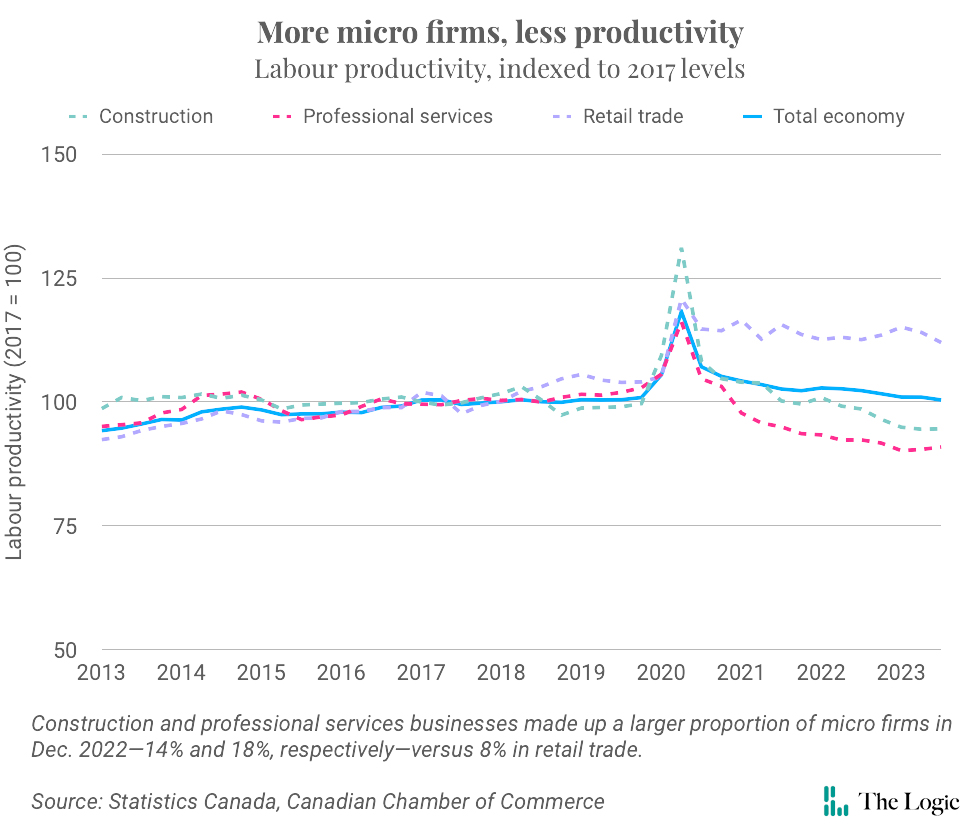
An overabundance of micro firms likely contributes to Canada’s productivity problem. Investment in research and development correlates with size; bigger companies have access to greater pools of capital and the talent necessary to execute innovative technologies and strategies. A new Statistics Canada study found that intangible assets such as intellectual property make up a significantly greater percentage of the assets of larger and medium-sized enterprises than smaller ones. It’s probably not a fluke that the industries with the most micro companies—professional services, construction—are also among the least productive.
The Business Data Lab authors said they hope policymakers will use their work to design better programs, and they suggest the priorities should be access to finance and cutting red tape. “The lessons we have learned from analyzing the data in this report reiterate how government support is fundamental to the survival of small businesses and to ensuring their inclusive recovery and growth,” they wrote.
A government role in small-business lending is appropriate because we’ve built a financial system that values stability above all else. Entrepreneurs struggle to raise capital because the rules and norms of a lending structure designed to minimize risk are stacked against them. Ottawa’s aversion to financial risk means public money will be needed to maintain a base level of entrepreneurship—a necessary ingredient for innovation and ultimately stronger productivity growth.
But that doesn’t mean supporting policies that have the unintended consequence of giving entrepreneurs an incentive to curb their ambition. The most egregious example of this is the preferential tax rates we give small businesses, which probably douses ambition to grow, and worsens inequality by letting kitchen-table accountants, lawyers and consultants lower their contribution to the public purse by turning themselves into corporations. Data the Canada Revenue Agency shared with The Logic show 888,550 enterprises claimed the small business tax deduction in 2022, compared with 895,240 in 2021 and 819,210 in 2020.
Instead of creating demand for the services of such professionals, governments should be making it easier for entrepreneurs to find and apply for the subsidies they have created to stoke innovation. A recent study by the University of Toronto’s Innovation Policy Lab found that 70 per cent of technology scale-ups struggle to access government grants.
It’s one way Canada’s re-embrace of industrial policy over the past decade is half-baked: the policies are there to help companies innovate and grow, yet policymakers have made it too difficult for most companies to access the money. The fix for our productivity problems starts there.
Kevin Carmichael is The Logic’s economics columnist and editor-at-large. He has spent more than two decades covering economics, business and finance for outlets including Bloomberg News, The Globe and Mail and the Financial Post, where he also served as editor-in-chief.



Loading...
Thanks for sharing!
You have shared 5 articles this month and reached the maximum amount of shares available.
CloseThis account has reached its share limit.
If you would like to purchase a sharing license please contact The Logic support at [email protected].
CloseGift the full article!
You have gifted 0 article(s) this month and have 5 remaining.
Recipients will be able to read the full text of the article after submitting their email address. They will not have access to other articles or subscriber benefits.
Photo: AP Photo/David Zalubowski
Pierre Riel, head of Costco’s operations in Canada, appears as a witness at the House of Commons agriculture committee in Ottawa on Feb. 13.
Most Popular This Week




In-depth, agenda-setting reporting
Great journalism delivered straight to your inbox.
News
Adam Waterous proposes massive crude exports to Asia by rail through northern B.C.
Briefing
Rio Tinto gets nearly $165M in additional federal funds for Quebec aluminum
U.S. to lift tariffs on some Canadian products crucial to Maine: Collins
Carney warns of tech dependence after Starlink disruptions in Ukraine
Best business newsletter in Canada
Get up to speed in minutes with insights and analysis on the most important stories of the day, every weekday.
Exclusive events
See the bigger picture with reporters and industry experts in subscriber-exclusive events.
Membership in The Logic Council
Membership provides access to our popular Slack channel, participation in subscriber surveys and invitations to exclusive events with our journalists and special guests.






