Equitable Bank chief executive Andrew Moor leads a Canadian challenger bank, a job for which only eternal optimists need apply. Chipping away at the market share of Canada’s Big Five banks brings to mind The Shawshank Redemption, except the hero of that story needed only a couple of decades to chisel his way out of prison. Equitable has been at it since 1970.
Skip to content

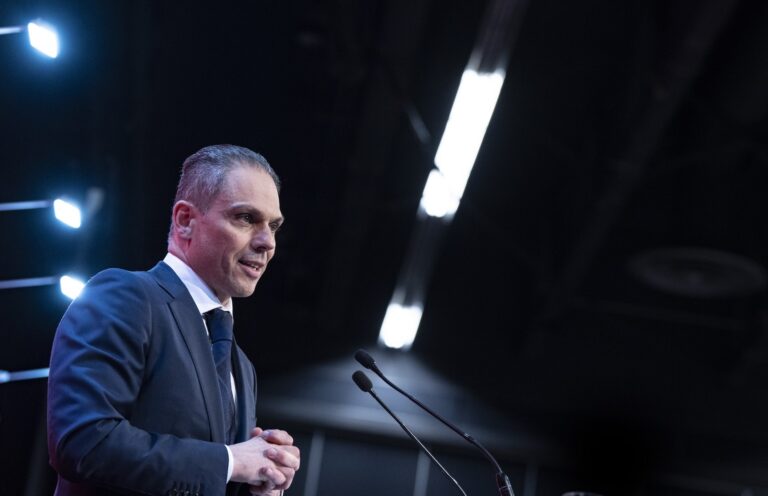
 Andrew Moor, CEO of EQ Bank, is photographed in Toronto, in April 2023. Photo: The Canadian Press/Chris Young
Commentary
Carmichael: How broken politics leads to a broken economy
An era of pup-tent politics is affecting the way policy is made
The Peace Tower of Parliament Hill is shown in Ottawa in December 2023. Photo: The Canadian Press/Sean Kilpatrick
Equitable Bank chief executive Andrew Moor leads a Canadian challenger bank, a job for which only eternal optimists need apply. Chipping away at the market share of Canada’s Big Five banks brings to mind The Shawshank Redemption, except the hero of that story needed only a couple of decades to chisel his way out of prison. Equitable has been at it since 1970.
It feels like a good moment to let an optimist lead the conversation. The doomsters misled us into thinking that there was no way the central banks could lower sky-high inflation without causing a recession. And yet it looks like the Lords of Finance nailed their soft landing. That doesn’t mean we’re on the cusp of an economic boom; gross domestic product stalled over the summer. But it isn’t 2008 either.
Moor, who has led Equitable since 2007, feels OK about the state of the economy. He sees the Bank of Canada cutting interest rates in the spring, which would improve consumer sentiment. And he said widespread worry about what will happen when a wave of mortgages reset at higher rates over the next couple of years is exaggerated.
“What we’ve seen is people riding through that quite well,” Moor said in an interview on Dec. 13. “Mortgages run into problems, not really when you have rate shocks, payment shocks with higher interest rates; they run into problems when people lose their jobs and just don’t have the cash to pay the mortgage. So far it looks like we’re entering something of a soft landing where employment will continue to be fairly strong.”
Related Articles


A run through the list of some of Canada’s bigger economic challenges suggests investors should expect Equitable to attempt to make the most of the creative destruction that will be caused by sweeping demographic changes and the digital technology revolution.
Moor agrees that an aging society will make growth more difficult, but not impossible. Equitable pays a smaller dividend than its peers on the S&P/TSX composite index, he said, so it has more cash on hand for investment, including in technology that will make it less reliant on a shrinking talent pool. Moor’s strategy also involves catering to older clients with products such as reverse mortgages, a bet that older Canadians will be keen to tap their housing wealth to finance an active retirement.
“There will be shifts,” Moor said. “It’s a matter of anticipating where the shifts go and position the business to respond as best as possible to deal with the shifts.”
However, there’s one trend that tests Moor’s optimism: the deterioration of democratic politics. He’s perplexed by the lack of political will to get things done, something he’s experienced directly in a couple of ways. It took Ottawa five years to get to a point where it looks like it’s ready to allow customers to transport their banking data to other financial companies. Such a regulatory regime would level the playing field between legacy lenders and web-based upstarts, introducing competition that could only benefit consumers.
Equally frustrating: waiting for the government to make good on its promise to modernize digital-payments infrastructure and break the oligopoly’s control over who gets to access the Real-Time Rail. That effort is now some four years behind schedule, although the federal government said last month that it would amend the Canadian Payments Act to allow more financial companies to access the system directly. “It’s pretty inexcusable how long we’ve taken to get it sorted,” Moor said.
Avoiding the hard stuff has consequences. A more competitive banking system and modern payments system would have helped cope with the pandemic and inflation. Imagine if the political class had started thinking seriously about the housing crisis a decade ago, instead of only recently. The national mood would be dramatically different if Ottawa, the provinces and municipalities had a cohesive plan.
Instead, governments are run like volunteer fire departments. Stephen Harper liked to boast about his handling of the Great Recession, just as Prime Minister Justin Trudeau likes to boast about his handling of the COVID-19 crisis. Their true legacies are how little they accomplished the rest of the time. As the saying possibly misattributed to Anton Chekhov goes, “Any idiot can face a crisis—it’s the day-to-day living that wears you out.”
Moor was unsure why politics is so broken. He offered that social media has increased polarization, making it easier for a committed minority to derail projects designed for the greater good. “It does seem like sometimes the need to consult goes beyond what’s reasonable,” he said. “If you stand on the side of not doing something, it’s easier to stand in the way of things than it ever has been.”
The other problem is incentives. The major political parties used to assume that the path to victory required building broad coalitions. One way to appeal to non-partisans was to be seen as capable of governing. Prime ministers drew on multiple constituencies, so they could risk alienating certain supporters to move controversial projects along.
Politics no longer works like that. Technology and data allow parties to narrowly define their supporters; they know where their voters live and what excites them. Parties have learned that turning out their core supporters is a more productive use of resources than trying to win new ones. The political class’s embrace of “vote efficiency” means every decision is weighted against how it will go over with the roughly third of the electorate that will reliably vote Liberal or Conservative. We’re in an era of pup-tent politics and it’s affecting the way policy is made.
The spillover effects of a democracy based on vote efficiency has received too little attention. “What we’re trying to do is be a bit of a catalyst for change in the Canadian system,” Moor said. “We want to play a useful role in society.” Lawmakers no doubt feel the same. The problem is the incentives they face after they are elected cause them to do the opposite.
Kevin Carmichael is The Logic’s economics columnist and editor-at-large. He has spent more than two decades covering economics, business and finance for outlets including Bloomberg News, The Globe and Mail and the Financial Post, where he also served as editor-in-chief.



Loading...
Thanks for sharing!
You have shared 5 articles this month and reached the maximum amount of shares available.
CloseThis account has reached its share limit.
If you would like to purchase a sharing license please contact The Logic support at [email protected].
CloseGift the full article!
You have gifted 0 article(s) this month and have 5 remaining.
Recipients will be able to read the full text of the article after submitting their email address. They will not have access to other articles or subscriber benefits.
Photo: The Canadian Press/Sean Kilpatrick
Andrew Moor, CEO of EQ Bank, is photographed in Toronto, in April 2023.
Most Popular This Week




In-depth, agenda-setting reporting
Great journalism delivered straight to your inbox.
News
National Bank CEO warns AI alone won’t give banks a lasting edge
Briefing
Canada and Ontario commit over $5B to support tariff-hit steel sector
Hackers will see cars as major targets in next 3 years, 83% of car-tech workers say
EA shutting down Edmonton studio BioWare
Best business newsletter in Canada
Get up to speed in minutes with insights and analysis on the most important stories of the day, every weekday.
Exclusive events
See the bigger picture with reporters and industry experts in subscriber-exclusive events.
Membership in The Logic Council
Membership provides access to our popular Slack channel, participation in subscriber surveys and invitations to exclusive events with our journalists and special guests.





