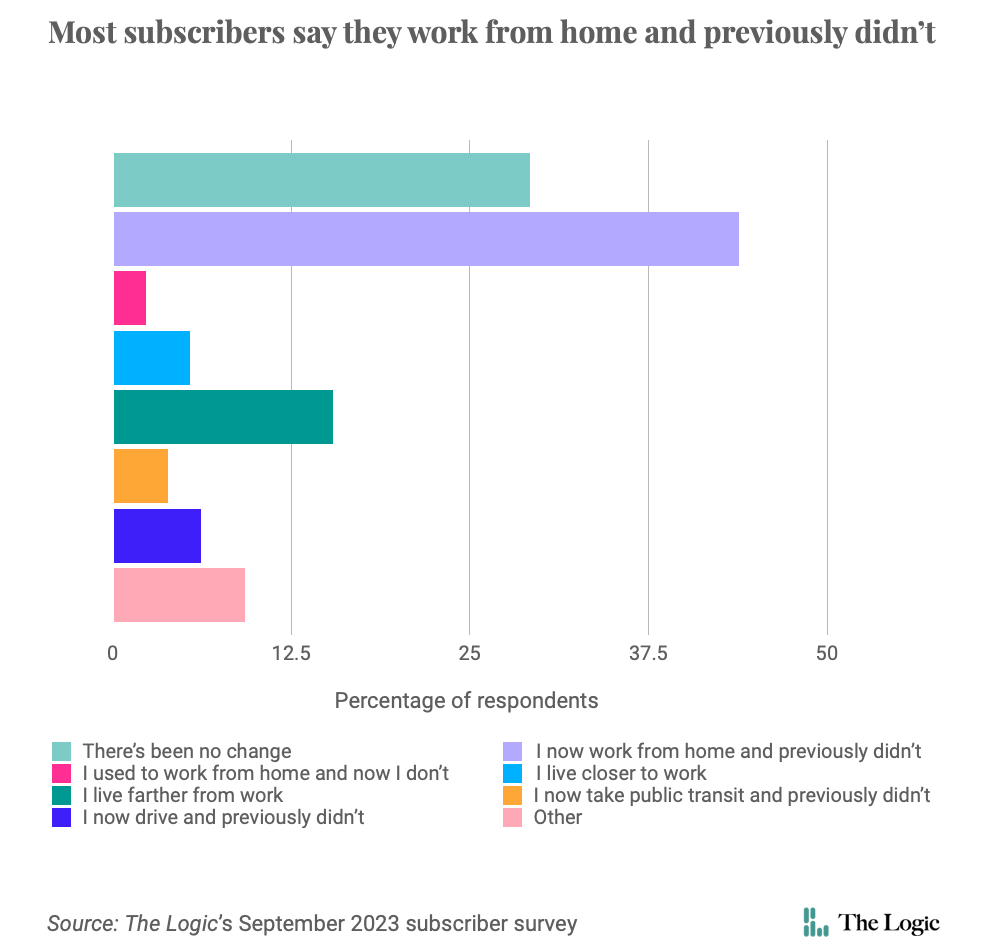
Nearly 40 per cent of respondents to The Logic’s latest subscriber survey said they are more satisfied with their commute to work than they were in 2019, before the COVID-19 pandemic began. Forty-four per cent also said they now work from home, but previously didn’t.
Skip to content



Subscriber Survey
‘A better life’: How subscribers feel about their commutes as return-to-office mandates rise
About 40% are happier with how they get to work compared to 2019, The Logic’s survey finds
A quarter of respondents to The Logic’s latest survey said they’re less satisfied with their commute to work than in 2019. Photo: The Canadian Press/Rachel Verbin
Nearly 40 per cent of respondents to The Logic’s latest subscriber survey said they are more satisfied with their commute to work than they were in 2019, before the COVID-19 pandemic began. Forty-four per cent also said they now work from home, but previously didn’t.
A quarter of subscribers were less satisfied with their commute, with 22 per cent reporting no change from 2019 to now.
The findings come as more companies are asking employees to return to offices after a major shift to hybrid and remote work during the pandemic. As both foot and rush-hour traffic have evolved since 2019—with some relocating from urban centres like Toronto and Vancouver to smaller communities—the new normal for office commutes is in flux.
For nearly a third of survey respondents, that’s meant driving to work as a primary method of commuting. Seventeen per cent said they take municipal transit, which includes transportation such as subway systems, buses and streetcars.
But more than a quarter of subscribers said they currently don’t commute to the office at all.
Related Articles



“I can’t believe the amount of time and money I wasted commuting when I could do pretty much 100 per cent of my work from home,” one subscriber wrote. “I think about that every time I have to commute somewhere. It’s a better life now.”
For respondents who do commute, 32 per cent said it takes them under 30 minutes to get to their office, while slightly less (29 per cent) said they spend between 30 minutes to an hour travelling to work.
Most survey respondents (40 per cent) said their commute has remained the same in length since 2019, but more than 30 per cent said it got shorter, while just a quarter of subscribers said it’s become longer.
“The trip is the same, but it is more unpredictable in that the number of people on a train is more varying,” one subscriber wrote. “Sometimes I get a seat; sometimes it is a sardine tin. Hard to know in advance.”
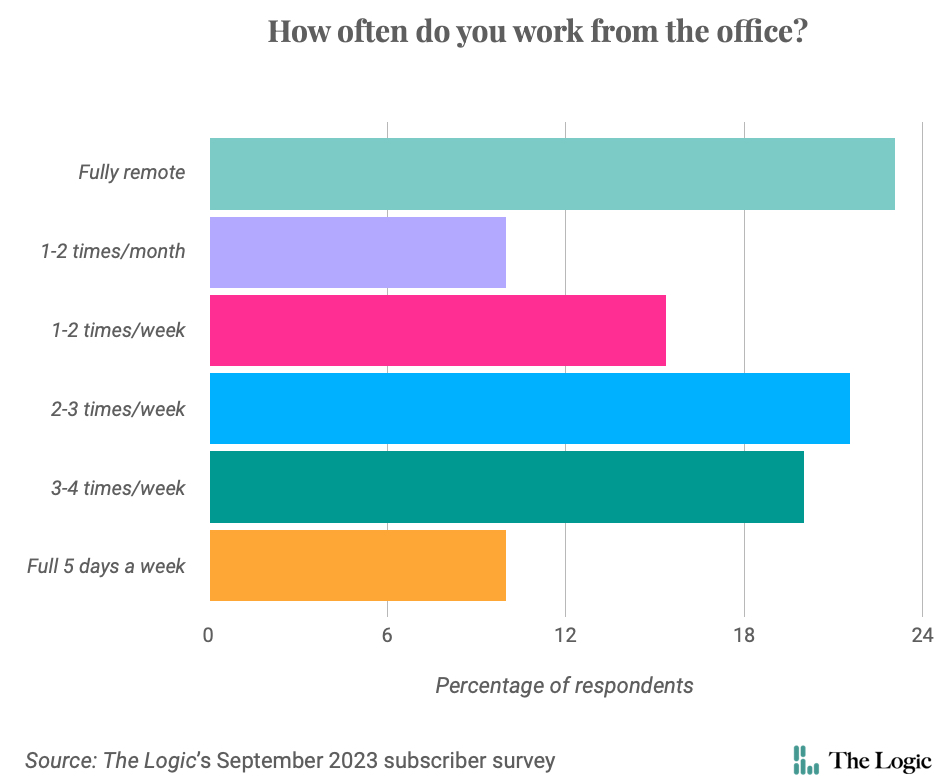
The survey also found that the amount of time that subscribers worked in their offices differed, though either working fully remotely (23 per cent) and going to the office two to three times a week (22 per cent) were the most popular answers.
Only a tenth of survey respondents said they worked in person five days a week.
As The Logic reported earlier this year, companies like RBC mandated a return to office for three to four days a week to address “productivity and innovation” challenges, while some major firms like Amazon are making greater efforts to enforce in-person work.
Meanwhile, less than three per cent of respondents to The Logic’s survey said they are no longer working from home, even though they did in 2019.
But not all respondents favoured the 100 per cent remote approach. “I’d rather be in the office more. Working at home has become really tiresome,” one person said.
Many subscribers also highlighted their desire for better transit access, reliability and frequency. “It’s unfortunate there aren’t more sustainable travel options for people living so close to an urban centre,” said one Niagara-area subscriber.
Methodology
The Logic emailed subscribers a private link to an online survey on Sept. 19 and the survey closed Sept. 21. Respondents’ identities were kept anonymous. Subscribers were first asked, “How long is your commute, one way?” and could answer, “Under 30 minutes,” “30 minutes to an hour,” “One to two hours,” “Over two hours” or “I work from home/I don’t have to commute.” They were then asked, “What is your primary method of commuting to the office?” and could select “Municipal public transit (subway/bus/streetcar),” “Intercity transit (such as GO Transit, West Coast Express or Exo),” “Biking,” “Walking,” “Ride-hailing or cab,” “Driving” or “Other.” Next, they were asked, “How has your commute changed since 2019?” and could choose “It’s gotten longer,” “It’s gotten shorter” or “It’s remained the same.” They were also asked, “Which of the following scenarios best describes the change in your commute? Check all that apply.” and could select: “I now work from home and previously didn’t,” “I used to work from home and now I don’t,” “I live closer to work,” “I live farther from work,” “I now take public transit and previously didn’t,” “I now drive and previously didn’t,” “There’s been no change” or “Other.” Additionally, they were asked “How often do you work from the office?” and could select “I am a fully remote employee,” “1-2 times a month,” “1-2 times a week,” “2-3 times a week,” “3-4 times a week” or “Full 5 days a week.” Finally, respondents were asked, “How satisfied are you with your current commute to work?” and could select “More satisfied than in 2019,” “Less satisfied than in 2019,” “No change in my commute since 2019” or “I do not commute to work.”



Loading...
Thanks for sharing!
You have shared 5 articles this month and reached the maximum amount of shares available.
CloseThis account has reached its share limit.
If you would like to purchase a sharing license please contact The Logic support at [email protected].
CloseGift the full article!
You have gifted 0 article(s) this month and have 5 remaining.
Recipients will be able to read the full text of the article after submitting their email address. They will not have access to other articles or subscriber benefits.
Photo: The Canadian Press/Rachel Verbin
Most Popular This Week




In-depth, agenda-setting reporting
Great journalism delivered straight to your inbox.
News
People hired to promote Canadian rocket firm didn’t actually help, company alleges in lawsuit defence
Briefing
New 100% U.S. tariffs on drones take effect, hitting Canadian industry
Solomon says Canada will stick with its own AI rules after U.S., tech giants push G20 not to regulate
Ottawa defence supplier Allen-Vanguard put into receivership
Best business newsletter in Canada
Get up to speed in minutes with insights and analysis on the most important stories of the day, every weekday.
Exclusive events
See the bigger picture with reporters and industry experts in subscriber-exclusive events.
Membership in The Logic Council
Membership provides access to our popular Slack channel, participation in subscriber surveys and invitations to exclusive events with our journalists and special guests.