OTTAWA — Hundreds of thousands of square feet are sitting vacant in Canada’s most prominent office towers, and the huge public pension funds that have long held those buildings for their steady income streams are getting out of those investments.
Skip to content

 Cadillac Fairview’s properties overlooking Canada Place and Burrard Inlet have thousands of square feet vacant. Photo: Shutterstock/Spiroview Inc.

News
As office vacancies reach all-time highs, Canada’s big pension plans are getting out of skyscrapers
Housing, logistics and life-sciences investments are the new hot properties
OMERS sold Royal Bank Plaza in downtown Toronto in 2022 to Spain's Amancio Ortega. Photo: Shutterstock/Colin Woods
OTTAWA — Hundreds of thousands of square feet are sitting vacant in Canada’s most prominent office towers, and the huge public pension funds that have long held those buildings for their steady income streams are getting out of those investments.
Taking their place, according to their recent annual reports and other documents: life-sciences buildings, warehouses and logistics centres and residential towers.
Talking Points
- Canada’s public pension funds are ditching office-tower investments in favour of new growth areas like housing and life sciences
- One realty firm blames a confluence of factors, from rising interest rates and the weakness of the tech sector to ongoing uncertainty created by the shift to remote work
It’s hard out there for an office landlord. Commercial realty firm CBRE reported this month that in the second quarter of 2023, office vacancies across Canada reached an all-time high of 18.1 per cent. Class A downtown spaces—premium quarters in great locations—were the most full, but even their vacancy rate was 16.5 per cent.
Office properties are suffering “a perfect storm of a recession threat, interest rate hikes, tech sector weakness, tenants rightsizing and new supply of office space,” CBRE found. “All of this is compounded by the continued uncertainty around remote work.” In even “superstar” cities like Paris and Shanghai, McKinsey recently reported, US$800 billion in real estate value is at risk as hybrid work becomes permanent.
The Logic contacted Canada’s biggest public pension funds to ask how they’re handling the uncertainty. Most said they had nobody to speak to the issue or (in CPP Investments’ case) did not respond at all. But they’ve disclosed their angst in public documents over the past few months.
AIMCo, Alberta’s $158-billion public investment fund, shared its take on the real estate business in a February report laying out its long-term assumptions about the asset classes it invests in.
Related Articles

“The overall real estate market hit a tipping point in 2022. Equity drawdowns, high inflation, and interest rate hikes began to have an impact on real estate pricing, volumes, and debt availability,” it said. But the effects were not spread equally across all types of property: “Namely, industrial, multi-family, and necessity-based retail are continuing to garner interest. Valuations are trending downwards for office properties, particularly in the U.S. and Europe.”
Office tenants were “prioritizing quality and wellness in their leasing decisions,” AIMCo reported.
In its annual report for 2022, released at the end of June, AIMCo nevertheless boasted a 4.6 per cent net return on its total real estate portfolio, against a benchmark of 1.8 per cent—achieved partly by shifting away from office properties.
“For the past several years [AIMCO’s real estate segment] has employed a strategy of repositioning the domestic and foreign portfolios towards industrial, multi-family and growing niche sectors like data centres to lean into the secular tailwinds,” AIMCo reported.
“If we tried to do that same thing today, I would think we would get $300 million or $400 million less.” — OMERS CEO Blake Hutcheson on selling Toronto’s Royal Bank Plaza in 2022
That’s borne out by its annual filings: in 2019, 31.3 per cent of AIMCo’s real estate was offices; by 2022, that was down to 21.3 per cent—though it still included Scotia Plaza as a top holding. Industrial real estate had vaulted from 15.8 per cent of AIMCo’s properties to 27.1 per cent.
AIMCo spokesperson Alexandra Zabjek referred The Logic to the two reports for most questions about how it’s approaching the uncertainty in the office real-estate market, except when asked what precisely prompted the shift in emphasis.
“AIMCo works to ensure our investments are diversified by sector and geography so that we both benefit from a broad range of opportunities and effectively mitigate any exposure to risk,” she wrote in an email.
Even so, AIMCo’s landmark Scotia Plaza in Toronto’s financial district has multiple floors open. Leasing agents BentallGreenOak tout its certifications of environmental quality (LEED Platinum) and healthy-building standards (Fitwel Class AAA). The 62nd and 68th floors—of a 68-storey tower—are among those available.
It’s far from unique. Cadillac Fairview, the real-estate subsidiary of the $247.2-billion Ontario Teachers’ Pension Plan, owns the black blocks of Toronto’s TD Centre—where it currently lists numerous vacancies, including several whole floors.
In Vancouver, Cadillac Fairview’s complex of properties by Canada Place and Burrard Inlet have thousands of square feet vacant, including full floors in a tower at the foot of Granville Street.
Teachers’ real-estate returns have been brutal. Cadillac Fairview’s “performance vis-à-vis our benchmark can be attributed to CF’s relative overconcentration in Canadian retail and office properties, which have underperformed other real estate asset classes in the benchmark,” Teachers’ explained in its annual report for 2022. It’s diversifying into U.S. residential and life-sciences developments, British offices and life-sciences and European industrial space.
The sector produced a net loss of 3.5 per cent last year, the plan reported, against a benchmark positive return of 6.7 per cent. It’s lost an average of 0.8 per cent for the Ontario teachers over the last five years, against a benchmark of 5.1 per cent.
Oxford Properties, the real-estate arm of the $124.2-billion Ontario Municipal Employees Retirement System (OMERS) and CPP Investments share ownership of Toronto’s Richmond-Adelaide Centre, another multi-building complex in the financial district that has several floors waiting for tenants.
The two funds are looking to sell a pair of office buildings in Vancouver for a reported $350 million. In its latest annual report, OMERS talked about “increasing portfolio weightings in high-conviction growth sectors focused on the life sciences and industrial sectors” and boasted of all the office properties it had sold, across North America, Europe and Australia.
One of those was a former OMERS-CPP Investments jewel. In early 2022, they sold Toronto’s Royal Bank Plaza, a gleaming amber edifice whose windows were tinted with real gold, to a holding company controlled by Spain’s Amancio Ortega for $1.2 billion. Ortega, a multibillionaire and founder of clothing chain Zara, has invested heavily in real estate in an effort to diversify his portfolio, scooping up buildings around the world despite the COVID-19 pandemic.
OMERS thinks it got an amazing return, CEO Blake Hutcheson said in its annual meeting in April. “If we tried to do that same thing today, I would think we would get $300 million or $400 million less,” he told plan members.
CPP Investments’s real estate portfolio lost 1.2 per cent in its last fiscal year, the $570.3-billion national pension fund reported. Why? Office and retail investments tanked.
“Industrial assets benefitted from increased tenant and investor demand. This contrasted with retail and office investments, which were affected by the transition towards e-commerce and the impact of post-pandemic hybrid working trends,” its annual report said.
Quebec’s $401.9-billion Caisse de dépôt et placement has tens of thousands of square feet vacant in Place Ville Marie, the cross-shaped tower whose searchlight pierces the Montreal sky at night. The Caisse’s annual report for 2022 lamented the “poorer performance in the traditional office sector” compared to properties in “promising sectors such as logistics, residential and life sciences.”
It cut the weighting of offices in its real estate portfolio from 28 per cent to 18 per cent between 2017 and 2022 (and retail from 27 per cent to 11 per cent), while logistics sites shot up from three per cent to 23 per cent.
As even some of the ritziest offices sit empty, shortages of space for other uses make them more attractive investments.
Toronto alone is estimated to be short millions of square feet that biotech and health companies would occupy—tenants that need specialized infrastructure like ventilation, plumbing and backup power. In Vancouver, drug-discovery company AbCellera is anchoring a major neighbourhood redevelopment.
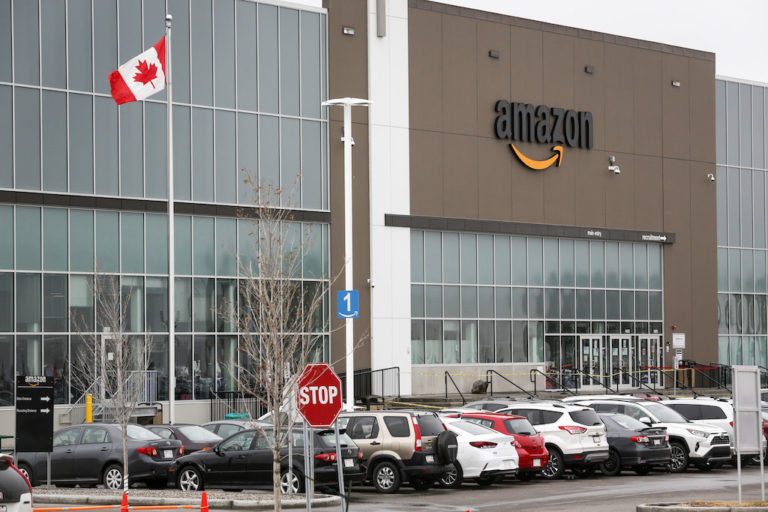
Amazon’s warehouse footprint in Canada is to grow by 4.8 million square feet in 2023, amid a coast-to-coast shortage of space with suitable zoning and transportation connections.
Private-sector asset manager Brookfield sees those as growth areas. In a May white paper, it argued that properties in housing, hospitality, entertainment, logistics and sciences are good investments, driven by demographics, changing consumer preferences and deglobalization (with a side of public funding for domestic research and manufacturing).
The paper doesn’t mention office space at all.



Loading...
Thanks for sharing!
You have shared 5 articles this month and reached the maximum amount of shares available.
CloseThis account has reached its share limit.
If you would like to purchase a sharing license please contact The Logic support at [email protected].
CloseGift the full article!
You have gifted 0 article(s) this month and have 5 remaining.
Recipients will be able to read the full text of the article after submitting their email address. They will not have access to other articles or subscriber benefits.
Photo: Shutterstock/Colin Woods
Cadillac Fairview’s properties overlooking Canada Place and Burrard Inlet have thousands of square feet vacant.
Most Popular This Week




In-depth, agenda-setting reporting
Great journalism delivered straight to your inbox.
News
Canada faces a satellite-launch crunch as SpaceX retires its workhorse rocket
Briefing
Rio Tinto gets nearly $165M in additional federal funds for Quebec aluminum
U.S. to lift tariffs on some Canadian products crucial to Maine: Collins
Carney warns of tech dependence after Starlink disruptions in Ukraine
Best business newsletter in Canada
Get up to speed in minutes with insights and analysis on the most important stories of the day, every weekday.
Exclusive events
See the bigger picture with reporters and industry experts in subscriber-exclusive events.
Membership in The Logic Council
Membership provides access to our popular Slack channel, participation in subscriber surveys and invitations to exclusive events with our journalists and special guests.






